Outgrowing B2B workarounds: apps, scripts, and plugins on a consumer platform
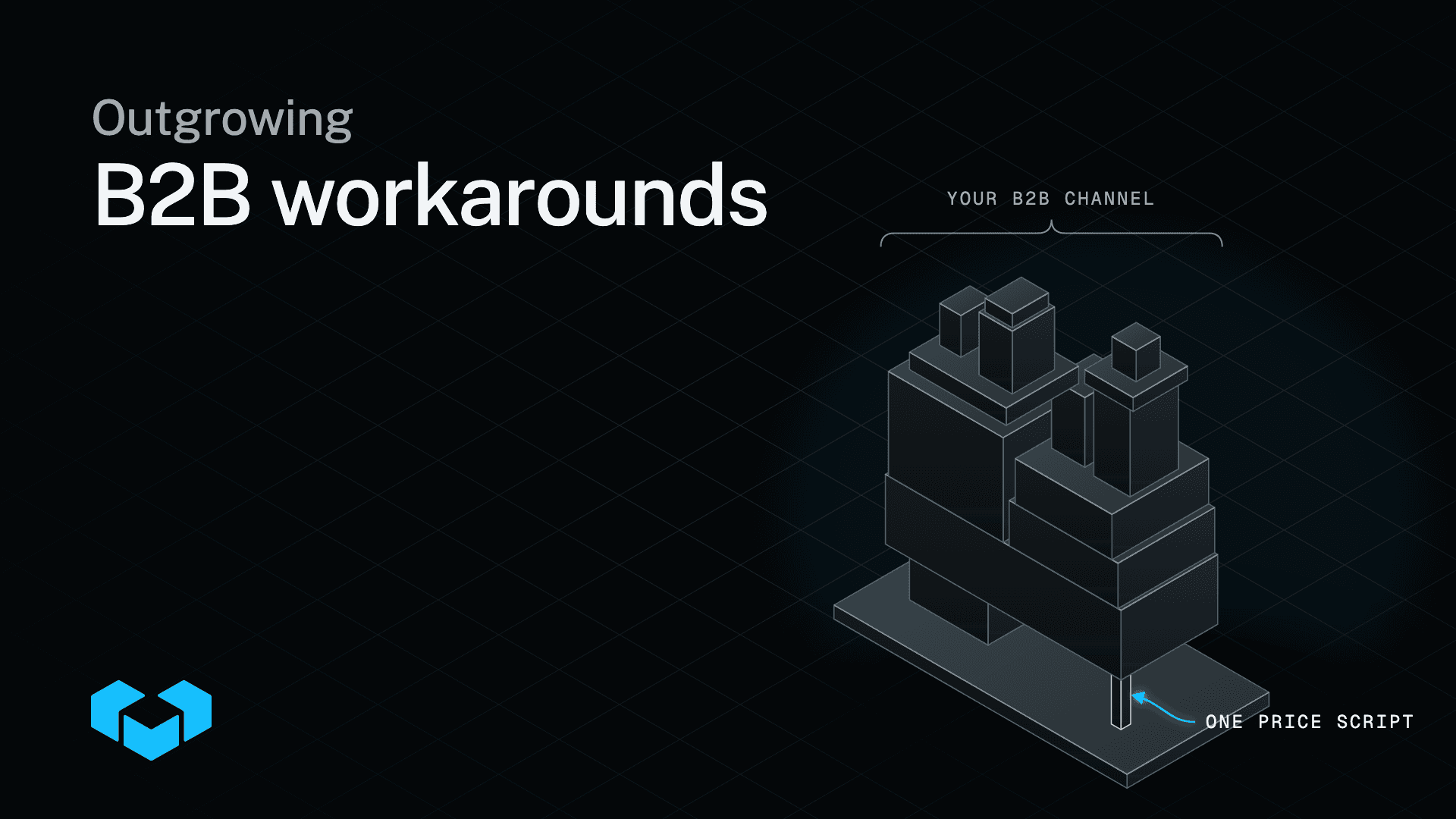
Most B2B webshops on a consumer platform start the same way. A wholesale customer asks for their own prices, so you install an app. The next one wants several buyers on one account, so you add another. Quotes come from a third app, approvals happen in someone's inbox, and the orders still get typed into the ERP by hand.
Each of those choices made sense on the day. Together they become the way your B2B channel works, and every platform update, new customer rule, or price change has to pass through all of them.
This guide is for teams running B2B on Shopify, WooCommerce, or Shopware, with apps, extensions, and scripts filling the gaps. It shows where each platform falls short, six signs you have outgrown the workarounds, and what changes when company accounts, customer prices, quotes, and approvals come built into the platform.
The short answer
You have outgrown your B2B workarounds when one order passes through more tools than anyone can keep track of, and every platform update means testing them all again. The six signs below make that concrete.
The way out is a platform where the B2B rules are part of the product. Then you can retire the apps, scripts, and spreadsheets that hold your B2B channel together today, and keep only the custom code that is specific to your business.
How a B2B workaround stack grows
Consumer ecommerce platforms are built around one kind of customer: a person with a card, one price list, and a checkout that ends in a payment. B2B buying breaks each of those assumptions:
- The customer is a company, with several buyers and often several branches.
- Each company has its own agreed prices, with dates when they start and stop.
- Orders over a buyer's limit wait for a manager to approve them.
- Large orders start as a quote, and many are paid on invoice.
- The ERP stays in charge of prices, stock, and invoices.
Every rule the platform does not cover becomes an app, an extension, a script, or a person doing it by hand. Each one closes a single gap. Together they put five tools from five vendors on the same order, each with its own data model and its own release schedule.
Company accounts, quotes, contract pricing and approvals come built into the plans, at a flat monthly price.
Compare Vendure plansWhere Shopify, WooCommerce, and Shopware fall short
All three platforms handle some B2B today, but each one falls short on the rules B2B orders depend on: approvals, quotes, customer-specific prices, or PunchOut. Those gaps are where the workarounds start, and they are the gaps Vendure closes.
Shopify
Shopify B2B runs on the Basic, Grow, Advanced, and Plus plans. It covers company and location accounts, payment terms, catalogs, and quick order. It has no buyer approval rules, so an order that needs sign-off can only be held as a draft for the merchant to review. There is no request for quote or PunchOut, and orders cap at 500 lines.
Custom pricing and checkout logic used to live in Shopify Scripts, which stopped running on 30 June 2026. Teams are rebuilding that logic on Shopify Functions, which run at the extension points Shopify defines. Quotes and approval chains still have to come from apps or manual steps. See how Vendure compares with Shopify Plus.
That may hold for a few wholesale accounts on payment terms. Once buyers need approvals, quotes, or orders past 500 lines, it becomes the limit your team builds around.
WooCommerce
Out of the box, WooCommerce has two prices per product, a regular price and a sale price, plus discount coupons. B2B features such as wholesale price groups, company accounts, and quote requests come from third-party extensions. Each one is a separate subscription, and WooCommerce advises testing every extension on a staging site after each update. See how Vendure compares with WooCommerce.
Munich work-wear supplier Wilhelm Weishäupl ran its B2B ordering on a WooCommerce portal. Restaurant managers reordering uniforms for their teams went through slow pages, crashes, and a checkout built for single shoppers, and poor ERP integration forced manual workarounds.
A wholesale extension can cover a small B2B corner of a WordPress site. For a B2B channel your business depends on, we don't think it is enough.
Shopware
Shopware's B2B Components, from the Evolve plan at €2,400 a month, include employees and roles, quotes, organisation units, budgets, and approvals on order value. Each approval rule goes to one reviewer role, and neither PunchOut nor multi-level approvals is in any Shopware plan today.
Shopware prices its plans on GMV, so growth past a plan means an upgrade. The older B2B Suite is no longer supported from Shopware 6.8, which forces a migration for teams still on it. Rules past the B2B Components become PHP plugins, and Shopware's upgrade guides list required plugin updates for the 6.5, 6.6, and 6.7 major releases. See how Vendure compares with Shopware, and where it goes further.
Six signs you have outgrown your B2B workarounds
- One process runs across three or more tools. A quote starts in one app, becomes an order in the platform, and takes its price from a spreadsheet. Nobody owns the whole flow, and when it breaks you open tickets with three vendors.
- Approvals happen in an inbox. An order over a buyer's limit sits as a draft or an email until someone notices it. There is no rule, no reminder, and no record of who approved what.
- Customer prices live in a spreadsheet. Agreed prices with start and end dates are kept outside the platform and loaded by a script or by hand. A wrong price reaches the customer before anyone sees it.
- Every update needs a test week. Each platform release means checking every extension on staging again, and some updates wait because one app is not ready.
- Someone retypes orders into the ERP. If staff copy orders from the webshop into the ERP, the webshop added a sales channel without removing the manual work.
- The platform forces a rebuild anyway. Scripts that stop running, a B2B module that reaches end of life, or a plan upgrade triggered by revenue all mean paying to rebuild the same logic. That is the cheapest moment to decide where the logic should live.
If two or three of these sound familiar, add up what the workarounds cost each year: the app and extension subscriptions, the testing at each update, and the hours spent on manual steps. Our guide to B2B ecommerce total cost of ownership shows how to put a number on each line.
What changes when B2B comes built in
In Vendure, these rules are capabilities in the plans. They share one data model and upgrade together, and each plan includes everything in the one before it.
| What the workaround does today | Built into Vendure | From |
|---|---|---|
| An app for several buyers on one customer account | Company accounts | Starter |
| A quote app or an email thread | Quote requests | Starter |
| A reorder spreadsheet sent by email | Quick order, reorder, and shopping lists | Starter |
| A separate account for each branch | Organization hierarchy | Growth |
| Boxes and pallets set up as separate products | Packaging units | Growth |
| A wholesale price app or price script | Contract pricing with dated price lists | Scale |
| Draft orders waiting for sign-off | Order approvals | Scale |
| A third-party PunchOut connector | PunchOut | Enterprise |
The price is flat. Starter is $229 (€199), Growth $689 (€599), and Scale $2,899 (€2,499) a month on a 12-month term, billed monthly, and Enterprise starts at €60,000 a year on contract. All prices exclude VAT. There is no fee on order value, orders, or users, so selling more never changes the price. The pricing page has the current figures and month-to-month terms.
If your process differs from the standard one, your developers add their own code next to Vendure. A PO number on every order and an approval rule for each cost centre are typical examples. Vendure updates leave that code alone.
Vendure ships no ready-made ERP connectors. Your team or an official partner builds the connection on Vendure's APIs and the Workflow Engine, which is included in every plan. When the ERP does not answer, only the failed step retries, so the order waits instead of disappearing. See ERP and integrations.
Complex B2B and B2C on one adaptable, headless ecommerce platform.
Compare Vendure plansHow to move off the workarounds
You do not have to replace everything at once. A move off a workaround stack usually runs in five steps:
- List every workaround. Write down each app, extension, script, and spreadsheet that touches a B2B order, and what it costs a year.
- Sort each one. Retire it when a built-in capability replaces it, rebuild it as a plugin when the logic is specific to your business, and drop it when nobody uses it. Felipe Arango of iDeum sorts apps and Functions into retire, redesign, and adopt in his Shopify Plus migration guide.
- Pick the plan from what is left. The capabilities your orders need decide the plan. Compare them on B2B buying and B2B pricing and catalogues.
- Move the catalogue and customers. Product data moves as data. The partner-written guides for WooCommerce and Shopware cover what moves as it is and what gets rebuilt.
- Put the most common orders online first. Reorders of known products at agreed prices usually carry most of the volume. Quotes, approvals, and PunchOut can follow.
For Weishäupl, the agency eCube rebuilt the ordering portal on Vendure in four weeks and connected it to the ERP through real-time APIs. Franchise partners now complete bulk orders in seconds instead of minutes, and zero downtime since launch replaced the previous pattern of frequent crashes.
When the workarounds are enough
Not every B2B channel needs a new platform. If you sell to a handful of wholesale customers on one price list, orders rarely need sign-off, and a nightly export to the ERP works, the B2B features your current platform ships may be all you need. Check again when a customer asks for their own prices, a quote, or an approval step.
Worth reading, once a month
Product updates, customer stories, and engineering thinking, delivered monthly.
The bottom line
Apps and scripts are a reasonable way to start B2B on a consumer platform. Once they run your B2B channel, every update and every new customer rule has to work across all of them. With Vendure, B2B comes built in: company accounts, customer prices, quotes, and approvals on one platform, at a flat price. Compare the plans or start a 30-day trial.
Frequently asked questions
An app, extension, script, spreadsheet, or manual step that adds a B2B rule the platform does not support itself, such as company accounts, customer-specific prices, quotes, or order approvals.
Shopify B2B covers company and location accounts, payment terms, catalogs, and quick order on the Basic, Grow, Advanced, and Plus plans. It has no buyer approval rules, no request for quote, and no PunchOut, and orders cap at 500 lines, so those come from apps or manual work. See how Vendure compares with Shopify Plus.
Through extensions. Wholesale price groups, company accounts with sub-accounts, and quote requests are third-party extensions in the Woo Marketplace, each with its own subscription, and WooCommerce advises testing them on a staging site after every update. See how Vendure compares with WooCommerce.
They cover the basics. B2B Components, from the Evolve plan, cover employees and roles, quotes, budgets, organisation units, and single-step approvals. PunchOut and multi-level approvals are not in any Shopware plan today, and plans are priced on GMV. See how Vendure compares with Shopware.
Starter covers company accounts, quote requests, quick order, reorder, and shopping lists. Growth adds organization hierarchy and packaging units. Scale adds contract pricing and order approvals. Enterprise adds PunchOut, quote negotiation, and multi-level approvals. Every self-serve plan starts with a 30-day free trial.
It depends on what runs in production and how many workarounds you rebuild instead of retire. Weishäupl's agency rebuilt its B2B ordering portal on Vendure in four weeks.
Share this guide
B2B comes built in, from the Starter plan
Vendure is the complete, headless ecommerce platform for complex B2B. Replace fragile workarounds and fragmented stacks while keeping the systems your business already runs.