Vendure vs commercetools
Both platforms are API-first. The difference is where your business logic lives, and whether the bill moves when your orders do.
The short answer
Choose Vendure when
- CPQ, punchout and contract pricing must be product, not a build
- The bill should not track order volume
- You want to own the code and self-host in any region
- You would rather extend one TypeScript backend than integrate around one
- You have no permanent platform engineering team
Choose commercetools when
- You run a global multi-brand programme at very large scale
- You want zero infrastructure to operate
- Delivery is led by a large systems integrator
- A long enterprise track record is a procurement requirement
The biggest pain points on commercetools, and how Vendure solves them
B2B depth is product, not build territory
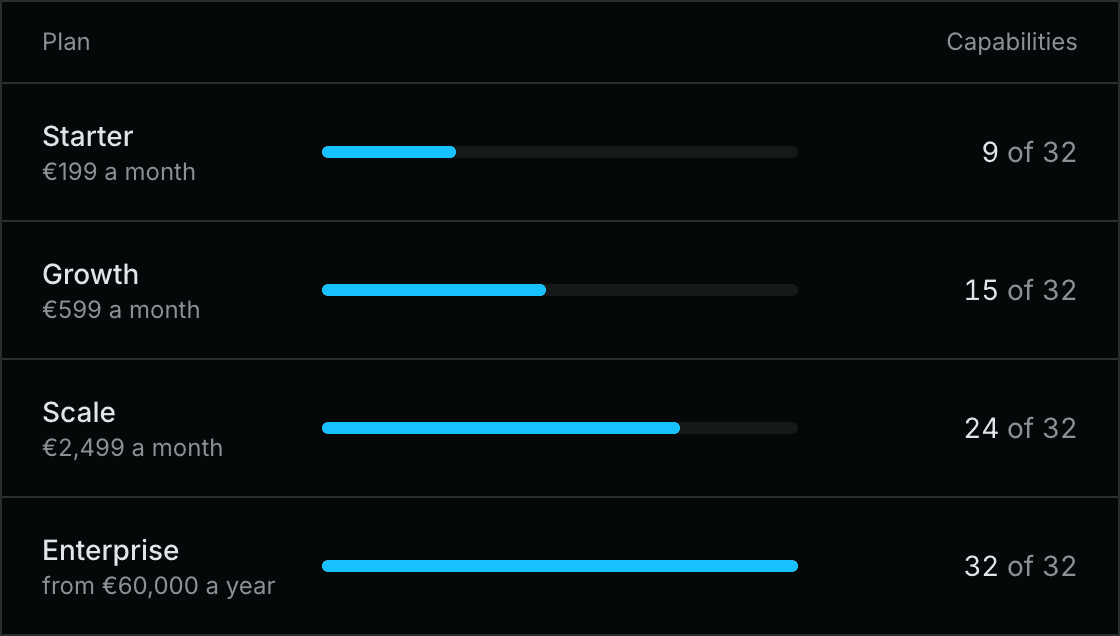
commercetools has no native CPQ or punchout (partner integrations exist), and puts part of its B2B behind a paid add-on. Vendure ships that territory as plan entitlements. The gap is not features on a slide, it is which line of the budget they come out of.
Your logic lives inside the platform, not around it
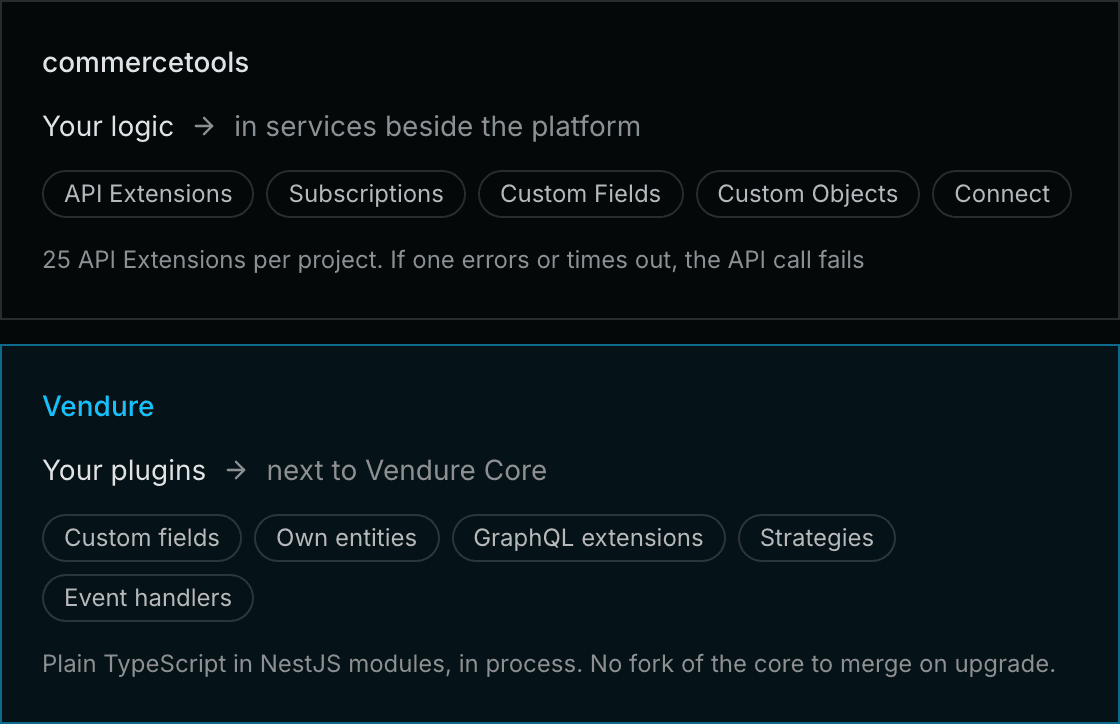
With no source access and 25 API Extensions per project, every change crosses a system seam. Vendure plugins are NestJS modules beside the core, with custom fields that propagate straight into the GraphQL schema.
One flat price, and the code stays yours
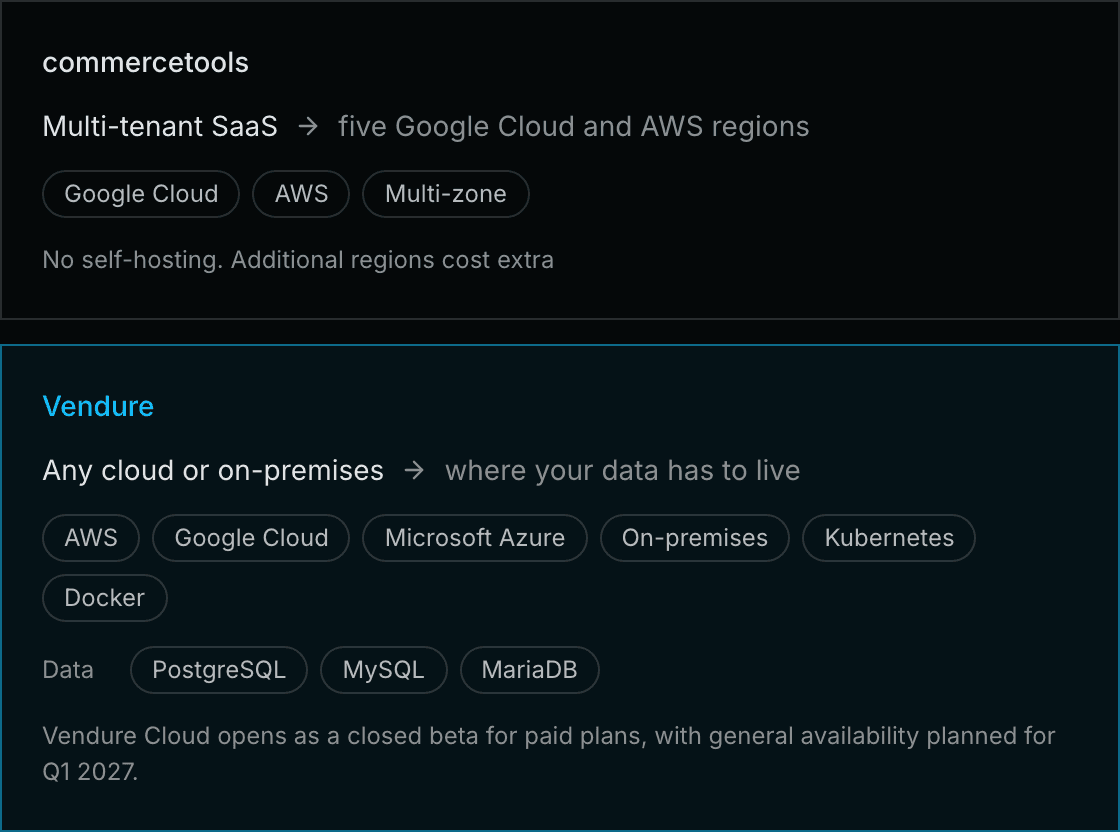
No metering on orders, no GMV charge and no fee per user. The GPLv3 core cannot be revoked, and your data sits in your own SQL database.
How they compare
The same six dimensions on every Vendure comparison. Sources for every commercetools claim are at the foot of the page.
| Dimension | Vendure | commercetools |
|---|---|---|
| Architecture and extensibility | VendureTypeScript end to end on NestJS, with GraphQL Shop and Admin APIs. Plugins sit beside the core. No forks, no extension cap. | commercetoolsMulti-tenant SaaS, no source access. API Extensions cap at 25 per project, so business logic runs in services beside the platform. |
| Licensing and cost model | VendureFree open-source core under GPLv3. Four flat, cumulative plans from €199 a month on a 12-month term, with Enterprise from €60,000 a year. No GMV, per-order or per-user fees. | commercetoolsSales-quoted, order-based pricing with paid add-ons such as Advanced B2B APIs and additional regions. No public rate card. |
| B2B depth | VendureCompany accounts and quotes from Starter. Organization hierarchy at Growth. Contract pricing, single-level order approvals, the audit log and the Next.js B2B storefront at Scale. PunchOut (cXML), Configurator and multi-level approvals with timeouts and delegation at Enterprise. | commercetoolsBusiness units, associates, quotes and approval flows, partly behind a paid add-on. No native CPQ or punchout (partner integrations exist). |
| Hosting and operations | VendureSelf-host on any cloud or on-premises, in any region. Managed Vendure Cloud is planned for Q1 2027, with a base set of Cloud resources in each paid plan. | commercetoolsMulti-tenant SaaS on GCP and AWS, including EU regions. No self-hosting. Additional regions cost extra. |
| Ecosystem and talent | VendureMainstream TypeScript, Node and GraphQL. No proprietary skill silo. | commercetoolsStandard web skills plus MACH experience, and a team to build and maintain the services that run beside the platform. |
| Migration effort | VendureImport catalogue and customers, rebuild the storefront on the GraphQL API or start from the Next.js one included from Scale, then re-point integrations. | commercetoolsNot applicable. |
Vendure pricing: a free open-source core, then four flat tiers
Vendure Core is free under GPLv3. Starter, Growth, Scale and Enterprise add B2B capabilities cumulatively, on a flat fee with no GMV, per-order or per-user charges.
Where commercetools is strong
Where commercetools is the better answer, we say so. The composable model works when the platform team exists. This comparison is about when it does not.
Genuinely API-first, from the start
A mature MACH platform rather than a headless layer over a monolith with an API bolted on afterwards. The pieces compose cleanly because the platform was designed that way.
Mature SaaS with nothing to operate
Event-driven SaaS across five Google Cloud and AWS regions. No infrastructure to run, patch or scale, and Connect hosts and runs the integration applications for you.
Proven at enterprise scale
More than 500 enterprise customers in over 50 countries, by its own count. For global multi-brand retail with a permanent platform engineering team and a composable mandate, commercetools fits the model it was built for.
When teams move from commercetools to Vendure
Renewal is the moment in this matchup: it is when the cost of the whole assembly becomes a single number.
Licence renewal
where the licence is only part of the annual run cost: frontend, integrations and Connect apps come on top
B2B gaps found mid-build
CPQ and punchout, which come from partner integrations rather than the platform
Headless-only frontend spend
a permanent line item rather than a one-off
Code ownership and self-hosting
which multi-tenant SaaS cannot offer. Not a residency argument: they do host in the EU
Moving off commercetools?
Catalogue and customer import, a storefront rebuilt on the GraphQL API or started from the Next.js B2B storefront included from Scale, then integrations re-pointed. Migration guides are being written; the hub has what exists today.









Teams building complex commerce with Vendure
Vendure and commercetools, answered
Yes, when the B2B rules are the hard part and you would rather license that depth than build it beside a platform you cannot see into. If you have a permanent platform engineering team and a genuine composable mandate across many brands and regions, commercetools is built for that and we would not argue otherwise.
Company accounts, quotes, lists, quick order and store credit from Starter. Organization hierarchy, managed lists, packaging, gift cards and global search at Growth. Contract pricing, order approvals, the audit log, single sign-on, search analytics and the Next.js B2B storefront at Scale. Negotiation, access policy, advanced approvals, audit governance, Configurator and PunchOut at Enterprise. They are licensed capabilities rather than services you commission.
Vendure Core is free under GPLv3. Four cumulative paid plans sit on top: Starter at €199, Growth at €599 and Scale at €2,499 a month on a 12-month term, with Enterprise from €60,000 a year. Each plan inherits the one below, and there is no GMV charge, per-order surcharge or per-user fee, so growing revenue does not reprice the platform.
Yes. Vendure Core is a complete open-source commerce framework under GPLv3, written in TypeScript on Node.js with GraphQL Shop and Admin APIs. It is free to run and self-host, and the licence cannot be revoked or discontinued for you. The commercial B2B capabilities are separately licensed plugins layered on top of that core. Every paid plan also includes a commercial licence for Vendure Core for your project, as an alternative to GPLv3.
Yes, on any cloud or on-premises, in any region, with your data in your own SQL database. That is what makes EU-mandated and otherwise regulated deployments possible today. Vendure Cloud, our managed hosting, opens as a closed beta for paid plans, with general availability planned for Q1 2027. Each paid plan will include a base set of Cloud resources, and usage above that is billed on top.
Yes, headless by default, with GraphQL Shop and Admin APIs and any frontend you choose. The difference from a headless-only platform is that the Next.js B2B storefront is included from the Scale plan, so a frontend build is a starting point rather than a prerequisite before anything ships.
Through plugins that live beside the core rather than patching it: strategies, custom fields that propagate straight into the GraphQL schema, custom entities and typed events. There is no cap on how many you write and no fork to reconcile at upgrade time, so your business logic stays first-class TypeScript inside one backend.
Sources (8) · claims last checked 2026
- commercetools API limits: the API Extensions cap, order search indexing window and variant limits · docs.commercetools.com/api/limits
- commercetools B2B documentation: business units, associates, quotes, approval flows and the Advanced B2B APIs add-on · docs.commercetools.com/offering/core-commerce-b2b
- commercetools pricing: sales-quoted, order-based pricing and paid add-ons such as Advanced B2B APIs, Audit Log Premium and additional regions · commercetools.com/pricing
- commercetools API regions: Google Cloud and AWS regions in North America, Europe and Australia · docs.commercetools.com/api/general-concepts#regions
- commercetools technology partners: Shopspray Commerce Punchout, a partner punchout integration · commercetools.com/technology-partners/shopspray
- commercetools Connect documentation: hosted Connect applications · docs.commercetools.com/connect
- commercetools company information: 500+ enterprise customers in 50+ countries, as published · commercetools.com
- Vendure pricing and plans · vendure.io/pricing
