Vendure vs BigCommerce
BigCommerce B2B Edition packages a lot of B2B. Packaged is the operative word: the depth stops at fixed edges.
The short answer
Choose Vendure when
- Approvals are multi-step, or contract prices need validity dates
- You need an ERP call at checkout, written by your team on Enterprise Advanced pricing
- Spending limits must sit inside the approval rules
- You do not want growth repriced by GMV caps and payment-provider fees
- You choose the region, the cloud and the infrastructure
Choose BigCommerce when
- Your B2B fits inside the packaged feature set
- You want zero DevOps with a documented compliance record
- Punchout via TradeCentric covers your procurement need
- Multi-storefront on every plan matters to you
The biggest pain points on BigCommerce, and how Vendure solves them
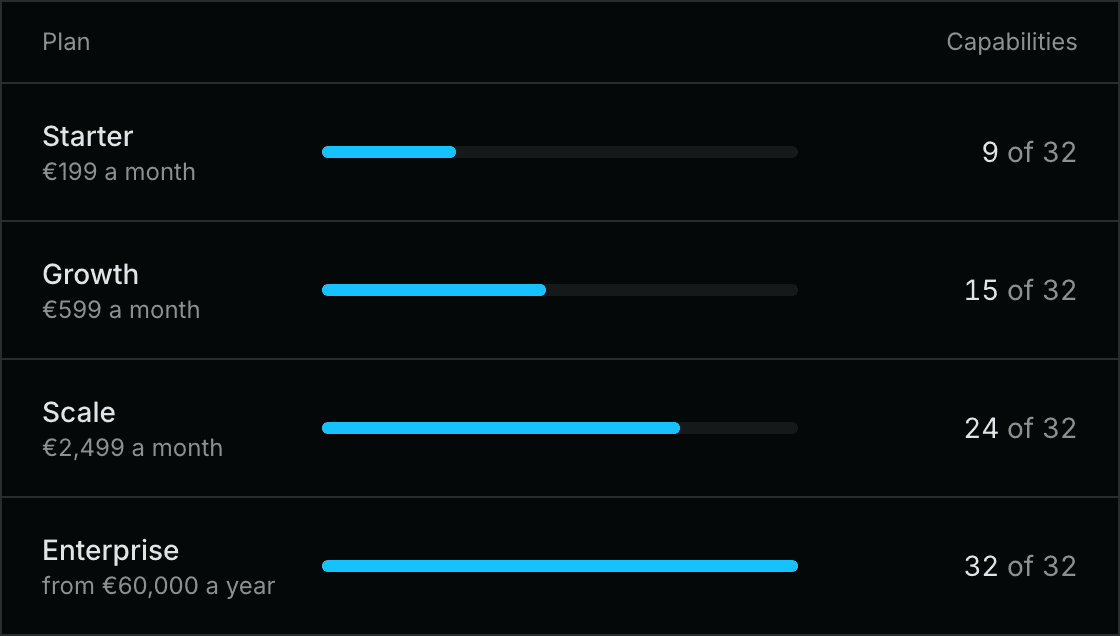
Cost scales with complexity, not with GMV
The June 2026 restructure prices growth: GMV allowances with automatic upgrades, a 0.9% overage on Scale, a 0.6% to 2.0% Open Payment Provider fee on Core to Scale (0% on Performance with contract), and B2B Edition quoted separately. Vendure Core is free, the plans are a flat monthly fee and Enterprise a flat annual one.
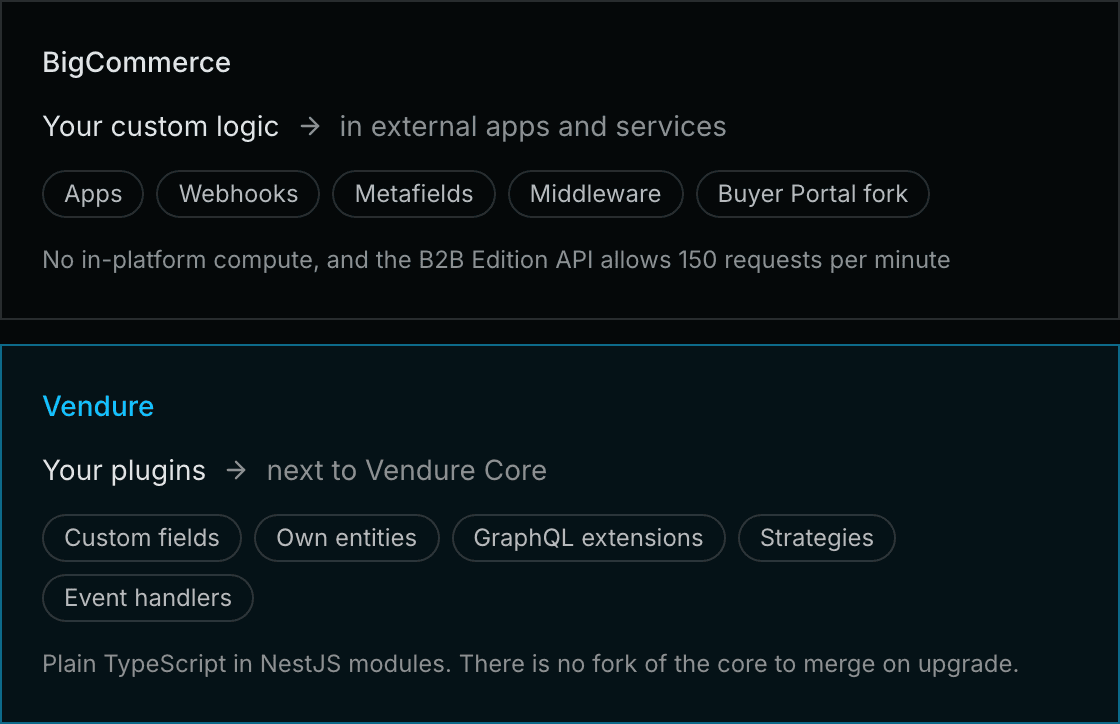
The buying rules are modelled, not packaged
B2B Edition's edges are exactly where mid-market B2B deals stall: approvals are single-step and list-based, and there is no ERP call at checkout. Each of those becomes a custom service against an API rate-limited to 150 requests a minute. In Vendure, contract pricing and single-level order approvals arrive at Scale, and multi-level approvals with timeouts and delegation, negotiation, access policy, Configurator and PunchOut (cXML) at Enterprise, as product rather than project.
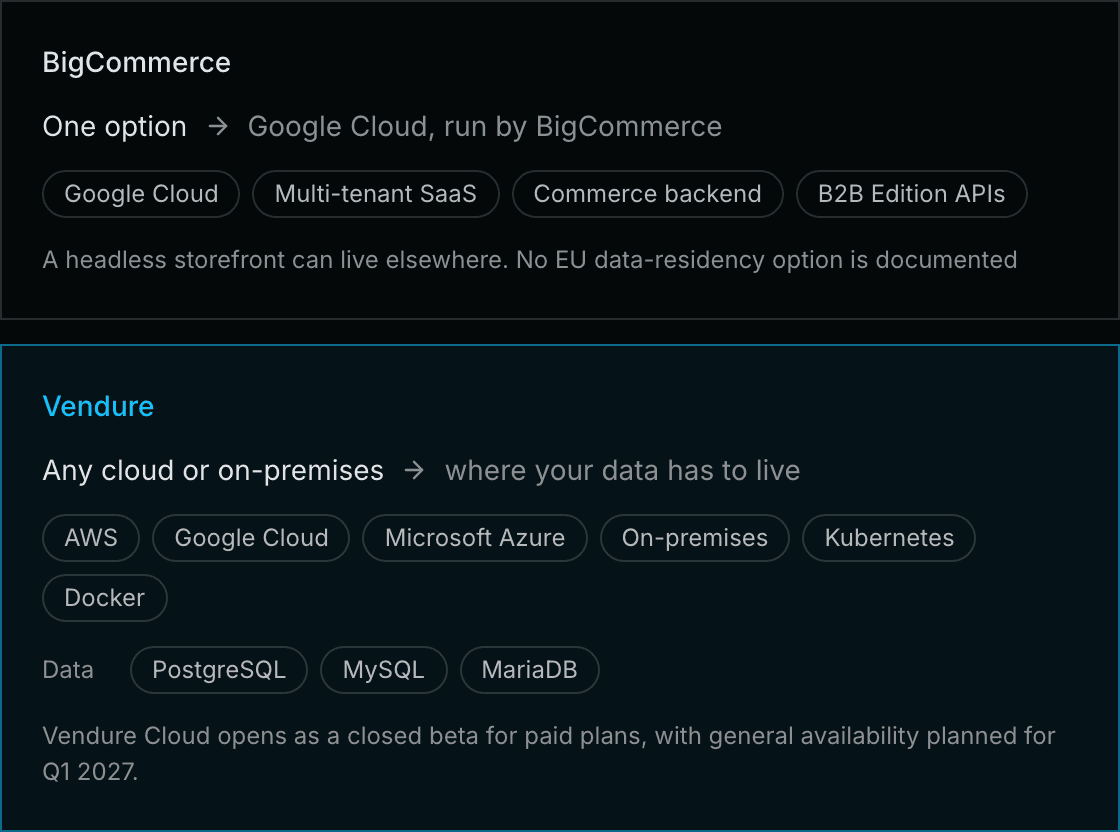
The code, the data and the deployment stay yours
BigCommerce is cloud-only on Google Cloud, operated by BigCommerce, with no self-hosting. The one deeply customisable piece, the open-source Buyer Portal, stops auto-updating the moment you fork it. Vendure runs on any cloud or on-premises, in the region you choose, the GPLv3 core cannot be revoked, plugins live beside the core so there is nothing to fork, and your data sits in your own SQL database.
How they compare
Six dimensions, the same six on every Vendure comparison page. Every claim about BigCommerce is sourced at the foot of this page.
| Dimension | Vendure | BigCommerce |
|---|---|---|
| Architecture and extensibility | VendureTypeScript end to end on NestJS, with GraphQL Shop and Admin APIs. Plugins sit beside the core. No forks, no extension cap. | BigCommerceClosed multi-tenant SaaS on Google Cloud. Apps and webhooks only, no plugin system, metafields cap at 250 per resource. The B2B API allows 150 requests a minute. |
| Licensing and cost model | VendureFree open-source core under GPLv3. Four flat, cumulative plans from €199 a month on a 12-month term, with Enterprise from €60,000 a year. No GMV, per-order or per-user fees. | BigCommerceCore $29 to Performance from $1,499 a month, billed annually, with GMV allowances, automatic upgrades and a 0.6% to 2.0% Open Payment Provider fee on Core to Scale (0% on Performance with contract). B2B Edition is priced separately. |
| B2B depth | VendureCompany accounts and quotes from Starter. Organization hierarchy at Growth. Contract pricing, single-level order approvals, the audit log and the Next.js B2B storefront at Scale. PunchOut (cXML), Configurator and multi-level approvals with timeouts and delegation at Enterprise. | BigCommerceWide and packaged: five-level hierarchies, buyer roles, quotes, an invoice portal, rep masquerade, punchout via TradeCentric. Approvals are single-step and list-based, with no ERP call at checkout. |
| Hosting and operations | VendureSelf-host on any cloud or on-premises, in any region. Managed Vendure Cloud is planned for Q1 2027, with a base set of Cloud resources in each paid plan. | BigCommerceCloud-only on Google Cloud, operated by BigCommerce, with no self-hosting. Strong compliance record: PCI DSS Level 1, SOC 1/2/3, ISO 27001. |
| Ecosystem and talent | VendureMainstream TypeScript, Node and GraphQL. No proprietary skill silo. | BigCommerceA large generalist web pool. React for Catalyst and the Buyer Portal, Handlebars for Stencil themes. B2B on Catalyst is officially experimental. |
| Migration effort | VendureExport catalogue, companies and customers via CSV and the APIs. A forked Buyer Portal is retired rather than merged forward. | BigCommerceNot applicable. |
Vendure pricing: a free open-source core, then four flat tiers
Vendure Core is free under GPLv3. Starter, Growth, Scale and Enterprise add B2B capabilities cumulatively, on a flat fee with no GMV, per-order or per-user charges.
Where BigCommerce is strong
Where BigCommerce is the better answer, we say so. Inside the package, B2B Edition does the job. This comparison is about the edges of the package.
B2B Edition packages more B2B than most SaaS
Five-level hierarchies, buyer roles, quotes, an invoice portal with net terms, rep masquerade and punchout through TradeCentric. This is a genuinely wide feature set and denying it would not be honest.
A serious compliance record
PCI DSS Level 1, SOC 1/2/3 and ISO 27001. It is a managed platform, with no servers and no DevOps for your team to carry.
Multi-storefront on every plan
Every plan can run several storefronts from one dashboard, for separate brands, customer segments or regions, with each added storefront priced per month. Catalyst is a real Next.js path, and the App Marketplace lists reviewed third-party apps.
When teams move from BigCommerce to Vendure
These are the moments the package stops fitting and custom services start accumulating around it.
Complex B2B hits the package edges
multi-level approvals, spending limits inside approval rules, or checkout-time ERP calls
The June 2026 cost mechanics start to bite
GMV allowances, automatic upgrades and the Open Payment Provider fee
Forked Buyer Portal maintenance
where every upstream release becomes a manual merge
Infrastructure control
when the region, the cloud and the infrastructure have to be your choice, which BigCommerce's SaaS-only model does not offer
Migration runs in three phases: catalogue, company and customer import, storefront rebuild, then integration cutover. We scope the effort against what is actually in production rather than quoting a band.
Moving off BigCommerce?
Catalogue, company and customer export via CSV and the APIs, a storefront rebuilt on the GraphQL API, and webhooks replaced by typed events. Migration guides are being written; the hub has what exists today.









Teams building complex commerce with Vendure
Vendure and BigCommerce, answered
Yes, when you need multi-step approvals, contract pricing with validity dates or an ERP call at checkout built by your team, or when you have to choose the region, the cloud and the infrastructure yourself. If your B2B requirements fit inside BigCommerce's packaged feature set, it is a reasonable choice with a strong compliance record.
Company accounts, quotes, lists, quick order and store credit from Starter. Organization hierarchy, managed lists, packaging, gift cards and global search at Growth. Contract pricing, order approvals, the audit log, single sign-on, search analytics and the Next.js B2B storefront at Scale. Negotiation, access policy, advanced approvals, audit governance, Configurator and PunchOut at Enterprise. They are licensed capabilities rather than services you commission.
Vendure Core is free under GPLv3. Four cumulative paid plans sit on top: Starter at €199, Growth at €599 and Scale at €2,499 a month on a 12-month term, with Enterprise from €60,000 a year. Each plan inherits the one below, and there is no GMV charge, per-order surcharge or per-user fee, so growing revenue does not reprice the platform.
Yes. Vendure Core is a complete open-source commerce framework under GPLv3, written in TypeScript on Node.js with GraphQL Shop and Admin APIs. It is free to run and self-host, and the licence cannot be revoked or discontinued for you. The commercial B2B capabilities are separately licensed plugins layered on top of that core. Every paid plan also includes a commercial licence for Vendure Core for your project, as an alternative to GPLv3.
Yes, on any cloud or on-premises, in any region, with your data in your own SQL database. That is what makes EU-mandated and otherwise regulated deployments possible today. Vendure Cloud, our managed hosting, opens as a closed beta for paid plans, with general availability planned for Q1 2027. Each paid plan will include a base set of Cloud resources, and usage above that is billed on top.
Yes. Contract pricing and standard approval policies (single-level) arrive with the Scale plan. Chains the standard policies cannot express use advanced approvals on Enterprise, with multiple levels, timeouts and delegation, alongside negotiation, access policy, Configurator and PunchOut (cXML). Contract prices carry the dates they start and stop applying.
No. The paid plans are a flat monthly fee, and Enterprise a flat annual one. There are no GMV allowances, no automatic upgrades when you cross a revenue band, no fee per order and no payment-provider fee, so the platform line in your budget does not move when trading volume does.
Sources (13) · claims last checked 2026
- BigCommerce pricing: plan prices, GMV caps and auto-upgrades, the 0.9% overage on Scale, the Open Payment Provider fee, and additional storefronts on every plan · bigcommerce.com/pricing
- BigCommerce B2B Edition app listing: custom pricing on request · bigcommerce.com/apps/b2b-edition
- BigCommerce B2B Edition overview: buyer roles, sales quotes, the invoice portal on net terms and sales staff assisting buyers · docs.bigcommerce.com/developer/docs/b2b-edition/getting-started/overview
- BigCommerce B2B Edition best practices: the limit of 150 API requests per minute · docs.bigcommerce.com/developer/docs/b2b-edition/getting-started/best-practices
- BigCommerce B2B Edition account hierarchy: up to five layers of company accounts · bigcommerce.com/blog/now-available-b2b-edition-account-hierarchy
- BigCommerce B2B Edition buyer functions: shopping lists submitted for approval and approved by a buyer with the right permission · support.bigcommerce.com/articles/en_US/Knowledge/B2B-Edition-Buyer-Functions
- TradeCentric for BigCommerce: punchout and purchase-order automation · bigcommerce.com/apps/tradecentric
- BigCommerce API reference: at most 250 metafields per order, product, category, variant or brand per client ID · docs.bigcommerce.com/developer/api-reference/rest/admin/catalog/products/metafields/create-product-metafield
- BigCommerce Catalyst documentation: the B2B Edition integration with Catalyst is experimental · docs.bigcommerce.com/developer/docs/storefront/catalyst/experiments/b2b-edition
- BigCommerce trust centre: Google Cloud infrastructure, PCI DSS Level 1, SOC 1/2/3 and ISO 27001 · security.bigcommerce.com
- BigCommerce open source: the B2B Buyer Portal · github.com/bigcommerce/b2b-buyer-portal
- BigCommerce App Marketplace: reviewed third-party apps · bigcommerce.com/apps
- Vendure pricing and plans · vendure.io/pricing
