Vendure vs Shopify Plus
Shopify Plus is built for D2C at speed. This comparison starts where the buying rules stop being standard.
The short answer
Choose Vendure when
- Approval chains (Enterprise), contract pricing, RFQ, CPQ or punchout
- The bill should not move with revenue
- You want your own payment provider without a surcharge
- You need to choose the region and run your own infrastructure
- The core engine itself needs to change, not just the theme
Choose Shopify Plus when
- You want the fastest route to a running store
- Consumer checkout conversion is the priority
- Your requirements are standard and an app per need is fine
The biggest pain points on Shopify Plus, and how Vendure solves them
B2B stops at accounts, terms and catalogs
Shopify B2B gives you company and location accounts, net terms, catalogs and quick order, with no RFQ, CPQ or punchout. No buyer approval rules. Orders can only be held as drafts for merchant review. Vendure ships company accounts and quotes from Starter, organization hierarchy at Growth, contract pricing and single-level order approvals at Scale, and negotiation, access policy, Configurator, PunchOut (cXML) and multi-level approvals with timeouts and delegation at Enterprise. Each plan inherits the one below, so you buy the depth your workflows actually need.
Cost scales with complexity, not with revenue
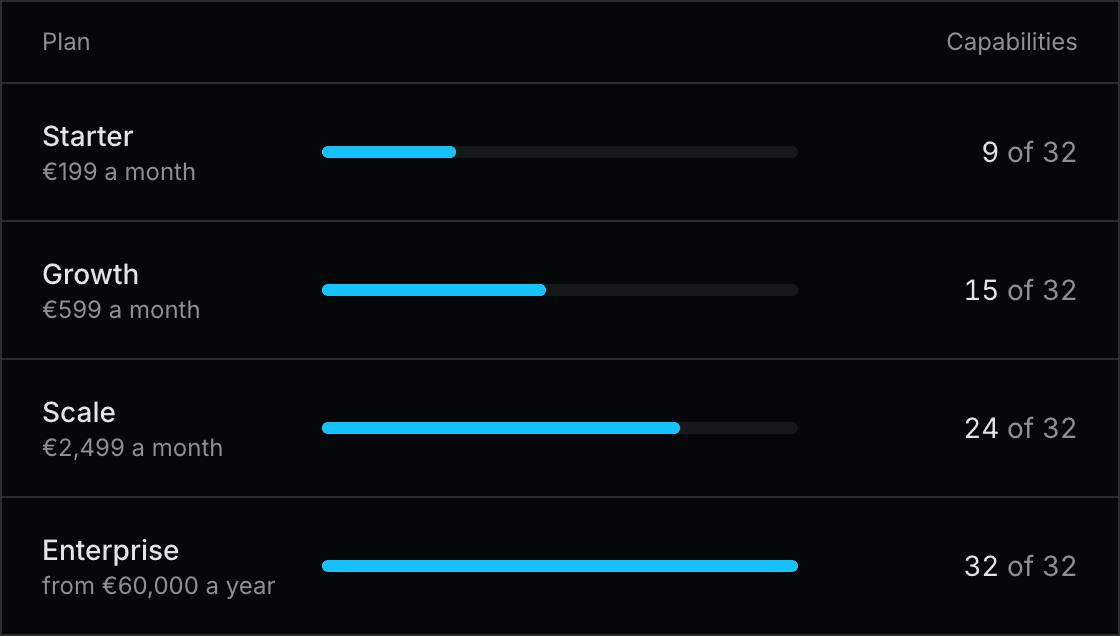
Vendure Core is free, the plans are a flat monthly fee and Enterprise a flat annual one. There is no revenue share, no per-order surcharge and no 0.20% penalty for choosing your own payment provider. Growing revenue does not reprice the platform.
The code and the data stay yours
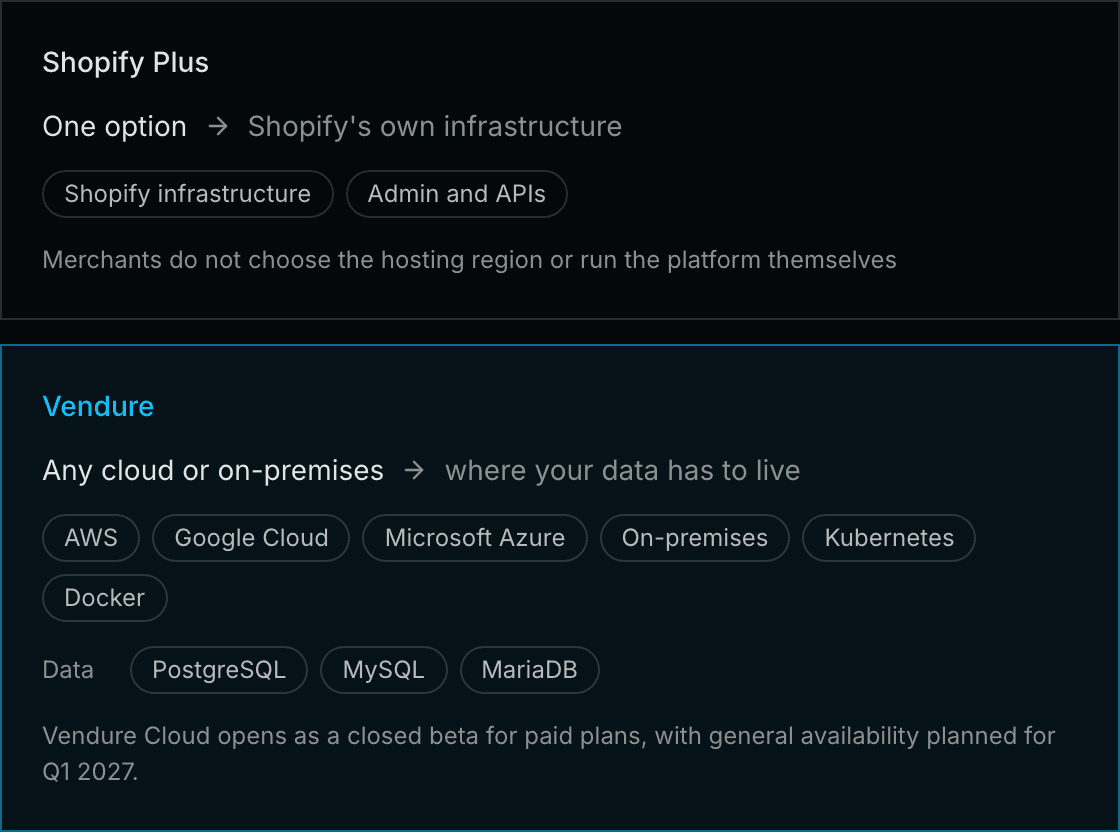
The GPLv3 core cannot be revoked or discontinued for you, the plugin-licence exception keeps your customisations proprietary, and your data sits in your own SQL database. You choose the region and the cloud, which a closed SaaS with no hosting-region choice cannot offer.
How they compare
Six dimensions, the same six on every Vendure comparison page. Every claim about Shopify Plus is sourced at the foot of this page.
| Dimension | Vendure | Shopify Plus |
|---|---|---|
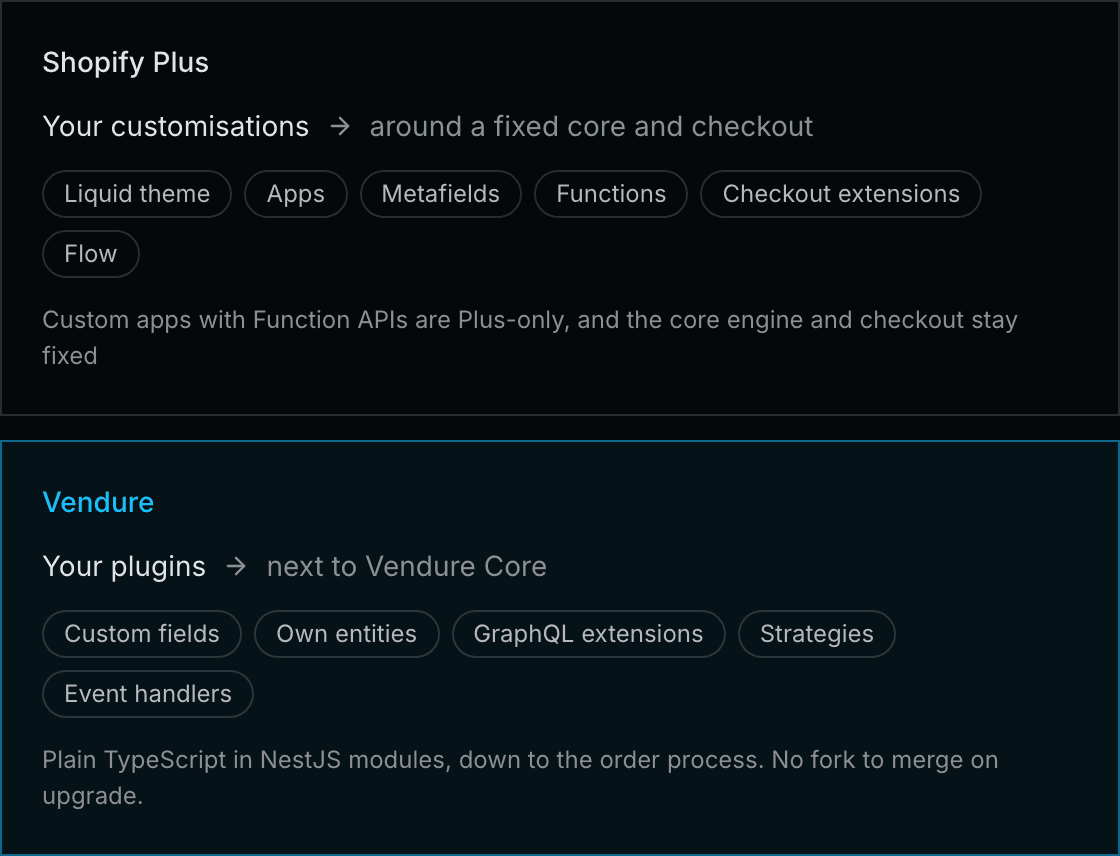
| Architecture and extensibility | VendureTypeScript end to end on NestJS, with GraphQL Shop and Admin APIs. Plugins sit beside the core. No forks, no extension cap. | Shopify PlusClosed SaaS. Themes, apps, metafields and Functions at fixed extension points. The core engine and checkout do not change. |
| Licensing and cost model | VendureFree open-source core under GPLv3. Four flat, cumulative plans from €199 a month on a 12-month term, with Enterprise from €60,000 a year. No GMV, per-order or per-user fees. | Shopify Plus$2,300 a month on three years, $2,500 on one (€2,100 and €2,250 in the EU), plus 0.20% per transaction on third-party payment providers. Larger merchants move to a variable platform fee, and stores past the tenth cost €250 a month each or a revenue share. |
| B2B depth | VendureCompany accounts and quotes from Starter. Organization hierarchy at Growth. Contract pricing, single-level order approvals, the audit log and the Next.js B2B storefront at Scale. PunchOut (cXML), Configurator and multi-level approvals with timeouts and delegation at Enterprise. | Shopify PlusCompany and location accounts with net terms, catalogs and quick order. No buyer approval rules. Orders can only be held as drafts for merchant review. No RFQ, CPQ or punchout. Orders cap at 500 lines. |
| Hosting and operations | VendureSelf-host on any cloud or on-premises, in any region. Managed Vendure Cloud is planned for Q1 2027, with a base set of Cloud resources in each paid plan. | Shopify PlusFully managed SaaS, zero DevOps. No hosting-region choice, no infrastructure or log access. |
| Ecosystem and talent | VendureMainstream TypeScript, Node and GraphQL. No proprietary skill silo. | Shopify PlusA very large agency and app ecosystem. Functions and checkout-extensibility skills are the rarer commodity. |
| Migration effort | VendureImport catalogue and customers, then rebuild the storefront on the GraphQL API or start from the Next.js storefront included from Scale. | Shopify PlusNot applicable. |
Vendure pricing: a free open-source core, then four flat tiers
Vendure Core is free under GPLv3. Starter, Growth, Scale and Enterprise add B2B capabilities cumulatively, on a flat fee with no GMV, per-order or per-user charges.
Where Shopify Plus is strong
Where Shopify Plus is the better answer, we say so. For D2C at speed with standard requirements, Plus fits. This comparison starts where the requirements stop being standard.
The fastest route to a running store
There is no infrastructure to operate, patch or keep on call, no upgrade cycle to manage and no platform team to staff. For a merchant who needs to be selling this quarter, that is a real advantage and it is worth saying plainly.
Consumer checkout is their core competence
Shopify has spent years optimising the checkout most shoppers have used before, and the conversion benefit of that familiarity is difficult to reproduce from scratch. Its app and agency ecosystem is extensive too.
For standard D2C, the total cost is usually lower
For brand-led D2C with a standard checkout there is nothing to build, and Plus comes at a published price. If your requirements sit inside what the platform already does, the total cost of Plus is usually lower than building and running the equivalent yourself.
When teams move from Shopify Plus to Vendure
These are the moments where the platform stops carrying the business and the workarounds start carrying it instead.
Scripts stopped running on 30 June 2026
so logic that lived in Scripts is being rebuilt on Functions right now, which is a natural moment to ask where it should live
Contract prices with validity dates
negotiated per customer
Formal quote or approval processes
particularly multi-step approval chains
ERP as the source of truth
with a call needed at checkout rather than a nightly sync (Enterprise Advanced pricing gives you the hook, and your team writes the call)
Configurators beyond three options
where the product itself is assembled rather than picked
Orders past 500 lines
which is a documented platform cap
Multi-entity groups
with separate legal entities, catalogues or currencies
EU data-residency mandates
where no hosting-region choice is a hard stop
App sprawl on a single process
where three or four apps and a spreadsheet hold one workflow together
Migration runs in three phases: catalogue and customer import, storefront rebuild, then integration cutover. We scope the effort against what is actually in production rather than quoting a band.
Moving off Shopify Plus?
Felipe Arango of iDeum, who has moved Plus and headless Hydrogen stores onto Vendure, on who should stay, how to sort the apps and Functions before anyone writes code, what ports and what gets rebuilt, and why B2C goes before B2B.









Teams building complex commerce with Vendure
Vendure and Shopify Plus, answered
Yes, when the buying rules belong in the platform: multi-step approval chains, contract pricing with validity dates, RFQ, punchout, ERP write-back built on Vendure by your team, or multi-entity structures. For D2C with standard requirements, Shopify Plus is the faster route to a running store and the stronger fit, and we would say so.
Company accounts, quotes, lists, quick order and store credit from Starter. Organization hierarchy, managed lists, packaging, gift cards and global search at Growth. Contract pricing, order approvals, the audit log, single sign-on, search analytics and the Next.js B2B storefront at Scale. Negotiation, access policy, advanced approvals, audit governance, Configurator and PunchOut at Enterprise. They are licensed capabilities rather than services you commission.
Vendure Core is free under GPLv3. Four cumulative paid plans sit on top: Starter at €199, Growth at €599 and Scale at €2,499 a month on a 12-month term, with Enterprise from €60,000 a year. Each plan inherits the one below, and there is no GMV charge, per-order surcharge or per-user fee, so growing revenue does not reprice the platform.
Yes. Vendure Core is a complete open-source commerce framework under GPLv3, written in TypeScript on Node.js with GraphQL Shop and Admin APIs. It is free to run and self-host, and the licence cannot be revoked or discontinued for you. The commercial B2B capabilities are separately licensed plugins layered on top of that core. Every paid plan also includes a commercial licence for Vendure Core for your project, as an alternative to GPLv3.
Yes, on any cloud or on-premises, in any region, with your data in your own SQL database. That is what makes EU-mandated and otherwise regulated deployments possible today. Vendure Cloud, our managed hosting, opens as a closed beta for paid plans, with general availability planned for Q1 2027. Each paid plan will include a base set of Cloud resources, and usage above that is billed on top.
Yes. Vendure runs B2C and B2B on one platform with a shared catalogue, inventory and fulfilment, which is usually the point for a manufacturer or distributor selling through both. The Next.js storefront included from the Scale plan covers both models, and you can also bring your own frontend against the GraphQL APIs.
No. The paid plans are a flat monthly fee, and Enterprise a flat annual one. There is no revenue share, no per-order surcharge, and no surcharge for using your own payment provider, so your platform cost is not a function of how much you sell.
Sources (7) · claims last checked 2026
- Shopify Plus pricing: subscription, contract terms, the variable platform fee, expansion stores and the third-party payment provider fee · shopify.com/plus/pricing
- Shopify B2B requirements and limitations: B2B on Basic, Grow, Advanced and Plus, and the 500 line item limit on orders and draft orders · help.shopify.com/manual/b2b/getting-started/considerations
- Shopify B2B companies: company and location accounts, payment terms, catalogs, and orders submitted as drafts for review · help.shopify.com/manual/b2b/companies-and-customers/creating-companies
- Shopify B2B online store: quantity rules, volume pricing and the quick order list · help.shopify.com/manual/b2b/store-customization
- Shopify developer changelog: Shopify Scripts stopped running on 30 June 2026, with Shopify Functions as the replacement · shopify.dev/changelog
- Shopify Partners: the partner and agency directory · shopify.com/partners/directory
- Vendure pricing and plans · vendure.io/pricing
