Vendure vs Medusa
Two open-source Node.js commerce platforms. Both give you the code and the data. The difference is where complex B2B comes from.
The short answer
Choose Vendure when
- Typed GraphQL contracts are a requirement
- Hierarchies, RBAC, SSO and audit must be supported product
- You need vendor support behind a self-hosted deployment
- MySQL or MariaDB is mandated
Choose Medusa when
- Your policy requires an MIT licence
- A durable workflows engine is central to your build
- Your team is Next.js-centric and speed to demo is the goal
- You are happy to own and maintain the B2B layer yourself
The biggest pain points on Medusa, and how Vendure solves them
B2B depth is a supported product, not a starter fork
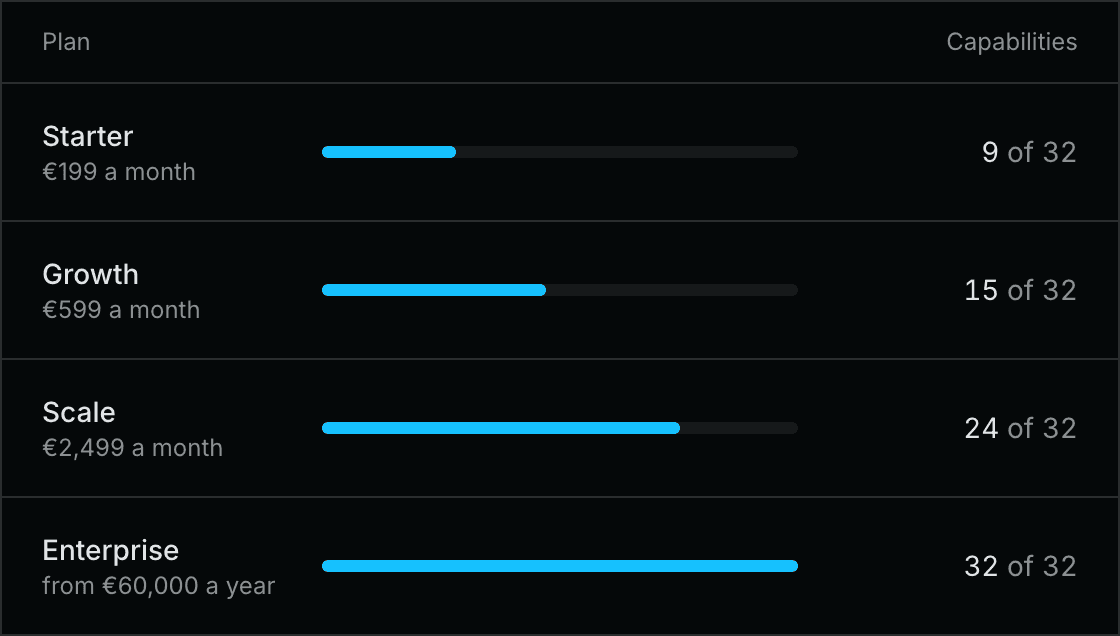
Medusa's companies, quotes, approvals and spending limits ship as a B2B starter template, which is clone-and-own code your team then maintains, and RBAC, SSO and audit logs sit behind Medusa Enterprise. Vendure ships the same territory as plan entitlements: company accounts and quotes from Starter, organization hierarchy at Growth, contract pricing and single-level order approvals at Scale, negotiation, multi-level approvals and PunchOut (cXML) at Enterprise.
Typed contracts and a database choice
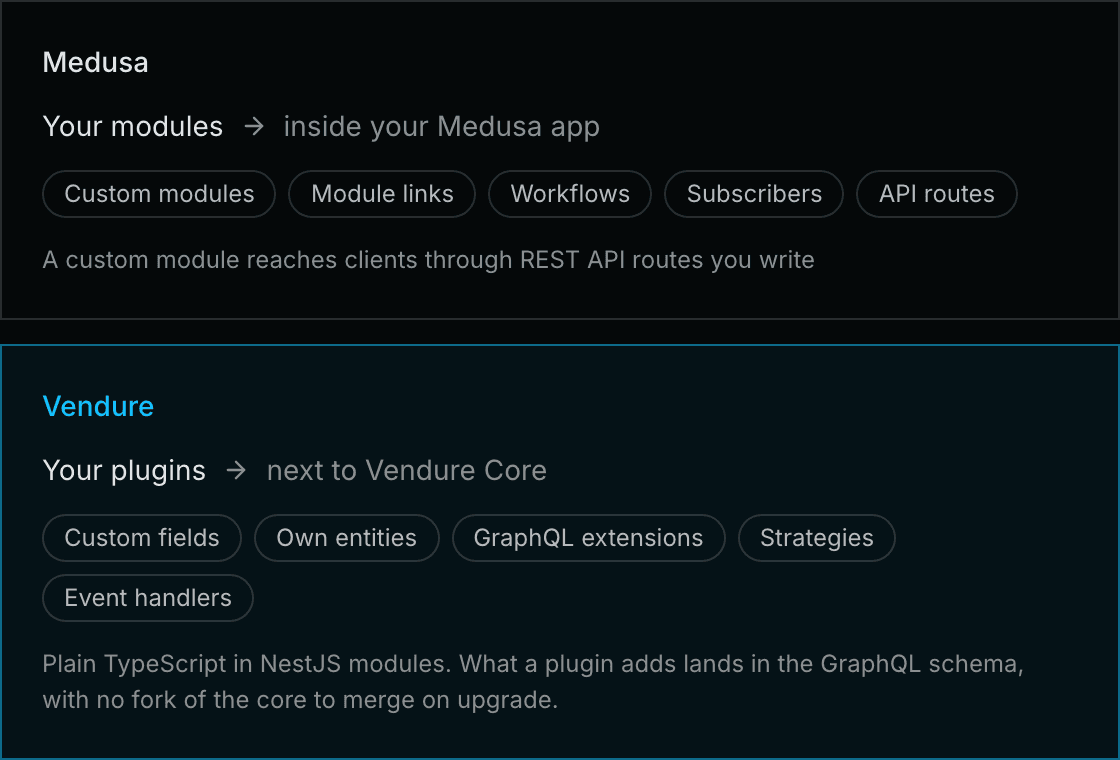
Vendure is GraphQL Shop and Admin APIs end to end, with custom fields that propagate into the schema and first-class custom entities, on PostgreSQL, MySQL or MariaDB. Medusa is REST-only with no official GraphQL, and PostgreSQL only. If you have a typed client contract or a non-PostgreSQL mandate, that decides the question before anything else does.
Governance is in the published plans, wherever you host
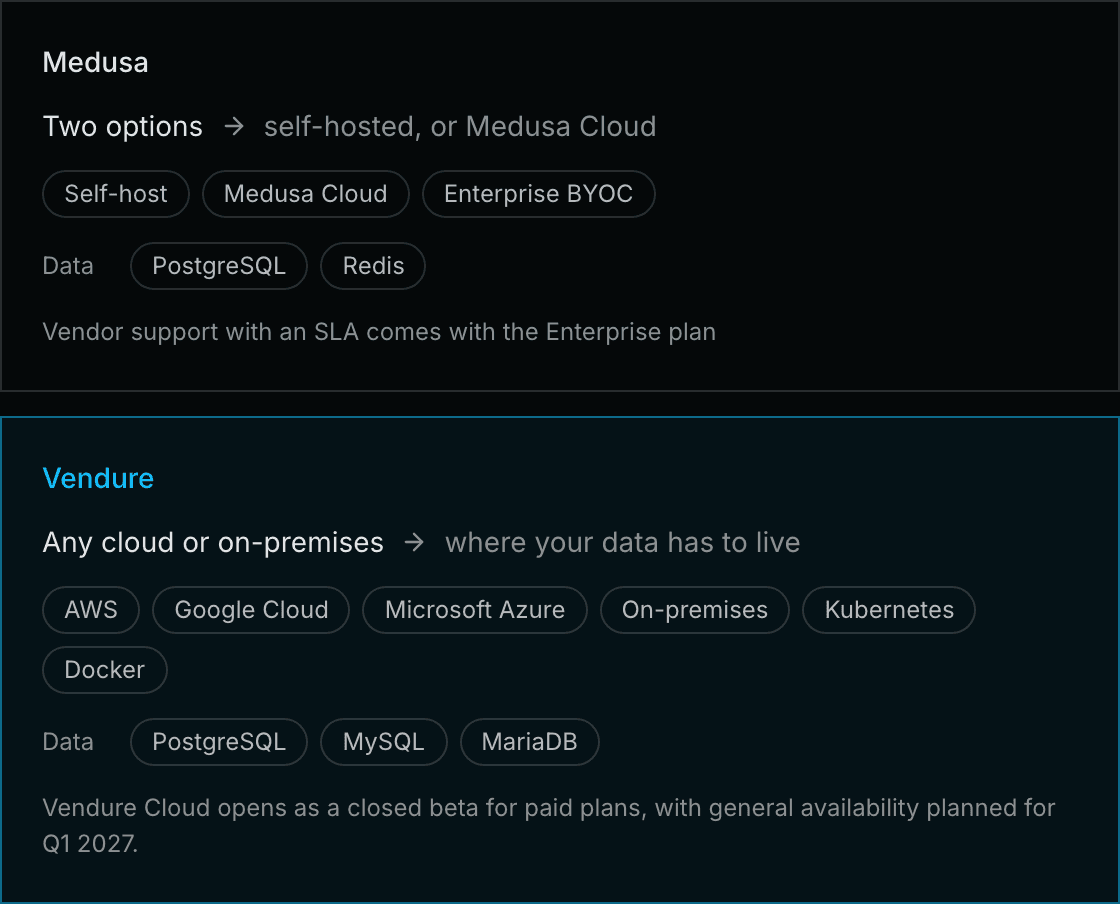
RBAC, SSO and audit logs come with Medusa's Enterprise plan. Vendure's single sign-on and audit log arrive at Scale as supported product, and the plan entitlements travel with a self-hosted deployment on your own cloud or on-premises, with the GPLv3 core and your data in your own SQL database.
How they compare
Six dimensions, the same six on every Vendure comparison page. Every claim about Medusa is sourced at the foot of this page.
| Dimension | Vendure | Medusa |
|---|---|---|
| Architecture and extensibility | VendureTypeScript end to end on NestJS, with GraphQL Shop and Admin APIs. Plugins sit beside the core. No forks, no extension cap. | MedusaNode and TypeScript on Express, REST only with no official GraphQL, PostgreSQL only, Redis recommended in production. A distinctive durable Workflows engine. |
| Licensing and cost model | VendureFree open-source core under GPLv3. Four flat, cumulative plans from €199 a month on a 12-month term, with Enterprise from €60,000 a year. No GMV, per-order or per-user fees. | MedusaMIT core, free, with some Enterprise features under a commercial licence. Cloud at $29, $99 or $299 a month plus usage, with 0% GMV fees. RBAC, SSO and audit logs are Enterprise only. |
| B2B depth | VendureCompany accounts and quotes from Starter. Organization hierarchy at Growth. Contract pricing, single-level order approvals, the audit log and the Next.js B2B storefront at Scale. PunchOut (cXML), Configurator and multi-level approvals with timeouts and delegation at Enterprise. | MedusaSolid core primitives: customer groups, price lists, draft orders. Companies, quotes, approvals and spending limits ship as a B2B starter template you clone and maintain. |
| Hosting and operations | VendureSelf-host on any cloud or on-premises, in any region. Managed Vendure Cloud is planned for Q1 2027, with a base set of Cloud resources in each paid plan. | MedusaSelf-host with PostgreSQL and Redis, or use Medusa Cloud. Vendor support with an SLA comes with the Enterprise plan. |
| Ecosystem and talent | VendureMainstream TypeScript, Node and GraphQL. No proprietary skill silo. | MedusaAn active project with monthly releases. |
| Migration effort | VendureRarely a replatform. Where it happens, catalogue and orders import from PostgreSQL and the Next.js storefront is re-pointed at the GraphQL API. | MedusaNot applicable. |
Vendure pricing: a free open-source core, then four flat tiers
Vendure Core is free under GPLv3. Starter, Growth, Scale and Enterprise add B2B capabilities cumulatively, on a flat fee with no GMV, per-order or per-user charges.
Where Medusa is strong
Where Medusa is the better answer, we say so. For a developer-led build, Medusa fits. This comparison is about what the B2B layer costs to own.
MIT licence
An MIT core, with some Enterprise features under a commercial licence, and full code and data ownership. That is the same argument we make for open source, and on the licence itself Medusa's is the more permissive of the two.
An active, production-ready project
An active project with monthly releases, on a modular architecture. Medusa is production-ready and we would not suggest otherwise; this comparison does not turn on that.
A fast, inexpensive start for developer-led builds
Cloud from $29 a month with 0% GMV fees and official Next.js starters. Its durable Workflows engine undoes completed steps in reverse order when a later step fails. For D2C and time to first demo, especially on Next.js-centric teams, it is a strong fit.
When teams pick Vendure over Medusa
Medusa is rarely a replatform target. This is an evaluation-stage contest, and these are the requirements that tip the fit.
Typed GraphQL contracts
are a stated requirement rather than a preference
Real organisation hierarchies, RBAC, SSO and audit trails
are wanted as supported product rather than as a starter fork your team maintains
Multi-language without a feature flag
is needed in production today
Vendor support behind a self-hosted deployment
on a published plan rather than an enterprise contract
A non-PostgreSQL database
is mandated by the organisation
Outgrowing a Medusa B2B build?
This is usually an evaluation rather than a replatform. Where teams do move, the Next.js work carries over conceptually and workflows become Vendure plugins. Migration guides are being written; the hub has what exists today.









Teams building complex commerce with Vendure
Vendure and Medusa, answered
Yes, when you need typed GraphQL contracts, a database other than PostgreSQL, or organisation hierarchies, RBAC, SSO and audit trails as supported product rather than as a starter template your team maintains. Medusa is a genuinely good product, and for a developer-led build where time to first demo matters most, it is the stronger fit.
Company accounts, quotes, lists, quick order and store credit from Starter. Organization hierarchy, managed lists, packaging, gift cards and global search at Growth. Contract pricing, order approvals, the audit log, single sign-on, search analytics and the Next.js B2B storefront at Scale. Negotiation, access policy, advanced approvals, audit governance, Configurator and PunchOut at Enterprise. They are licensed capabilities rather than services you commission.
Vendure Core is free under GPLv3. Four cumulative paid plans sit on top: Starter at €199, Growth at €599 and Scale at €2,499 a month on a 12-month term, with Enterprise from €60,000 a year. Each plan inherits the one below, and there is no GMV charge, per-order surcharge or per-user fee, so growing revenue does not reprice the platform.
Yes. Vendure Core is a complete open-source commerce framework under GPLv3, written in TypeScript on Node.js with GraphQL Shop and Admin APIs. It is free to run and self-host, and the licence cannot be revoked or discontinued for you. The commercial B2B capabilities are separately licensed plugins layered on top of that core. Every paid plan also includes a commercial licence for Vendure Core for your project, as an alternative to GPLv3.
Yes, on any cloud or on-premises, in any region, with your data in your own SQL database. That is what makes EU-mandated and otherwise regulated deployments possible today. Vendure Cloud, our managed hosting, opens as a closed beta for paid plans, with general availability planned for Q1 2027. Each paid plan will include a base set of Cloud resources, and usage above that is billed on top.
Yes, for both the Shop and Admin APIs, end to end. Custom fields you define propagate straight into the GraphQL schema, and custom entities are first-class, so a typed client contract stays accurate as the model grows. Vendure also runs on PostgreSQL, MySQL or MariaDB rather than a single supported database.
No. The paid plan entitlements and the support behind them travel with a self-hosted deployment on your own cloud or on-premises. Vendure Cloud, planned for general availability in Q1 2027, is a deployment choice rather than a condition of being supported. Service levels are part of Enterprise agreements.
Sources (10) · claims last checked 2026
- Medusa developer documentation: REST API routes · docs.medusajs.com
- Medusa developer documentation: the durable Workflows engine · docs.medusajs.com
- Medusa Redis Event Module: recommended in production · docs.medusajs.com
- Medusa Translation Module: currently behind a feature flag · docs.medusajs.com
- Medusa pricing: Cloud tiers, usage, 0% GMV fees, and the Enterprise plan with support SLAs, RBAC, SSO and audit logs · medusajs.com/pricing
- Medusa B2B starter template: companies, quotes, approvals and spending limits · github.com/medusajs/b2b-starter
- Medusa repository: monthly release cadence · github.com/medusajs/medusa
- Medusa licence: MIT, except the Enterprise Edition materials under a separate licence · github.com/medusajs/medusa/blob/develop/LICENSE
- Vendure developer documentation: plugins, custom fields, custom entities and supported databases · docs.vendure.io
- Vendure pricing and plans · vendure.io/pricing
