How to cut B2B ecommerce total cost of ownership (TCO)
Every platform shortlist ends with someone from finance asking what it will cost. The honest answer starts with the licence and ends a long way further down the spreadsheet.
B2B ecommerce total cost of ownership (TCO) is everything you pay to run your online sales channel over three to five years: the licence, the build, the ERP integration, hosting, upgrades, payment fees, the people who keep it running, and the orders your team still types in by hand. This guide shows where that money goes, how platform pricing behaves when your revenue grows, and nine ways to bring the total down.
The short answer
You cut B2B ecommerce TCO by removing the costs that grow without adding anything:
- Pick a platform price that does not rise with your revenue.
- Use B2B features that come with the platform instead of paying for apps or custom builds.
- Run B2B and B2C on one platform.
- Leave the ERP in charge of prices and stock, and connect to it properly.
- Keep your customisations out of the platform's core, so upgrades stay cheap.
- Build on a stack you can hire for.
- Choose hosting by what it costs your team to run.
- Move your most common orders online first.
- Pay only for the features you use.
Vendure is designed around all nine. The rest of this guide explains each one, how to put numbers on them, and how Vendure keeps each cost down.
The licence is the smallest surprise
Most TCO conversations start with the pricing page, because it is the only number anyone can find before signing. The other costs show up once the project is running.
- ImplementationOnce
- Apps for missing B2B featuresEvery year
- ERP integration, build and upkeepEvery year
- Hosting and operationsEvery year
- Upgrade workEvery major release
- Payment and transaction feesGrows with revenue
- Orders keyed in by handGrows with orders
- Leaving laterOnce
Two of those lines get less attention than they deserve. Payment and transaction fees grow every year you sell more. And when orders still arrive by email or phone, or the webshop is not connected to the ERP, someone on your team types them in by hand. Those staff hours belong in your TCO, even though no invoice ever arrives for them. If a customer sends a 40-line order by email every Monday, someone spends part of every Monday copying it into the ERP.
Ready to build? The Vendure docs cover architecture, setup, and extension from day one.
Read the docsWhy B2B costs more to run than B2C
A consumer shop has one kind of customer and one price list, while B2B has neither:
- Your customer is a company, with several buyers on one account and often a tree of branches.
- Each company has its own agreed prices, with dates when they start and stop applying.
- Orders over a buyer's limit wait for a manager, and large customers order through quotes, purchase order numbers, or PunchOut.
- The ERP stays in charge of prices, stock, credit, and invoices, and the webshop has to keep in step with it.
Each of those rules your platform cannot handle turns into an app subscription, a custom build, or a person doing it by hand. Much of the difference in TCO between two B2B platforms comes down to how many of these rules each one handles out of the box.
What happens to your bill when revenue doubles
Platform pricing comes in four shapes. For TCO, the question to ask about each one is what happens when your online revenue doubles.
| Pricing model | How it works | When revenue doubles | Examples |
|---|---|---|---|
| Share of revenue | A plan fee plus a percentage of sales or payments | The fee doubles too | Shopify Plus charges 0.20% per transaction on third-party payment providers, and larger merchants move to a variable platform fee (comparison) |
| Tiered by revenue | Plans with revenue (GMV) allowances | You move up a tier | BigCommerce plans have GMV allowances with automatic upgrades (comparison). Shopware prices its plans on GMV (comparison) |
| Negotiated licence | A price agreed with sales, reviewed at renewal | Usually renegotiated | Adobe Commerce, SAP Commerce Cloud, commercetools, and Spryker publish no rate card for their commercial offers (comparisons) |
| Flat plan | A fixed monthly price per plan | Nothing changes | Vendure: Starter, Growth, Scale, and Enterprise, with no fee on order value, orders, or users (Vendure pricing) |
Each model suits some businesses. A revenue fee can be the cheapest option while you are small, and a negotiated licence can include services a flat plan does not. What matters is that you price each one at the revenue you expect in year three, not the revenue you have today.
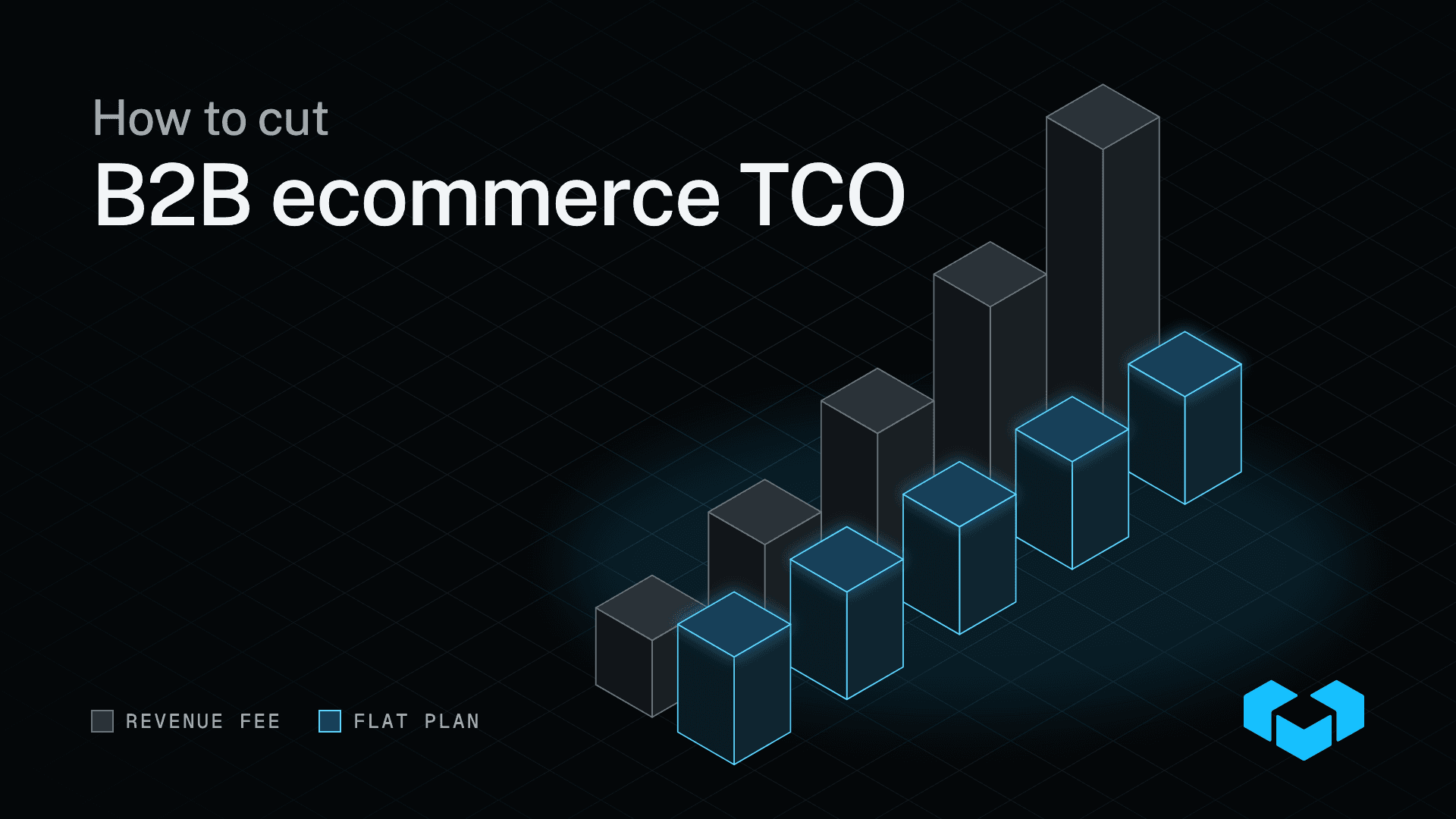
The chart shows the shape with round numbers: a fee of 0.25% of online revenue next to a flat price of $2,899 a month, while online revenue grows from $10 million to $40 million. The flat price is Vendure's Scale plan, which includes 24 of Vendure's 32 capabilities, from contract pricing and order approvals to the B2B storefront.
In year one the fee is the cheaper option. By year three it is bigger, and over five years it adds up to $280,000 against $174,000 for the same platform doing the same job.
How to work out your own 3 to 5 year TCO
You do not need a consultant for this. You need a spreadsheet, your order history, and the same assumptions for every platform on the list.
- Start from real orders. Take the last 90 days and write down every rule they follow: who can order, which price applies, who approves, and where the order ends up.
- Price each rule per platform. Mark it as built in, an app (with its price), custom work (with an estimate), or manual work (with hours per month).
- Price the licence at year-three revenue. Use each vendor's own pricing, applied to the revenue you expect by then.
- Add the integrations. The build, plus a yearly line for keeping each one working. Start with the ERP.
- Add hosting, upgrades, and your team. Include the work each major upgrade takes, times the number of upgrades in the period.
- Estimate what leaving would cost. It will be rough: list the custom code you would have to rebuild and the data you would have to move. You cannot put an exact number on it, but it shows which platform would be hardest to leave.
Add each line up over three and five years. The platform that is cheapest in year one is often not the cheapest over five, and the lines tell you why.
Complex B2B and B2C on one adaptable, headless ecommerce platform.
Compare Vendure plansNine ways to cut B2B ecommerce TCO
1. Pick a price that does not rise with revenue
A fee on gross merchandise value (GMV) or on transactions grows every year you do well. A flat price stays the same until you need more features. If you expect online revenue to grow, this is often the biggest single difference between two platforms over five years.
2. Use B2B features that come with the platform
Company accounts, customer price lists, quotes, order approvals, and quick reorder are the basics of B2B ecommerce. When they ship with the platform, you do not pay to build them, and you do not pay again to keep them working after every upgrade. Check each one in the vendor's documentation, where the limits are written down.
3. Run B2B and B2C on one platform
If you sell to businesses and to consumers, two platforms mean two licences, two catalogues to keep in sync, and two streams of orders to reconcile in the ERP. One platform with separate channels gives each audience its own prices and rules on one product catalogue. See how brands and markets run on one platform.
4. Leave the ERP in charge, and connect to it properly
Your ERP already owns prices, stock, credit, and invoices. Let the webshop own the buying experience: orders go to the ERP, and the sales-order number, stock, and prices come back. Build the connection so that a failed call is retried and someone is alerted when it cannot recover. An integration that quietly drops orders costs far more to run than one that waits and tries again.
See how Vendure connects to your ERP.
5. Keep your customisations out of the core
Your process will differ from any platform's default. If your changes live in your own code, through plugins or extension points, an upgrade leaves them alone. If an agency patched the platform's core, every major release turns into a merge project, and you pay for it every time.
6. Build on a stack you can hire for
Skills that only apply to one platform cost more and take longer to find. A platform built on a mainstream language lets you hire from a bigger pool and change agencies without retraining anyone. Count the day rates of the people you will need alongside the licence.
7. Choose hosting by what it costs you to run
Self-hosting avoids a hosting margin but needs servers and someone to look after them. A managed service removes that work and adds a plan fee and usage charges. Choose whichever costs your team less today, on a platform that lets you switch later without a rebuild.
8. Move your most common orders online first
You do not need every B2B rule live on day one. Start with the orders customers place most often, which are usually reorders of known products at agreed prices. Every order that moves from email to self-service saves the time it took to retype it. Quotes, approvals, and PunchOut can follow.
9. Pay only for the features you use
Choose a plan by the features your orders need today, and check what each step up adds before you take it. A plan full of features nobody uses is cost without return. Platforms whose plans build on each other let you start small and move up when your buying process needs more.
How Vendure keeps B2B ecommerce TCO down
Vendure is the ecommerce platform for complex B2B, and its pricing and architecture follow the nine levers above.
| Lever | How Vendure handles it |
|---|---|
| A price that does not rise with revenue | Flat monthly plans with no fee on order value, orders, or users |
| B2B features that come with the platform | 32 capabilities across the plans, from company accounts to PunchOut |
| B2B and B2C on one platform | Every brand, region, and customer group runs as a channel on one backend |
| The ERP stays in charge | A Workflow Engine in every plan pushes orders to the ERP and retries failed calls |
| Customisations out of the core | Your team extends Vendure in TypeScript through plugins that survive upgrades |
| A stack you can hire for | TypeScript, Node.js, NestJS, and GraphQL, end to end |
| Hosting by running cost | Self-host anywhere, or run the same application on Vendure Cloud |
| Common orders online first | Quick order, reorder, and shopping lists from the Starter plan |
| Pay only for the features you use | Plans follow capabilities, and each plan includes the one before it |
Flat prices you can budget
Starter is $229 (€199), Growth $689 (€599), and Scale $2,899 (€2,499) a month on a 12-month term, and Enterprise starts at €60,000 a year on contract. Month-to-month terms are also available, both terms are billed monthly, and every self-serve plan starts with a 30-day free trial. Selling more never changes the price. The pricing page has the current figures, and Introducing Vendure plans explains how they are built.
B2B features included
- Starter: company accounts, tax ID validation, quote requests, quick order, reorder, shopping lists, store credit, and catalogue search.
- Growth: organization hierarchy for customers with branches, packaging units for selling by the unit, box, or pallet, managed shopping lists, gift cards, and the Typesense search engine.
- Scale: contract pricing with dated price lists, order approvals, shared carts, product types, an audit log, single sign-on, search analytics, and the B2B storefront.
- Enterprise: quote negotiation, the product configurator, PunchOut, advanced pricing from your ERP or CPQ, multi-level approvals, access policies, federated single sign-on, and audit governance, plus engineers who build what is missing and contract terms your procurement team can sign.
See B2B buying and B2B pricing and catalogues.
Lower running costs
B2B and B2C run on one backend, so you keep one catalogue and one order flow into the ERP. Your ERP, CRM, and PIM stay in place, and integrations are built for your systems on Vendure's APIs and Workflow Engine, by your team, an official partner, or Vendure Professional Services, and on Enterprise also by the Vendure team. Upgrades leave your plugins alone. You can self-host the same application on any cloud or your own hardware, or run it on Vendure Cloud, which opens as a closed beta for paid plans with general availability planned for Q1 2027.
Swiss steel trader HANS KOHLER AG runs B2B and B2C on one Vendure platform and reports 20% more daily orders since launch. To see how Vendure compares with a specific platform on price and B2B depth, read the comparison pages.
Worth reading, once a month
Product updates, customer stories, and engineering thinking, delivered monthly.
Frequently asked questions
It is the full cost of running your online sales channel over its life, usually three to five years: the licence, implementation, apps, ERP and other integrations, hosting, upgrades, payment fees, the team that runs it, the manual work the platform leaves behind, and the cost of leaving.
Pick a platform price that does not rise with revenue, use B2B features that come with the platform, run B2B and B2C on one platform, leave the ERP in charge and connect to it properly, keep customisations out of the core, build on a stack you can hire for, choose hosting by running cost, move your most common orders online first, and pay only for the features you use. Vendure is built around all nine: flat plans with no revenue fee, B2B capabilities included, and one backend for B2B and B2C.
Write down the rules your last 90 days of orders follow, then price each one per platform as built in, an app, custom work, or manual work. Add the licence at your expected year-three revenue, integrations, hosting, upgrade work, your team, and the cost of leaving. Add each line up over three and five years, using the same assumptions for every platform.
B2B buying has more rules. The customer is a company with several buyers, prices are agreed per customer, orders go through approvals, and the ERP stays in charge. Each rule the platform cannot handle becomes an app, a custom build, or manual work.
Yes. B2B online revenue is often high enough for a small percentage to add up. A fee of 0.25% on $20 million of online revenue is $50,000 a year, and it doubles if revenue doubles. Model any revenue-based fee at the revenue you expect in year three.
Vendure plans start at $229 a month on a 12-month term, with Growth at $689, Scale at $2,899, and Enterprise from €60,000 a year, and no fee on order value on any plan. Elsewhere, published prices run from $29 a month for BigCommerce's entry plan, billed annually, to $2,500 a month for Shopify Plus on a one-year term, before transaction fees, while Adobe Commerce, SAP Commerce Cloud, commercetools, and Spryker quote through sales. Implementation and integrations cost extra on every platform.
The bottom line
Before you choose a platform, add up what it will cost over five years, including the manual work and the cost of leaving. Price each vendor at the revenue you expect to reach. Vendure keeps that number low with a flat price and B2B built in. Compare the plans, start a 30-day trial, or talk to us about your numbers.
Share this guide
Price your platform on a flat plan
Vendure is the complete, headless ecommerce platform for complex B2B. Replace fragile workarounds and fragmented stacks while keeping the systems your business already runs.