Vendure vs WooCommerce
Where commerce has outgrown the plugin stack, with product data, pricing and B2B rules that need a model of their own, Vendure is the better fit, and WordPress can stay the CMS. For a WordPress site with a simple catalogue and simple pricing, WooCommerce is the stronger fit.
The short answer
Choose Vendure when
- You sell B2B: manufacturing, wholesale, distribution or a member organisation
- Product data has to serve more than the website
- Pricing has become a domain: price lists, campaigns, customer-specific prices
- WordPress should stay the website and the content team's tool
Choose WooCommerce when
- A simple catalogue and simple pricing on one WordPress site
- Few integrations, and WooCommerce is not what holds the business back
- Nobody, in house or at a partner, will own commerce logic as code
The biggest pain points on WooCommerce, and how Vendure solves them
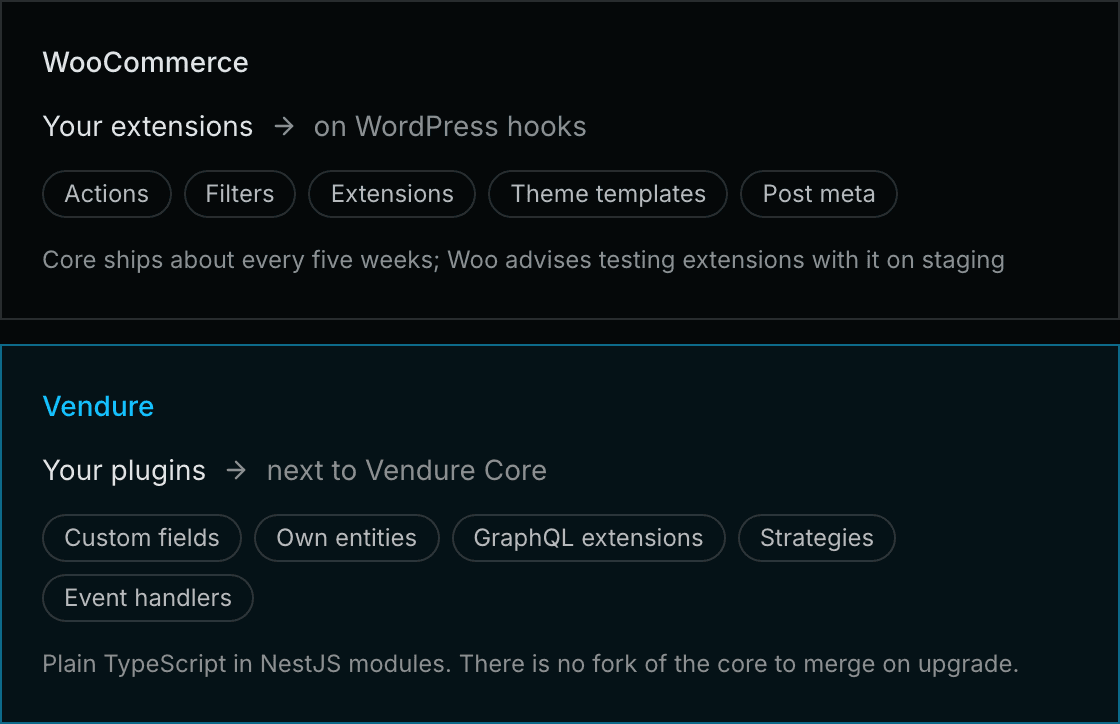
Commerce logic as code, not another plugin
WooCommerce grows by extensions that hook into WordPress through actions and filters, and Woo advises testing them with each core update on staging. Vendure plugins are NestJS modules beside the core, with price calculation as a strategy you write, custom fields that propagate into the GraphQL schema, custom entities and typed events. Pricing and B2B rules become code you own rather than a stack of plugins to keep in step.
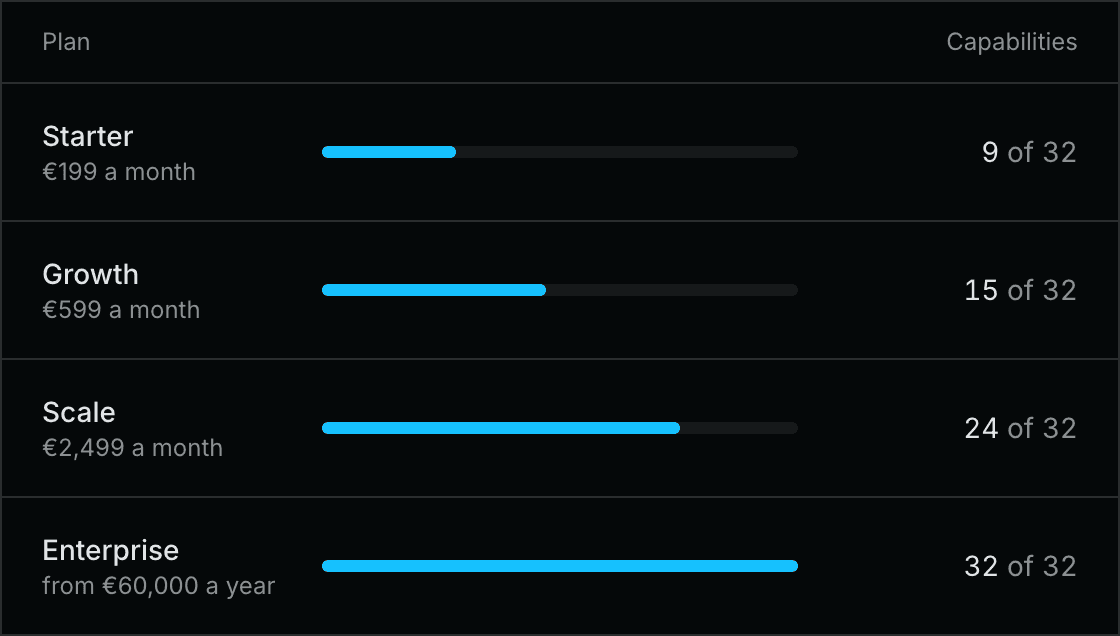
B2B depth you switch on, not assemble
On WooCommerce, B2B features such as wholesale prices, company accounts and quotes come from third-party extensions. Vendure's B2B capabilities come in four cumulative plans from one vendor, each inheriting the one below, at a flat fee per plan with no revenue share.
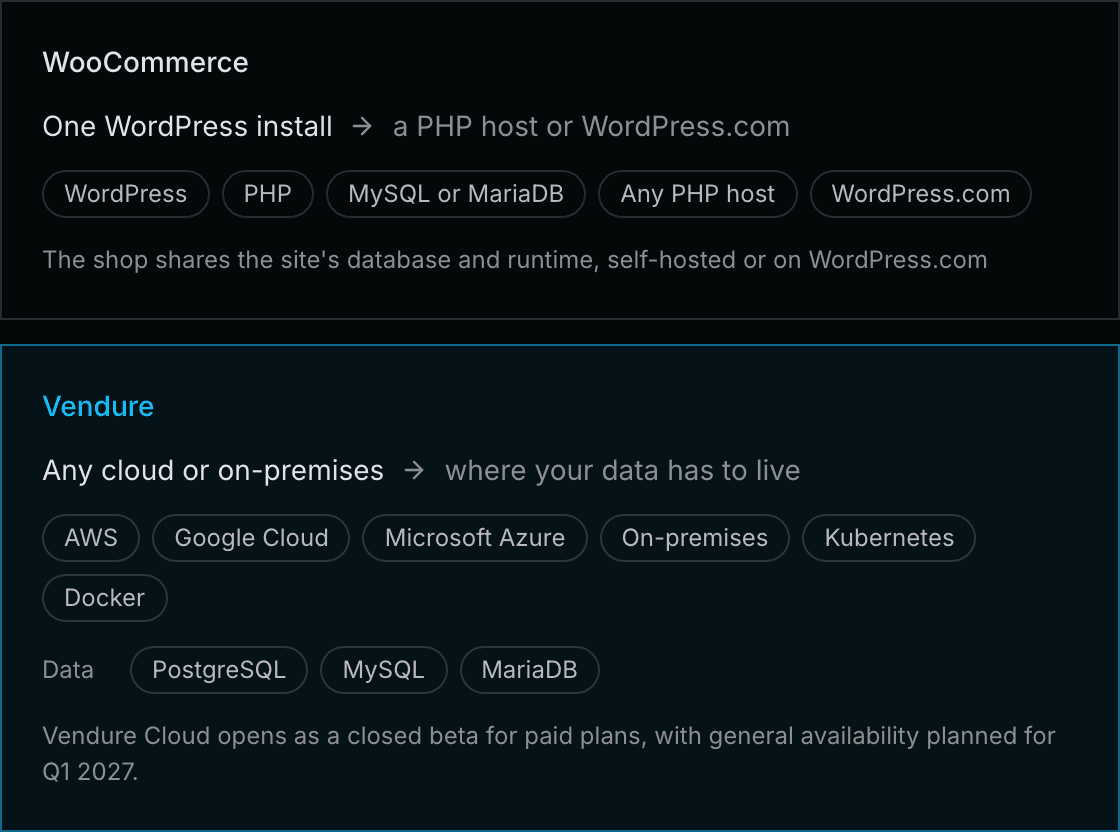
Commerce beside WordPress, not inside it
WooCommerce runs inside the WordPress install, where products are stored as WordPress posts. Vendure runs as its own service in any region, on any cloud or on-premises today, with your data in your own SQL database. WordPress can stay the CMS in front of it, calling Vendure's GraphQL API for the commerce parts of each page.
How they compare
Six dimensions, the same six on every Vendure comparison page. WooCommerce core is free, so the cost row compares what each bill is made of. Every claim about WooCommerce is sourced at the foot of this page.
| Dimension | Vendure | WooCommerce |
|---|---|---|
| Architecture and extensibility | VendureTypeScript end to end on NestJS, with GraphQL Shop and Admin APIs. Plugins sit beside the core. No forks, no extension cap. | WooCommerceA PHP plugin that runs inside WordPress on MySQL or MariaDB. Extensions change its behaviour through WordPress actions and filters, the REST API reads and writes store data, and the Store API serves cart and checkout. New installations keep orders in custom tables (HPOS) since version 8.2. |
| Licensing and cost model | VendureFree open-source core under GPLv3. Four flat, cumulative plans from €199 a month on a 12-month term, with Enterprise from €60,000 a year. No GMV, per-order or per-user fees. | WooCommerceThe core plugin is free under GPLv3. Costs come from hosting, from paid extensions and themes sold as subscriptions that renew at the listed price, and from the fees of your payment provider, such as WooPayments. |
| B2B depth | VendureCompany accounts and quotes from Starter. Organization hierarchy at Growth. Contract pricing, single-level order approvals, the audit log and the Next.js B2B storefront at Scale. PunchOut (cXML), Configurator and multi-level approvals with timeouts and delegation at Enterprise. | WooCommerceCore prices products and variations with a regular and a sale price, and discounts with coupons. Wholesale price groups, company accounts with sub-accounts and quote requests are sold as third-party extensions in the Woo Marketplace. |
| Hosting and operations | VendureSelf-host on any cloud or on-premises, in any region. Managed Vendure Cloud is planned for Q1 2027, with a base set of Cloud resources in each paid plan. | WooCommerceSelf-hosted WordPress on a host that meets Woo's server recommendations, or a hosted store on WordPress.com's Commerce plan, run by Automattic, with WooCommerce installed for you. |
| Ecosystem and talent | VendureMainstream TypeScript, Node and GraphQL. No proprietary skill silo. | WooCommerceThe largest WordPress ecosystem: 7+ million active installations of the plugin, over 1,000 Marketplace extensions and vetted agency partners, and more than 73,000 free plugins in the WordPress directory. |
| Migration effort | VendureThe catalogue imports through the Admin API, and customers and order history can follow by script. WordPress can stay the CMS with commerce components in its pages, or the storefront starts from the Next.js B2B storefront included at Scale. | WooCommerceProducts export as CSV from core, and customers and orders can be read over the REST API. WooCommerce states that store data can be exported and taken to any platform. |
Vendure pricing: a free open-source core, then four flat tiers
Vendure Core is free under GPLv3. Starter, Growth, Scale and Enterprise add B2B capabilities cumulatively, on a flat fee with no GMV, per-order or per-user charges.
Where WooCommerce is strong
Where WooCommerce is the better answer, we say so.
A free core and a low cost of entry
A free GPLv3 core and a low cost of entry, from your own PHP host to a hosted WordPress.com plan.
The largest WordPress ecosystem
More than 7 million active installations, over 1,000 Marketplace extensions and more than 73,000 free WordPress plugins.
Content and commerce in one CMS
The blogging and SEO tools of WordPress on the same site as the shop.
When teams move from WooCommerce to Vendure
If a pricing, catalogue or integration project is already on the table, that is the moment to ask whether commerce should keep living inside the website.
B2B arrives
and wholesale prices, company accounts and quotes would each come from a third-party extension
Pricing becomes a domain
with price lists, campaigns and customer-specific prices beyond a regular and a sale price
Product data has to feed more than the website
while the products are stored as WordPress posts inside the site
Every core update means re-testing the extensions
because Woo advises testing each update on staging with the extensions you run
A stack of extension subscriptions
each from its own vendor and renewing at the listed price
Migration runs in three phases: catalogue and customer import, a rebuild of the extension logic and shop pages, then integration cutover. We scope the effort against what is actually in production rather than quoting a band.
Moving off WooCommerce?
The catalogue moves as data. What gets rebuilt is the logic spread across extensions and the shop pages, and WordPress does not have to move at all. Jonas Landgård of Haus wrote up how Bad & Värme moved its commerce to Vendure and kept WordPress as its CMS.









Teams building complex commerce with Vendure
Vendure and WooCommerce, answered
Where commerce has outgrown the plugin stack, with product data, pricing and B2B rules that need a model of their own, yes, and WordPress can stay the CMS in front of it. For a WordPress site with a simple catalogue and simple pricing, WooCommerce is the stronger fit, and we would say so.
Vendure Core is free under GPLv3. Four cumulative paid plans sit on top: Starter at €199, Growth at €599 and Scale at €2,499 a month on a 12-month term, with Enterprise from €60,000 a year. Each plan inherits the one below, and there is no GMV charge, per-order surcharge or per-user fee, so growing revenue does not reprice the platform.
Yes. Vendure Core is a complete open-source commerce framework under GPLv3, written in TypeScript on Node.js with GraphQL Shop and Admin APIs. It is free to run and self-host, and the licence cannot be revoked or discontinued for you. The commercial B2B capabilities are separately licensed plugins layered on top of that core. Every paid plan also includes a commercial licence for Vendure Core for your project, as an alternative to GPLv3.
Yes, on any cloud or on-premises, in any region, with your data in your own SQL database. That is what makes EU-mandated and otherwise regulated deployments possible today. Vendure Cloud, our managed hosting, opens as a closed beta for paid plans, with general availability planned for Q1 2027. Each paid plan will include a base set of Cloud resources, and usage above that is billed on top.
Sources (9) · claims last checked 2026
- WooCommerce developer docs: actions and filters, the WC REST API and the Store API, High-Performance Order Storage and the release schedule · developer.woocommerce.com
- WooCommerce documentation: server recommendations, product and variation prices, coupons, the Product CSV Importer and Exporter, updating WooCommerce and WooPayments fees · woocommerce.com/documentation
- WooCommerce on GitHub: the GPLv3 licence file, the code reference, the REST API reference and Action Scheduler · github.com/woocommerce/woocommerce
- Woo Marketplace: WooCommerce.com subscriptions, the extension count, B2B extensions and vetted agency partners · woocommerce.com/products
- WordPress.com Commerce plan, run by Automattic, with WooCommerce preinstalled · wordpress.com/pricing
- WordPress.org: the WooCommerce plugin listing, and the plugin directory · wordpress.org/plugins/woocommerce
- Jonas Landgård, Haus: the Bad & Värme migration guide · vendure.io/migrate/woocommerce
- Vendure developer documentation: plugins, custom fields, custom entities and supported databases · docs.vendure.io
- Vendure pricing and plans · vendure.io/pricing
