One operating pattern behind every brand, unit, and market
The same pattern covers most of how B2B businesses are actually organised. Each of these runs on one platform, one Vendure Dashboard, and one shared catalogue, with only what differs configured per entity.
One catalogue, one order flow, one team
Running more brands, regions, and segments should not mean running more systems. On Vendure, everything that is shared stays shared, and only what actually differs is set per entity.
One catalogue to maintain
Products live once, in a shared catalogue. Each brand or market selects what it sells and overrides only its price, translation, or availability. Change the product once, and every storefront that carries it updates.
Local price, currency, and tax
Set pricing, currency, and tax per market. The European storefront sells in EUR, the US one in USD, each with its own tax rules, on one deployment.
Local language, one source
Product and content translations per market, from one canonical record. A Swedish storefront and an English export storefront read the same product, each in its own language.
The right access for each team
Scope Dashboard users to the brands or regions they run. A brand team sees only its brand, a regional manager only their region, a central team keeps the full view. One Dashboard, the right view for each person.
Regional stock and fulfilment
Attach warehouses and fulfilment rules per market, so the same product ships from a UK warehouse for UK orders and a German one for German orders.
One customer and order record
Every brand and market reports into one order and customer model, so a buyer who moves between your storefronts is one record, and your numbers add up across the business.
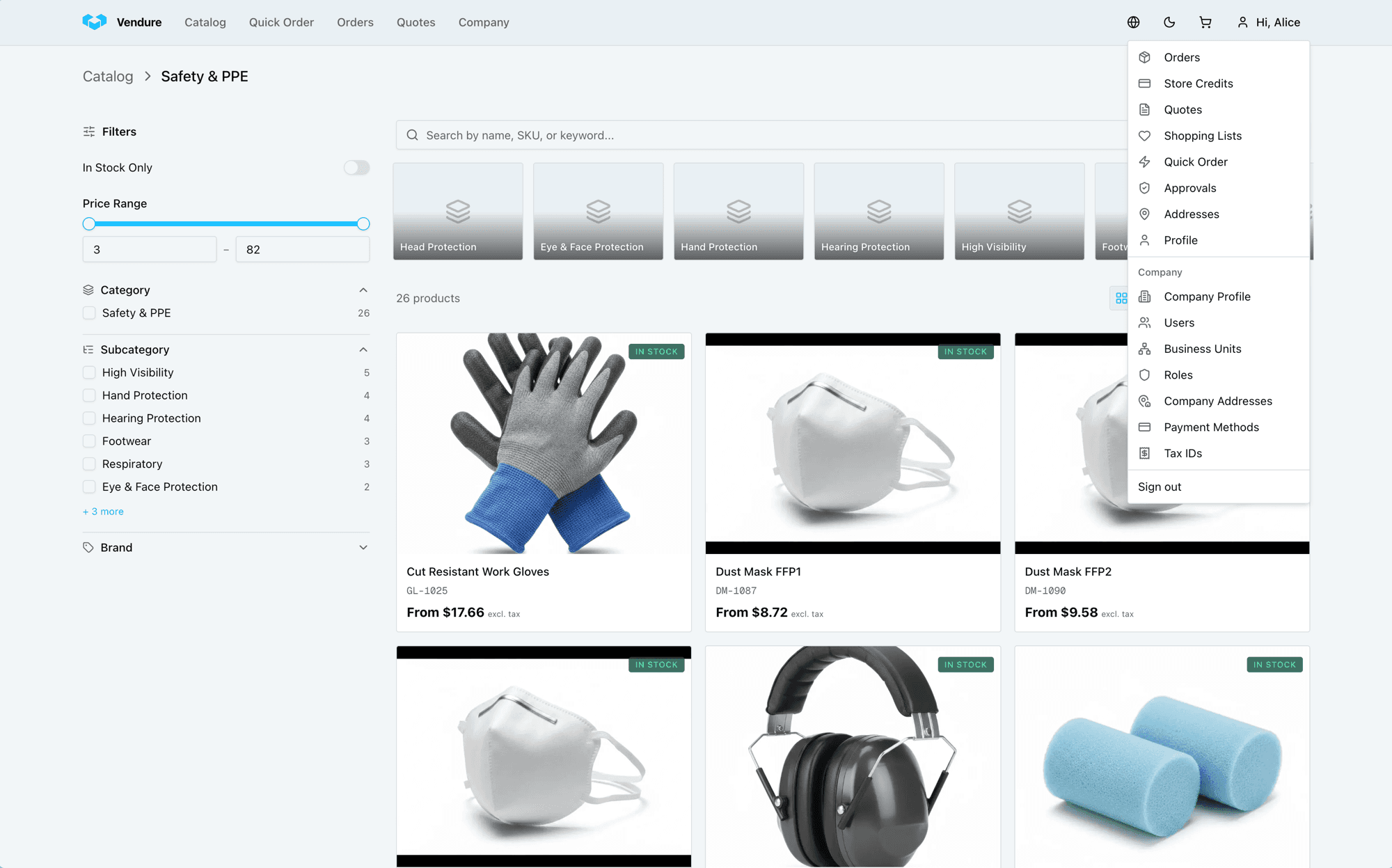
A storefront your customers actually use
Every one of these storefronts is a real, buyer-ready application, not a template you fight with. Company accounts, quotes, approvals, quick order, and multi-step checkout: the flows B2B buyers expect, wired to a surface your team owns and can change.
Launch a new brand or market on a storefront that already works, on a codebase your team controls. No proprietary frontend runtime between you and the experience your customers see.
One codebase, every business model
The storefront ships reference scenarios on one codebase, configured rather than forked. Hybrid businesses run B2B and B2C from the same code, scoped by the authenticated buyer.
Teams building complex commerce with Vendure.





Under the hood: one deployment, or a tenant per deployment
Most programmes run every brand, region, and segment on one deployment, sharing one Vendure Dashboard and one catalogue. When a business unit needs hard data isolation, Vendure can also run as one codebase with a separate instance and database per tenant, on the same upgrade path.
The two patterns compose. A multi-tenant deployment can still run multiple brands inside each tenant, so you match the isolation to the requirement rather than the other way round.
What teams ask about running multiple brands and markets
Common questions from operations and ecommerce teams sizing a multi-brand, multi-region, or hybrid rollout on Vendure.