Vendure vs Intershop
Intershop packages deep B2B and runs it as a cloud service. This comparison is about teams that need to own the code and choose where it runs.
The short answer
Choose Vendure when
- A funded ICM upgrade or a storefront rebuild onto the PWA is already on the table
- You need to run on infrastructure you control, outside Intershop's cloud
- You want code-level control of the commerce logic
- You want a published price rather than packages without prices
Choose Intershop when
- The packaged B2B processes already run in Intershop and fit how you sell
- One vendor for software and operations matters more than code-level control
- Nobody, in house or at a partner, will own commerce logic as code
The biggest pain points on Intershop, and how Vendure solves them
Customisation without the release-cycle tax
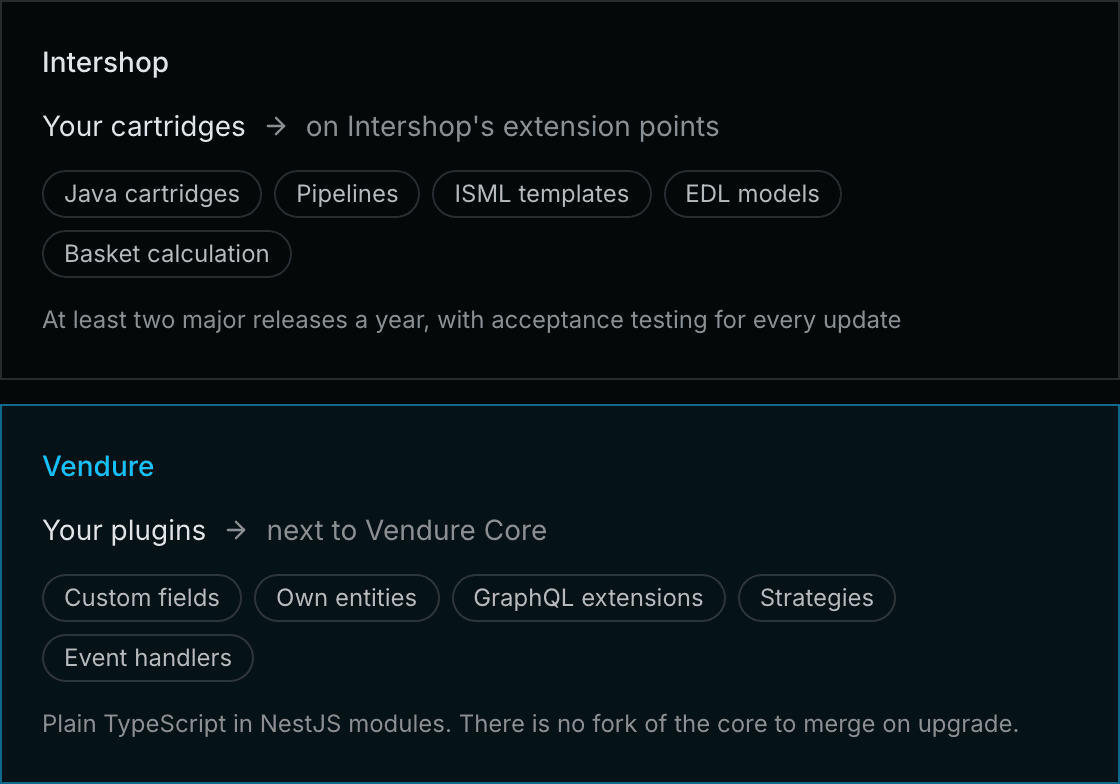
Intershop customisation means Java cartridges on Intershop's extension points, with at least two major releases a year that can include breaking changes and acceptance testing for each update. Vendure plugins are NestJS modules beside the core, with strategies, custom fields that propagate into the GraphQL schema, custom entities and typed events. Your business logic is first-class code rather than something to re-validate every release.
A published price that follows complexity
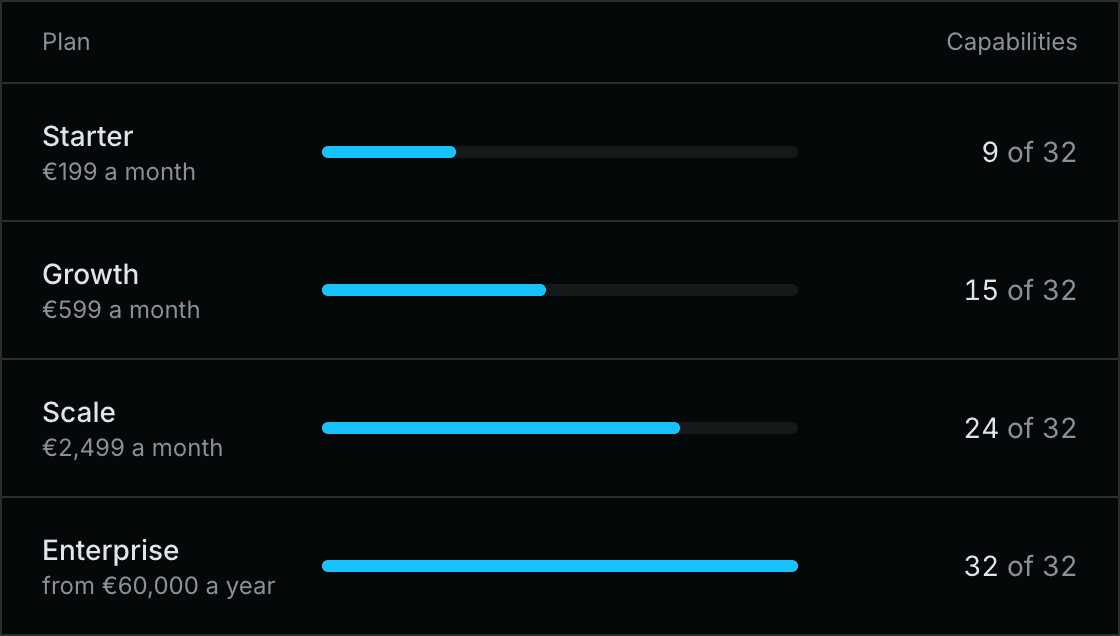
Intershop sells the platform as a SaaS/PaaS subscription in packages with optional add-ons, and its service description lists them without prices. Vendure Core is free under GPLv3, and the plans are a flat monthly fee up to Scale with Enterprise a flat annual one. The prices are published, with no revenue share and no per-order surcharge, so growing the top line is not a reason for the platform bill to move.
Deployment choice and code ownership
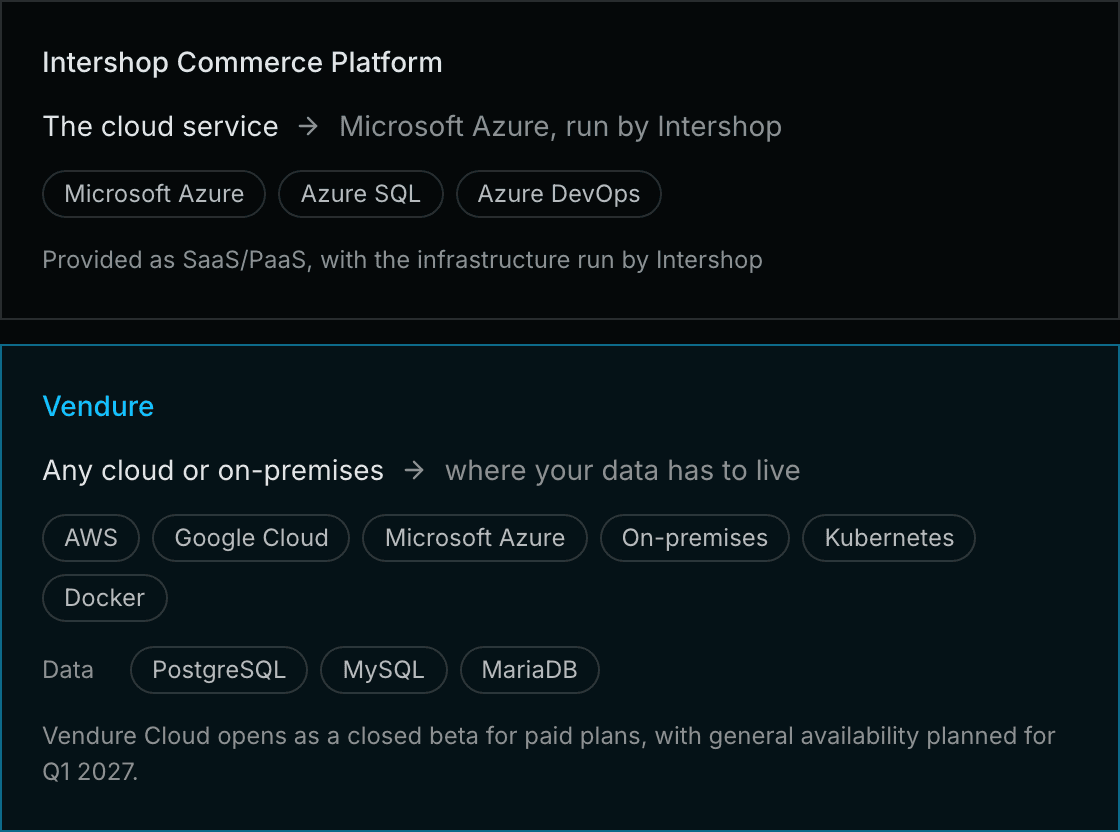
Intershop provides the platform as SaaS/PaaS on Microsoft Azure and runs the applications, infrastructure and operations. Vendure self-hosts in any region, on any cloud or on-premises today. The GPLv3 core cannot be revoked, the plugin-licence exception keeps your customisations proprietary, and your data sits in your own SQL database.
How they compare
Six dimensions, the same six on every Vendure comparison page. Intershop's service description lists its packages without prices, so this page describes how the platform is sold rather than what it costs. Every claim about Intershop is sourced at the foot of this page.
| Dimension | Vendure | Intershop |
|---|---|---|
| Architecture and extensibility | VendureTypeScript end to end on NestJS, with GraphQL Shop and Admin APIs. Plugins sit beside the core. No forks, no extension cap. | IntershopA Java platform, Intershop Commerce Management, extended through cartridges of Java code, pipelines and ISML templates, with REST APIs. At least two major releases a year can include breaking changes, and acceptance testing is required for each update. |
| Licensing and cost model | VendureFree open-source core under GPLv3. Four flat, cumulative plans from €199 a month on a 12-month term, with Enterprise from €60,000 a year. No GMV, per-order or per-user fees. | IntershopSold as a SaaS/PaaS subscription in packages with optional add-ons. Intershop's service description (August 2023) lists them without prices. |
| B2B depth | VendureCompany accounts and quotes from Starter. Organization hierarchy at Growth. Contract pricing, single-level order approvals, the audit log and the Next.js B2B storefront at Scale. PunchOut (cXML), Configurator and multi-level approvals with timeouts and delegation at Enterprise. | IntershopAn extensive packaged B2B model with cost centres, user and cost centre budgets, order approval, requisitions, quotes, order templates, quick order, and OCI and cXML punchout. |
| Hosting and operations | VendureSelf-host on any cloud or on-premises, in any region. Managed Vendure Cloud is planned for Q1 2027, with a base set of Cloud resources in each paid plan. | IntershopProvided by Intershop as SaaS/PaaS on Microsoft Azure. Intershop runs the applications, infrastructure and operations, and customers deploy through its DevOps tooling. |
| Ecosystem and talent | VendureMainstream TypeScript, Node and GraphQL. No proprietary skill silo. | IntershopA partner network of more than 3,500 Intershop experts. The storefront is the Angular-based Intershop PWA, and the platform skills are Intershop-specific rather than transferable. |
| Migration effort | VendureThe catalogue imports through the Admin API; customers and order history move by script. The storefront is rebuilt on the GraphQL API or starts from the Next.js B2B storefront included at Scale. | IntershopScoped per project. The catalogue, customers and orders export as XML, while the cartridges and pipelines are Intershop-specific and get reimplemented. |
Vendure pricing: a free open-source core, then four flat tiers
Vendure Core is free under GPLv3. Starter, Growth, Scale and Enterprise add B2B capabilities cumulatively, on a flat fee with no GMV, per-order or per-user charges.
Where Intershop is strong
Where Intershop is the better answer, we say so.
B2B focus since 1992
Founded in 1992 and focused on B2B, with more than 300 manufacturers, wholesalers, holding companies and business associations as customers.
An extensive packaged B2B model
Cost centres, budgets, order approval, requisitions, quotes and OCI and cXML punchout.
One vendor for software and operations
Applications, infrastructure and operations from one vendor, with a contractual availability commitment for production.
When teams move from Intershop to Vendure
If an ICM upgrade or a storefront rebuild is already funded, that is the moment to ask whether the platform underneath should stay the same.
A funded ICM upgrade
where the budget is already approved and every customisation needs acceptance testing either way
A storefront rebuild onto the PWA
where a new frontend is being built anyway, so the platform underneath is open to the same question
A requirement to run on your own infrastructure
where a SaaS/PaaS service on Microsoft Azure, operated by Intershop, is not an option
Customisation tied to the release cycle
with at least two major releases a year that can include breaking changes
A budget that needs a published price
where the packages and add-ons are listed without prices
Migration runs in three phases: catalogue, customer and order import from Intershop's XML export, storefront rebuild, then integration cutover. Cartridges and pipelines are reimplemented rather than ported. We scope the effort against what is actually in production rather than quoting a band.
Moving off Intershop?
The catalogue, customers and orders export as XML, so the data travels. The cartridges and pipelines are Intershop-specific, so the custom code is reimplemented rather than lifted and shifted. Migration guides are being written; the hub has what exists today.









Teams building complex commerce with Vendure
Vendure and Intershop, answered
Where the requirement is code-level control, deployment choice and a published price that follows complexity, yes. Where Intershop's packaged B2B processes already run and fit how you sell, and one vendor for software and operations matters more than code-level control, Intershop is the stronger fit.
Vendure Core is free under GPLv3. Four cumulative paid plans sit on top: Starter at €199, Growth at €599 and Scale at €2,499 a month on a 12-month term, with Enterprise from €60,000 a year. Each plan inherits the one below, and there is no GMV charge, per-order surcharge or per-user fee, so growing revenue does not reprice the platform.
Yes. Vendure Core is a complete open-source commerce framework under GPLv3, written in TypeScript on Node.js with GraphQL Shop and Admin APIs. It is free to run and self-host, and the licence cannot be revoked or discontinued for you. The commercial B2B capabilities are separately licensed plugins layered on top of that core. Every paid plan also includes a commercial licence for Vendure Core for your project, as an alternative to GPLv3.
Yes, on any cloud or on-premises, in any region, with your data in your own SQL database. That is what makes EU-mandated and otherwise regulated deployments possible today. Vendure Cloud, our managed hosting, opens as a closed beta for paid plans, with general availability planned for Q1 2027. Each paid plan will include a base set of Cloud resources, and usage above that is billed on top.
Sources (10) · claims last checked 2026
- Intershop Knowledge Base, Commerce Platform system overview: ICM architecture, cartridges and REST APIs · knowledge.intershop.com
- Intershop Knowledge Base, Continuous Releases: at least two major releases a year with breaking changes, and acceptance testing for each update · knowledge.intershop.com
- Intershop Knowledge Base, XML Import and Export Specifications: catalog, customer and order export · knowledge.intershop.com
- Intershop Commerce Platform Service Description, August 2023: SaaS/PaaS on Microsoft Azure, packages and add-ons listed without prices, and the availability commitment · intershop.com
- Intershop Knowledge Base, B2B Storefront Functionality: cost centres, budgets, order approval, requisitions, quotes, order templates, quick order, and OCI and cXML punchout · knowledge.intershop.com
- Intershop PWA on GitHub: Angular storefront, MIT licence, delivered as source code · github.com/intershop/intershop-pwa
- Intershop partners: 3,500+ Intershop experts in the global partner network · intershop.com/en/partners
- Intershop company profile: founded in 1992, B2B focus, more than 300 manufacturers, wholesalers, holding companies and business associations as customers · intershop.com
- Vendure developer documentation: plugins, custom fields, custom entities and supported databases · docs.vendure.io
- Vendure pricing and plans · vendure.io/pricing
