What Is Headless Commerce? A Complete Guide
Most ecommerce platforms ship the storefront and the backend as one program. That bundle is convenient right up to the day your team wants to redesign the storefront without re-testing checkout, launch a mobile app, or move the frontend to the edge for speed. Headless commerce removes that constraint by splitting the two apart. Adoption is well past the early-adopter phase: in WP Engine's State of Headless 2024 survey, 73% of businesses said they already use a headless architecture, and 98% of those not yet using it planned to evaluate it within a year.
This guide explains what headless commerce is, how it works, how it compares to traditional and composable commerce, where it pays off, what it costs you, and how to tell whether it fits. It is written for the engineers and technical leaders who have to make the call, and it stays platform-neutral, with links through to how Vendure approaches the backend where that is useful.
What is headless commerce?
Headless commerce is an architecture that separates the storefront, the part customers see and interact with, from the commerce backend that runs products, pricing, carts, orders, and customers. The two communicate over an API instead of living in one codebase, so each can be built, changed, and scaled on its own.
The name comes from the split. The "head" is the presentation layer: the website, app, or any other interface a customer touches. The "body" is the commerce engine underneath. In a headless setup you remove the head from the body and let an API sit between them. The backend exposes data and operations (a product catalogue, a cart, a checkout) through that API, and any number of frontends consume it. Take the head off and the same backend can serve a website today and a mobile app tomorrow without a rebuild underneath.
This is a direct answer to the limits of traditional platforms, where fusing the frontend and backend into one system meant that changing the storefront, adding a channel, or adopting a new framework all reached back into the commerce core.
How headless commerce works
A headless system has three parts: the frontend, the API, and the backend.
The backend owns the commerce logic and data. It manages the catalogue, calculates prices and promotions, holds carts, processes orders, and stores customer records. It is the single source of truth, and it does not render any pages.
The API is the contract between the two sides, usually REST or GraphQL. GraphQL is a common choice for commerce because the frontend can request exactly the data a page needs in one round trip, which cuts over-fetching and speeds up rendering. The API is also where authentication, rate limiting, and request shaping live, so those policies stay consistent across every channel.
The frontend consumes the API and decides what the customer sees. Because it is just an API client, you can build it in any framework (React, Vue, Svelte) and host it anywhere, including a CDN or the edge, independently of the backend.
The mechanics of decoupling, rendering strategies, caching, and migration patterns, go deeper than this overview. For the technical view, see the headless architecture guide.
Headless vs. traditional (monolithic) commerce
A traditional, or monolithic, platform bundles the frontend and backend into one tightly integrated system: one codebase, one deployment, one set of features. It is simpler to stand up and manage, which is exactly why it dominated for years. The cost is rigidity. Because the storefront and the commerce logic are fused, a change to one side usually means touching and re-testing the other, and the storefront design is bounded by what the platform's templating allows.
| Dimension | Headless commerce | Traditional (monolithic) commerce |
|---|---|---|
| Frontend and backend | Decoupled, connected over APIs | Bundled in one codebase |
| Storefront freedom | Any framework, any design | Bounded by the platform's themes |
| Channels | One backend serves many frontends | Built primarily for the web store |
| Change cadence | Ship frontend and backend independently | Changes ripple across the whole system |
| Scaling | Scale frontend and backend separately | Scale the whole platform together |
| Setup effort | Higher: you build the frontend | Lower: storefront comes included |
| Best fit | Custom UX, omnichannel, complex requirements | Standard storefronts, simpler needs |
The practical takeaway: headless trades day-one simplicity for long-run flexibility. If a packaged storefront covers your needs, a traditional platform is cheaper and faster. The case for headless starts when the bundle becomes the bottleneck.
Ready to build? The Vendure docs cover architecture, setup, and extension from day one.
Read the docsHeadless vs. composable commerce (and MACH)
Headless and composable are often used interchangeably, but they describe different things, and the difference matters when you choose a backend.
Headless decouples the frontend from the backend. Composable commerce takes that idea further down the stack and also breaks the backend itself into separate services, search, cart, pricing, promotions, fulfilment, each chosen independently and wired together over APIs. This is the approach often labelled MACH (Microservices, API-first, Cloud-native, Headless). Every composable system is headless; not every headless system is composable.
The distinction matters because the trade-offs are not equal. Decoupling the frontend is almost always worth it. Fragmenting the backend into a dozen separately hosted services is a decision with a standing operational cost: more systems to deploy, secure, version, monitor, and keep in sync. For many teams, especially those with complex B2B or omnichannel requirements, the better pattern is a decoupled frontend over one coherent, extensible backend: headless, without the microservice sprawl. Vendure is built on this model: one commerce backend you extend with plugins and expose through a single API, instead of a stack of services you assemble and operate yourself.
Composable was sold on an appealing promise: assemble best-of-breed vendors like modules on a shared bus, a search vendor here, a pricing vendor there, each swappable whenever you like. For most teams it has proved less efficient than advertised. You end up managing commercial contracts with a dozen vendors and integrating a dozen APIs that each change on their own schedule. Every one of those changes is integration work, and you are betting on your platform vendor to keep the connectors current fast enough that nothing breaks. The plug-and-play picture rarely survives contact with production.
The pattern we advocate is easier to reason about: decouple the frontends, consolidate the backend on a modern, scalable stack. Keep the freedom where it pays off, in the experiences you build, and keep the coherence where fragmentation hurts, in the one commerce engine they all depend on.
As Vendure's CTO and co-founder Michael Bromley puts it:
The mistake I see most often isn't going headless, it's confusing a decoupled frontend with a decoupled backend. Splitting the storefront from the commerce engine is almost always the right call. Splitting the engine itself into a dozen separately run services usually isn't. Decouple the frontends, consolidate the backend on a modern stack, and you get the flexibility without inheriting an integration project that never ends.
Benefits of headless commerce
Decoupling the storefront from the backend pays off in several ways at once.
Omnichannel reach
With the commerce logic behind an API, a single backend can serve a website, a mobile app, in-store kiosks, voice assistants, and social or AI-driven channels, all reading the same catalogue, pricing, and inventory. Customers see consistent information wherever they are, and their cart and history stay in sync across the journey. This is where headless earns its keep.
Performance and speed
Because the frontend is independent, you can build it for speed (server-side rendering, static generation, edge delivery) without waiting on the backend. Faster pages convert better, and a headless frontend gives you direct control over the levers that drive page speed.
Developer and design freedom
Headless lets your team pick the frontend stack it already knows and design a storefront without fighting a template system. The result is a distinctive, custom experience rather than a themed variation everyone else also ships.
Cleaner integrations
An API-first backend slots into the systems you already run, ERP, PIM, CMS, search, and analytics, through well-defined interfaces instead of bolt-on plugins. A headless CMS handles content while the commerce backend handles transactions, each doing what it is best at.
Future-proofing
New channels and frameworks arrive as new frontends against the same API, not as a re-platform. Swapping the storefront, or adding a second one, does not disturb the commerce core, so the architecture absorbs change instead of resisting it.
Headless commerce and AI agents
The next shift in commerce is agentic: AI assistants that browse, compare, and buy on a customer's behalf. It runs on the same foundation headless already stands on. Agentic commerce is API-first, and headless commerce is API-first, so a platform designed to be headless from day one does not care whether a request arrives from a web storefront, a mobile app, or an autonomous agent. They are all just clients of the same API.
That is a structural advantage a headless mode bolted onto a monolith struggles to match. When your commerce logic already lives behind a clean, complete API, you are most of the way to being agent-ready. Vendure is building on exactly that foundation, with agentic capabilities arriving across its open-source and commercial products.
Complex B2B and B2C on one adaptable, headless ecommerce platform.
Explore Vendure CoreThe trade-offs of going headless
The benefits are real, and so are the costs. An honest evaluation weighs both.
You build and own the frontend. A traditional platform hands you a storefront; headless hands you an API. That means frontend development, ongoing maintenance, and a team comfortable with a modern JavaScript framework and API integration. This is the single most underestimated cost of going headless: building a production storefront from a blank page is a substantial project in its own right, and misjudging it is how headless builds blow through budget or stall. The fix is to not start from scratch. Begin from a solid reference instead: Vendure provides an open-source storefront starter built on Next.js, and a production-ready storefront you can adopt directly. Even teams that build on a different stack benefit from a reference that shows how the pieces wire together, which removes the guesswork from the riskiest part of the project.
SEO moves onto you. Packaged platforms ship meta tags, sitemaps, and crawlable URLs by default. With headless you need server-side rendering or static generation so search engines can index the storefront properly. It is a solved problem, but it is now your problem.
More moving parts. Separate frontend and backend deployments, an API contract to version, and caching at several layers all add operational surface compared with a single bundled system.
The backend-fragmentation trap. Headless freedom is easy to over-read as "assemble a separate service for every concern." Going fully composable before you need to multiplies the systems your team has to run. Decouple the frontend first; fragment the backend only when a specific requirement justifies it.
If none of the benefits above press on you, and a packaged storefront covers your needs, a traditional platform is likely the better, cheaper choice. Headless is worth its complexity when the constraint it removes is one you actually feel.
Headless commerce examples
Headless shows up wherever the storefront has to do something a packaged theme cannot, or the same backend has to feed more than one channel. A few common shapes:
- Omnichannel retail across locations. One backend serves a website, an app, and in-store pickup, with inventory and pricing consistent everywhere. Sweden's ice cream delivery brand Hemglass runs exactly this: it moved off a stretched WooCommerce setup onto Vendure to unify 28 franchise owners behind one brand-consistent click & collect experience, with local inventory per franchise and integrations into CRM, POS, payments, and route planning, and zero peak-traffic outages since launch.
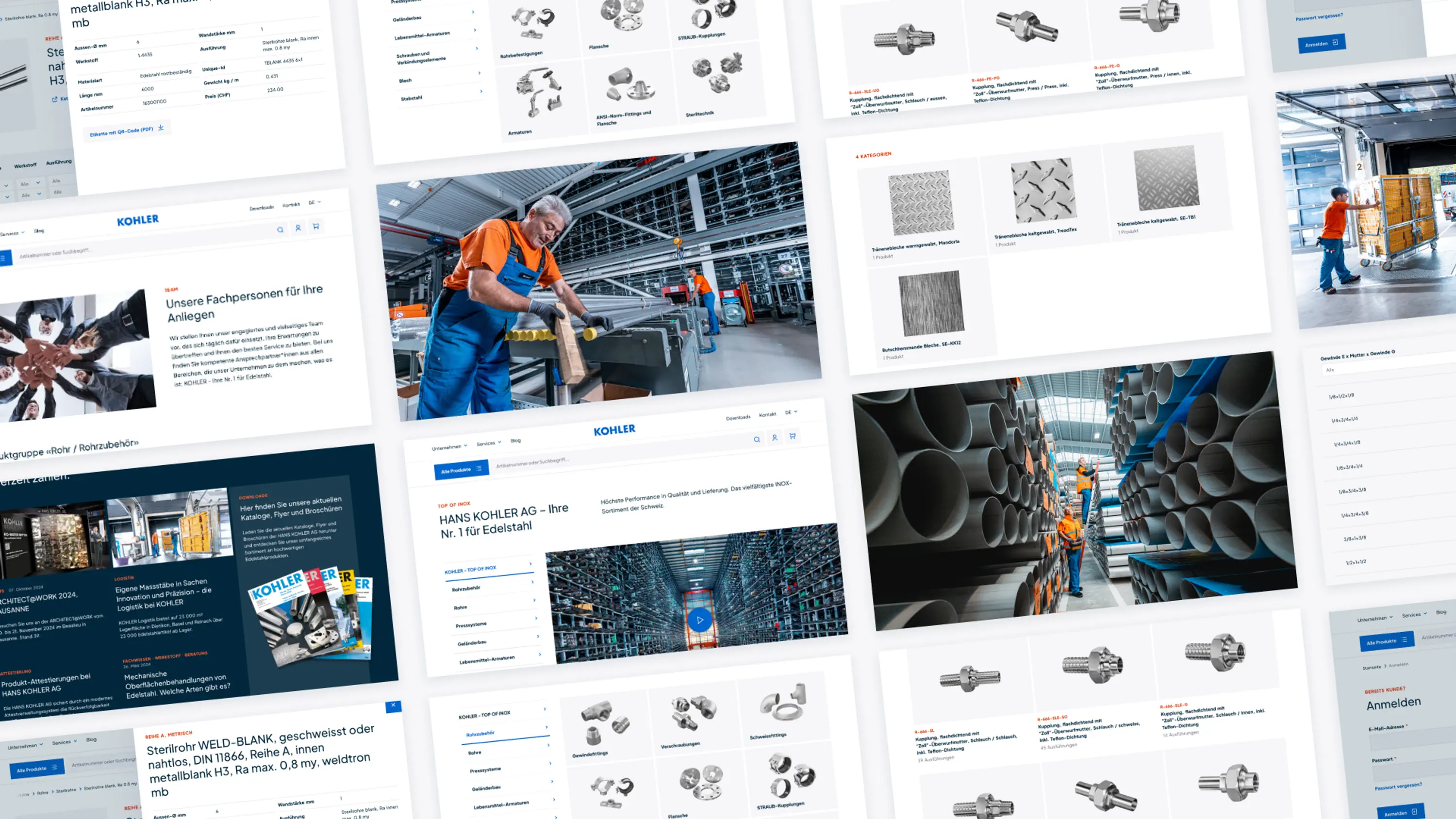
- Complex B2B and B2B2C. A supplier runs customer-specific pricing, configurable products, and ERP integration behind a custom storefront, often serving business and consumer customers from the same backend. Switzerland's largest stainless steel supplier, HANS KOHLER AG, replaced a manual phone-and-fax process with a headless Vendure platform that handles per-customer rates, cut-to-spec products, and Microsoft ERP sync, and lifted daily orders 15 to 20%.
- Brand-led D2C experiences. Direct-to-consumer brands go headless to build distinctive, fast storefronts, custom checkout flows, content-rich product pages, edge rendering, that a templated platform cannot express.
- New and emerging channels. Voice ordering, kiosks, social commerce, and AI shopping assistants all consume the same APIs as the website, so a new channel becomes a new frontend rather than a new platform.
When headless commerce is the right choice
Headless is a means, not a goal. It earns its added complexity when one or more of these is true:
- You need a custom storefront experience your current platform's themes cannot deliver.
- You sell, or plan to sell, across multiple channels from one source of truth.
- Page speed matters enough to justify owning the frontend stack.
- Your requirements are complex (B2B pricing, configurable products, multi-region, marketplace) and a packaged platform forces awkward workarounds.
- You want to change one part of the stack, a storefront, a pricing rule, an integration, without re-platforming the whole thing.
- You have, or can build, the frontend engineering capability headless assumes.
If few of these apply, a traditional platform will likely serve you better for less. A small or mid-sized business selling classic D2C products, fashion, footwear, and the like, with straightforward processes and no plan to add a second storefront, a mobile app, or a B2B customer portal, usually has little to gain from headless and a real cost to carry. The strongest signal for headless is a constraint you are already hitting, not a trend you are following.
Worth reading, once a month
Product updates, customer stories, and engineering thinking, delivered monthly.
How to get started with headless commerce
Once you have decided headless fits, the sequence is straightforward, and the most important decision comes first.
- Choose the commerce backend. This is the decision that matters most. The frontend you can swap later; the commerce engine is far harder to replace. Look for an API-first design (GraphQL or REST), extensibility without forking the core, omnichannel support, and production-grade B2B capability if you sell to businesses.
- Choose the frontend framework. Pick the stack your team knows (React with Next.js, Vue with Nuxt, or similar) and a rendering strategy that keeps the storefront fast and crawlable.
- Add a headless CMS if you need rich content. Let the commerce backend own transactions and the CMS own content. See the top headless CMS options for ecommerce.
- Plan integrations and migration. Map how the backend connects to your ERP, PIM, search, and payments, and whether you cut over all at once or migrate incrementally. The headless architecture guide covers both migration paths in detail.
When you are ready to evaluate a backend, Vendure is an open-source headless commerce platform: one coherent, extensible commerce core, exposed through a single GraphQL API, with B2B and omnichannel capability built in. For complex business selling specifically, see how Vendure handles B2B commerce.
Frequently asked questions
Headless commerce is an ecommerce architecture that separates the storefront (the part customers see) from the commerce backend that runs products, pricing, carts, orders, and customers. The two communicate over an API, so each can be built, changed, and scaled independently of the other.
Traditional (monolithic) commerce bundles the storefront and backend into one tightly integrated system, which is simpler to run but harder to customise. Headless decouples them and connects them over APIs, so you can build any frontend, serve multiple channels, and change one side without re-testing the other. Headless trades day-one simplicity for long-run flexibility.
No, though they are related. Headless decouples the frontend from the backend. Composable commerce goes further and also breaks the backend into separate, independently chosen services (the MACH approach). Every composable system is headless, but not every headless system is composable. You can run a headless frontend over a single coherent backend without fragmenting it into microservices.
Not necessarily, but they pair well. A headless commerce backend manages transactions (catalogue, cart, orders), while a headless CMS manages editorial content (landing pages, articles, campaigns). Teams that need rich, frequently updated content usually run both, each through its own API. Teams with light content needs can rely on the commerce backend alone.
The main benefits are omnichannel reach (one backend serving many frontends), better performance (you control the frontend and can render at the edge), design and developer freedom (any framework, any storefront design), cleaner integrations with systems like ERP and PIM, and future-proofing, since new channels arrive as new frontends rather than re-platforms.
Headless asks more of your team. You build and maintain the frontend, take ownership of SEO concerns like server-side rendering, and run more moving parts than a single bundled platform. There is also a temptation to over-fragment the backend into too many services. For simple storefronts without these pressures, a traditional platform is usually cheaper and faster.
It depends on the requirements, not the company size. If a packaged platform covers your storefront and you do not need custom UX, multiple channels, or complex logic, traditional is likely the better value. If you have specific needs a template cannot meet, or expect to grow into multiple channels, starting headless can avoid a costly migration later.
Common cases include omnichannel retailers serving web, app, and in-store from one backend; complex B2B suppliers running custom pricing and ERP integration behind a bespoke storefront; and D2C brands building distinctive, fast experiences. Real examples include Hemglass, which unified 28 franchisees on one click & collect platform, and steel trader HANS KOHLER AG, which unified B2B and B2C on a headless platform.
Conclusion
Headless commerce is an architectural choice that removes one specific constraint: the coupling between your storefront and your commerce backend. When that coupling is your bottleneck, splitting the two apart buys you the freedom to build any experience, serve any channel, and change one part of the stack without disturbing the rest. When it is not, a traditional platform is simpler and cheaper, and that is the honest answer. The principle worth carrying forward keeps the upside and drops the trap: decouple the frontends, consolidate the backend on a modern, scalable stack.
The decision that outlasts the rest is the backend you build on. If you are evaluating one, see how Vendure approaches headless commerce, a single extensible core with B2B and omnichannel built in, or talk to us about your requirements and we will walk through them with you.
Share this guide
Build on a headless commerce platform you own
Vendure is the complete, headless ecommerce platform for complex B2B. Replace fragile workarounds and fragmented stacks while keeping the systems your business already runs.