The Top 5 Headless CMS for Ecommerce: Building Content-Rich Commerce Experiences in 2026
Choosing the best headless CMS for ecommerce is one of the first architecture decisions you make after committing to decoupled commerce, and it shapes how your content and commerce teams work together for years. The case for going headless is well established: in WP Engine's State of Headless 2024 research, 82% of respondents said headless architecture makes it easier to deliver a consistent content experience, and 80% said it supports efficient content reuse across channels.
If you run a headless commerce engine like Vendure, pairing it with the right CMS lets your marketing team own rich content while developers keep full control of the commerce logic. The five platforms here, Storyblok, Strapi, Payload, Sanity, and DatoCMS, are the ones we see paired with Vendure most often in conversations with our users and customers, and below we cover how each one connects to your commerce backend.
Headless CMS for ecommerce at a glance
| CMS | Best for | Hosting | Standout with Vendure |
|---|---|---|---|
| Storyblok | Visual editing, mixed-skill teams | SaaS | Official Vendure plugin to pick products and categories in-editor |
| Strapi | Self-hosting and open-source control | Self-hosted | Full TypeScript, matching Vendure's stack |
| Payload | Code-first, Next.js-native teams | Self-hosted or serverless | Config-as-code alongside Vendure's plugin architecture |
| Sanity | Real-time editorial collaboration | SaaS | GROQ querying for complex product content |
| DatoCMS | Enterprise simplicity, proven in B2B | SaaS | GraphQL-first, powers HANS KOHLER AG on Vendure |
Why your headless commerce stack needs a dedicated CMS
Traditional ecommerce platforms bundle content management into the commerce application, which limits how far you can customise either side. A headless CMS separates the two concerns so they can scale and evolve independently. In practice that means content and commerce ship on their own schedules, a problem in one system is less likely to take down the other, and editorial and engineering teams each work in tools built for their job.
That separation matters most when the commerce side is complex. If you are managing B2B pricing, customer hierarchies, or multi-vendor marketplaces, scenarios where Vendure is a strong fit, a dedicated CMS lets marketers build content-rich experiences without touching commerce logic, and lets developers extend that logic without breaking the storefront.
Performance is part of the appeal too. Serving cached, CDN-delivered content separately from dynamic commerce data is one of the main reasons teams move to a headless architecture, and getting that split right is where most of the speed benefit comes from. We come back to how to do that in the integration section below.
Ready to build? The Vendure docs cover architecture, setup, and extension from day one.
Read the docsThe 5 best headless CMS platforms for ecommerce
1. Storyblok: visual editing with an official Vendure plugin
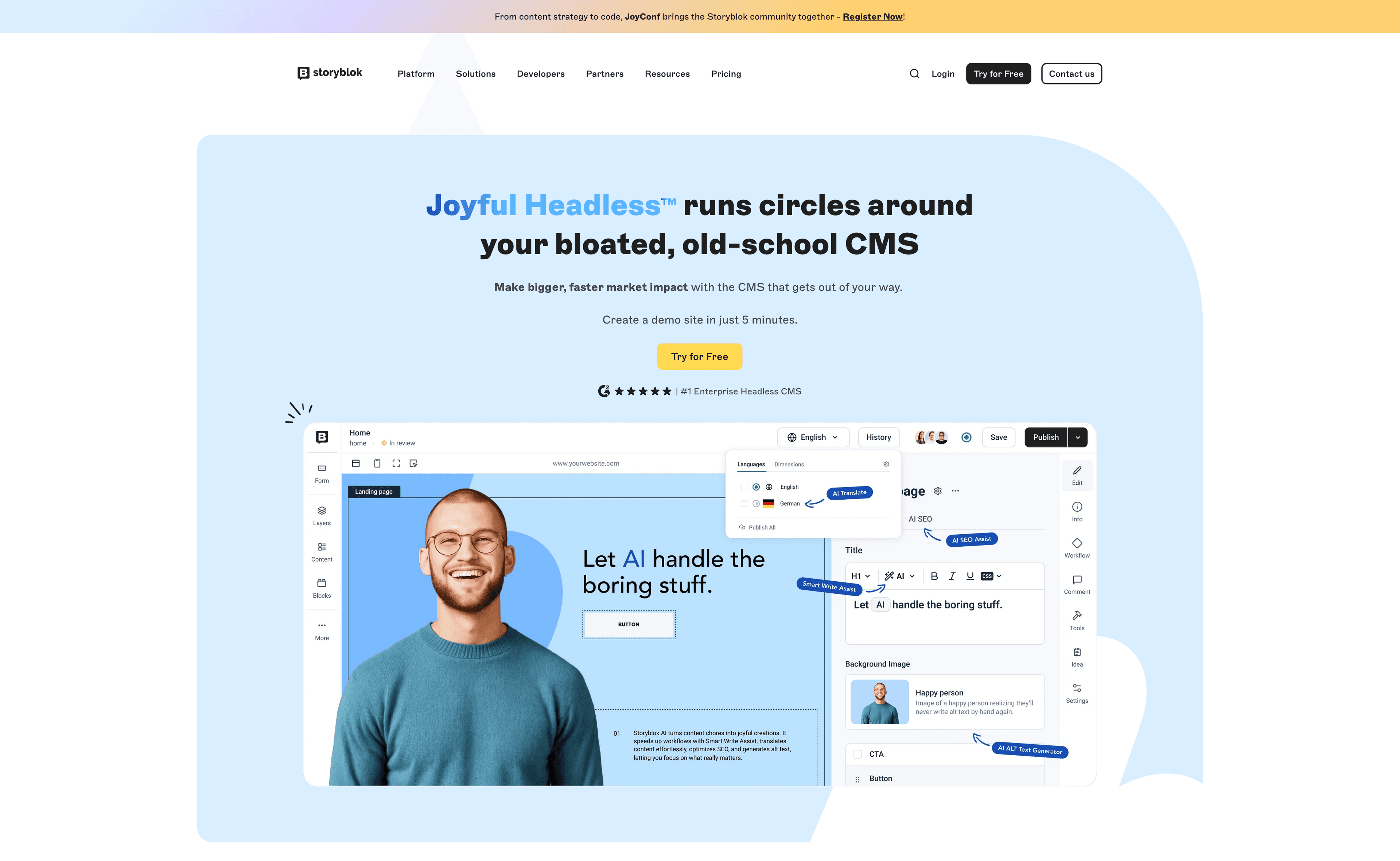
Storyblok is a visual-first headless CMS with an API-first architecture. For Vendure users, its stand-out feature is the official Vendure plugin, which lets content editors pick products and categories from a Vendure instance directly inside Storyblok.
The plugin works through field types that query your Vendure GraphQL API. After installing it, you create a new field of the plugin type in a block and set the custom type to sb-vendure. Content and commerce data stay in sync without custom middleware.
Strengths for ecommerce teams:
- Real-time collaboration for distributed editorial teams
- Component-based content modelling that maps to modern frontend frameworks
- Strong localisation for multi-market commerce
- Visual preview that shortens content iteration cycles
For teams with marketing, product, and development stakeholders all touching the same pages, Storyblok's collaborative editing keeps them out of each other's way.
2. Strapi: open-source, self-hosted control
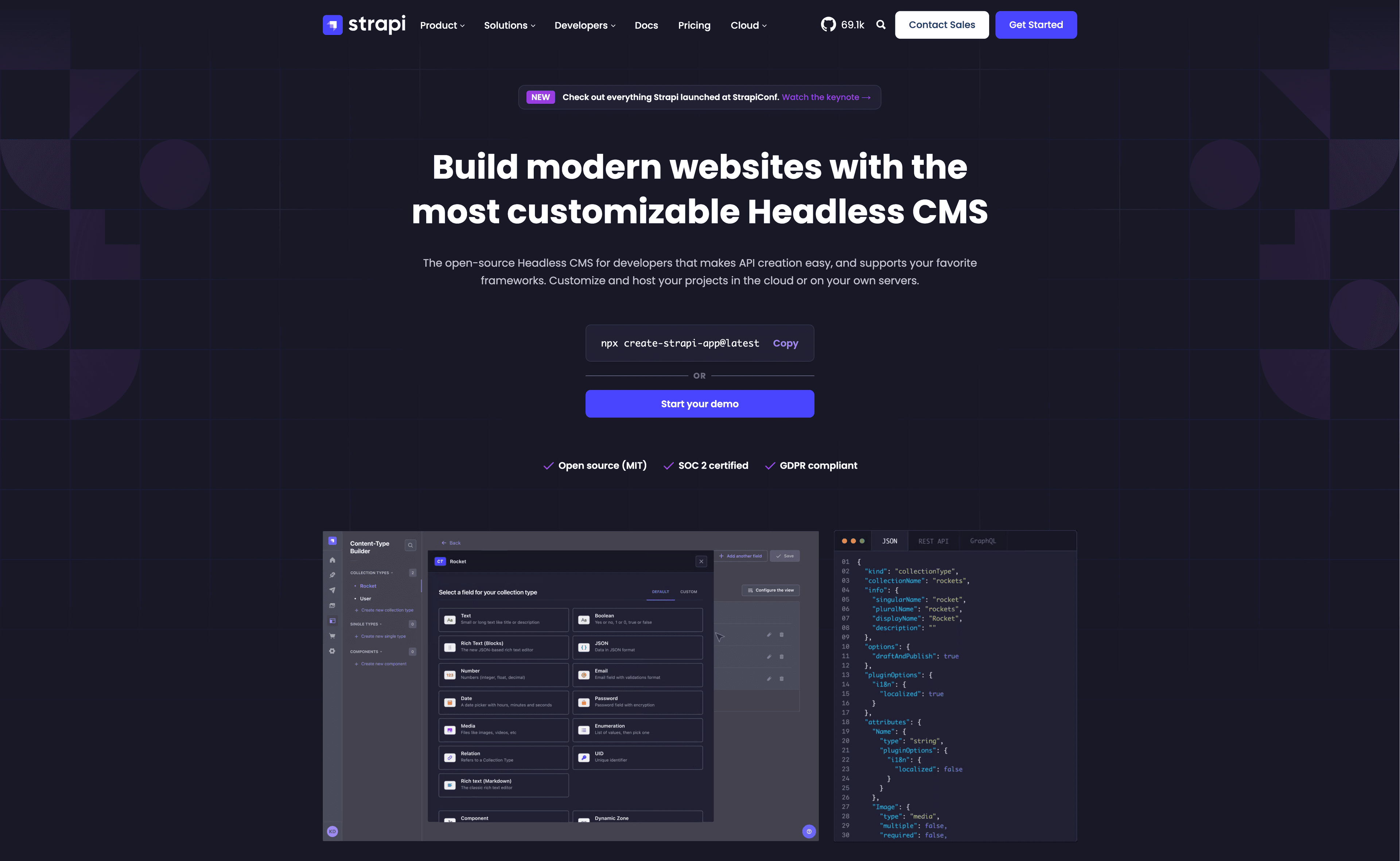
Strapi is the most widely adopted open-source headless CMS, and it gives you full ownership of your content infrastructure. Strapi 5 moved to a fully TypeScript codebase and added improved draft and content-history management, stronger internationalisation, and a larger plugin ecosystem.
For teams with data-sovereignty requirements, common in regulated B2B sectors, Strapi's self-hosting means your content never has to leave infrastructure you control. That fits naturally with Vendure, which is also open source and self-hostable.
Strengths for ecommerce teams:
- Full TypeScript support, matching Vendure's stack
- Self-hosting for complete data control
- A plugin ecosystem for extending the admin and API
- Both GraphQL and REST APIs
Teams already working in Node.js and TypeScript will find Strapi familiar, which shortens the path to integrating it with Vendure's GraphQL APIs.
3. Payload: TypeScript-native and code-first
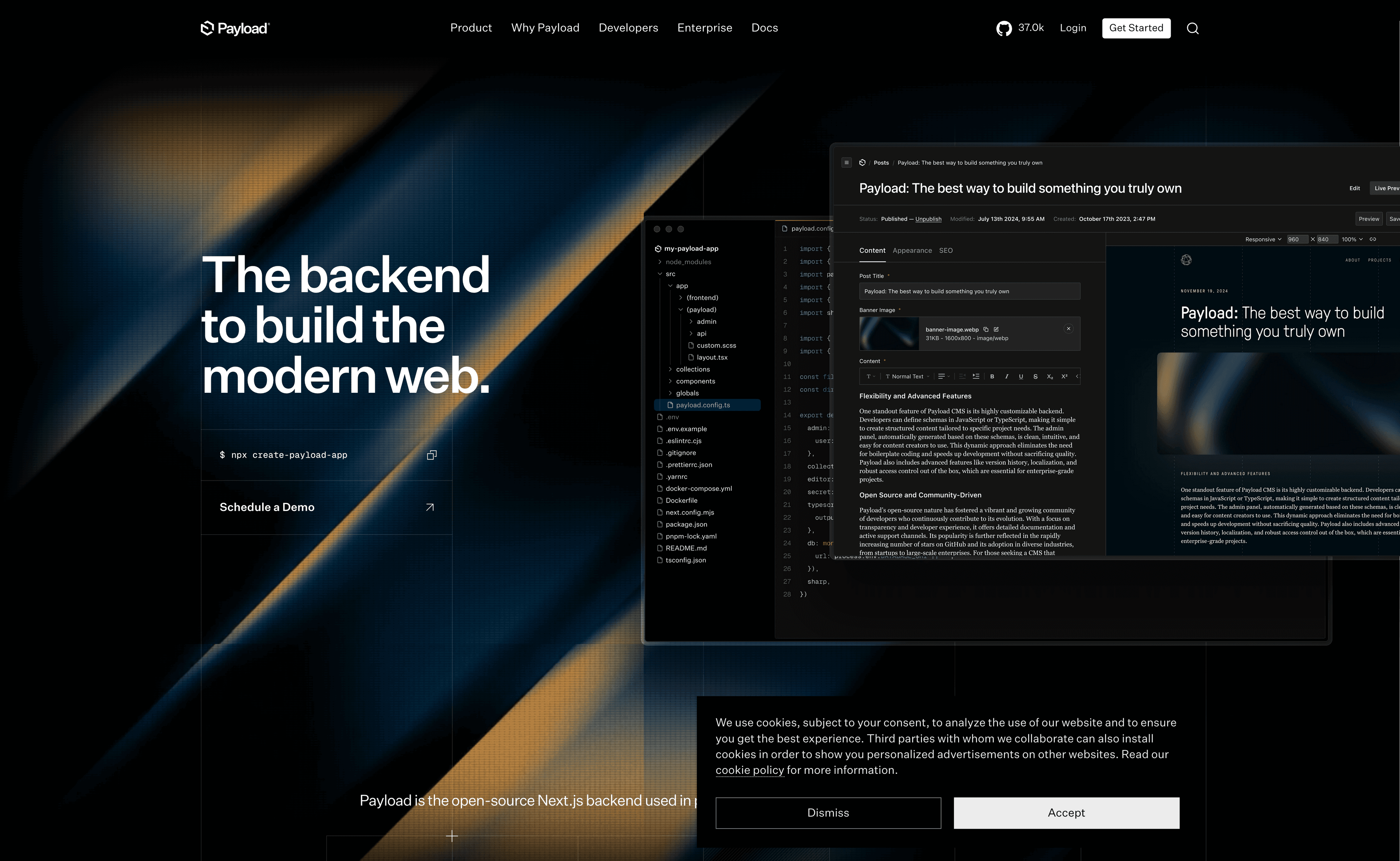
Payload is a code-first, TypeScript-native headless CMS aimed at developers who want to configure content models in code rather than through a UI. As a Next.js-native CMS, it can run inside your existing Next.js application rather than as separate infrastructure.
Configuration-as-code keeps your content models in version control alongside the rest of your codebase. Paired with Vendure's plugin architecture, that gives developer teams a consistent, code-first workflow across both content and commerce.
Strengths for ecommerce teams:
- Native TypeScript throughout, matching Vendure's architecture
- Self-hostable, with serverless deployment options
- Built-in authentication using secure HttpOnly cookies
- Code-first, version-controlled content schemas
For highly customised B2B platforms or subscription models, where Vendure's extensibility is a draw, Payload is a natural content companion.
4. Sanity: real-time collaboration and flexible modelling
Sanity is a headless CMS known for real-time collaboration and a highly flexible content model. Its GROQ query language gives precise control over how content is retrieved, which is useful for complex product catalogues and multi-variant content.
Sanity's customisable Studio and broad integration ecosystem make it a good fit for content-heavy commerce where storytelling drives conversion.
Strengths for ecommerce teams:
- Real-time collaboration for distributed teams
- The GROQ query language for complex content relationships
- A customisable content Studio for tailored editorial workflows
- A broad integration ecosystem
For enterprises managing rich product content across markets, where Vendure's multi-channel support comes in, Sanity provides matching content infrastructure.
5. DatoCMS: enterprise simplicity, proven in B2B
DatoCMS is an API-first SaaS headless CMS focused on enterprise simplicity. All content is available through a GraphQL API, which lines up cleanly with Vendure's GraphQL-first architecture and makes it straightforward to query content and product data together.
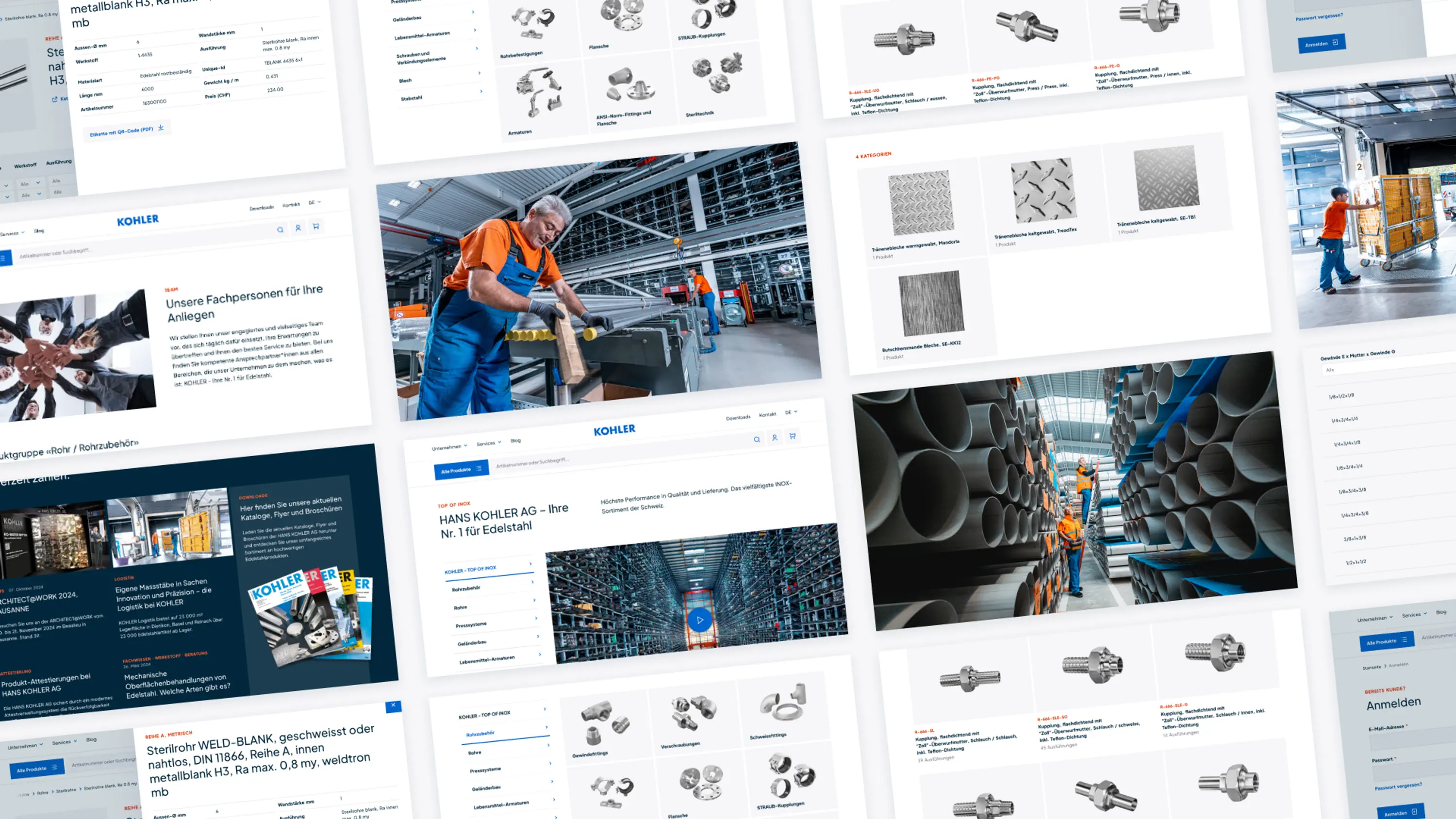
It has been proven in demanding commerce environments. HANS KOHLER AG runs DatoCMS for content management on its B2B/B2C steel-trading platform built on Vendure.
Strengths for ecommerce teams:
- Structured content well suited to complex product information
- Advanced localisation for global commerce
- Robust media management for product imagery
- Enterprise-grade security and compliance
The HANS KOHLER AG project shows DatoCMS and Vendure handling real B2B requirements together, including customer-specific pricing, configurable products, and multi-currency operations, and contributed to a 15-20% increase in daily orders.
Technical integration considerations
Whichever CMS you choose, compatibility with your headless commerce platform is what makes or breaks the project. All five platforms here expose GraphQL APIs, which pairs well with Vendure's GraphQL-first architecture.
The reliable way to connect the two is to keep each system as the source of truth for its own data and link them by reference. Vendure stays authoritative for products, prices, and stock; the CMS owns layout and editorial content. Say you want a product carousel managed in the CMS: you give editors a dynamic select field wired to Vendure's API so they pick real products, and you store only the product IDs in the CMS. The frontend then reads those IDs from the CMS and fetches the live product data straight from Vendure, so prices and availability are always current instead of going stale in a second copy. Vendure's CMS integration guide shows how to build a plugin that automates this sync through Vendure's event bus, and the same approach works whichever CMS you land on.
A few more patterns to plan for:
API federation: Many teams put an API gateway in front of the CMS and commerce APIs so a single query can fetch both content and product data. Vendure's extensible GraphQL schema makes this straightforward.
Caching and performance: Cache static CMS content aggressively at the edge while keeping dynamic commerce data such as pricing, stock, and carts fresh. Getting this split right is where most of the headless performance benefit comes from.
Content synchronisation: With a direct integration like Storyblok's Vendure plugin, product references stay in sync automatically. For other CMSes, webhook-based syncing keeps content and commerce data aligned without manual work.
Making the right choice
A simple heuristic from what we see work in practice: if your team likes code-first, schema-in-version-control workflows, Payload and Strapi pair most naturally with Vendure's own code-first approach. If you are editorial-heavy and would rather the CMS be hosted for you, Storyblok and Sanity are strong choices. It is not a hard rule, every CMS here pairs well with Vendure, so weight the decision toward how your team prefers to work.
In more detail, the best headless CMS for your ecommerce stack depends on your requirements:
- Storyblok if visual editing and the official Vendure plugin are priorities, especially for teams with mixed technical skill levels.
- Strapi if self-hosting and open source are non-negotiable, and your team already lives in Node.js and TypeScript.
- Payload if you want code-first control and the option to run the CMS inside your Next.js app.
- Sanity if real-time collaboration and content-heavy, editorial-driven commerce are central.
- DatoCMS if you want proven enterprise reliability with a straightforward implementation, as the HANS KOHLER AG project shows.
Complex B2B and B2C on one adaptable, headless ecommerce platform.
Compare plansImplementation best practices
Running a headless CMS alongside your commerce platform goes more smoothly with a few things planned up front:
- Define content models early. Map your content types to commerce entities before you build. Think through how product enrichment, category descriptions, and marketing content relate to your commerce data.
- Set a caching strategy. Cache static CMS content aggressively while keeping commerce data dynamic, and use CDN invalidation to balance performance against freshness.
- Plan for localisation. If you operate globally, check how your chosen CMS handles multi-language content and how that maps to Vendure's channel and zone configuration.
- Establish clear workflows. Decide who owns product descriptions versus marketing content, and how approvals work across the two systems.
- Monitor performance. Track Core Web Vitals and conversion metrics before and after launch so you can see what the architecture actually changed.
Future-proofing your commerce stack
Because content and commerce are decoupled, you can change either side without a costly re-platform. As your catalogue grows or you add channels, markets, or business models, you adapt one part of the stack at a time. The five CMS platforms here have all been used in production, from straightforward catalogues to complex, multi-national commerce operations.
Worth reading, once a month
Product updates, customer stories, and engineering thinking, delivered monthly.
Frequently asked questions
The questions teams ask most when pairing a headless CMS with a commerce backend.
There is no single best option, and the right choice depends on how your team works. Storyblok and Sanity suit editorial-heavy teams who want hosted, visual tools, while Strapi and Payload suit developers who prefer self-hosting and code-first content models. DatoCMS is a strong fit for enterprise B2B. All five pair well with a headless commerce platform like Vendure.
Yes. Vendure is API-first, so any of these platforms can sit alongside it. Storyblok offers an official Vendure plugin, and the others connect through Vendure's GraphQL API. Keep Vendure authoritative for products, pricing, and stock, and let the CMS own layout and editorial content.
Strapi is open source and self-hosted, which suits teams that need data ownership and already work in Node.js and TypeScript. Storyblok is a hosted, visual-first CMS with an official Vendure plugin, which suits teams with mixed technical skill levels who value in-context editing. Neither is universally better, so pick based on hosting preference and who edits content.
Not strictly, but most teams want one. A headless commerce engine handles products, pricing, and checkout, not rich marketing content. Pairing it with a dedicated CMS lets marketers build content-rich pages without touching commerce logic.
The reliable pattern is to keep each system as the source of truth for its own data and link them by reference. Store product IDs in the CMS and fetch live product data from the commerce backend at render time, so prices and availability never go stale. Vendure's CMS integration guide shows how to automate this through the event bus.
For complex B2B commerce with customer-specific pricing and configurable products, DatoCMS and Strapi are common choices. The HANS KOHLER AG steel-trading platform runs DatoCMS with Vendure. Storyblok also works well when B2B teams need visual editing across multiple markets.
Conclusion
The headless CMS you choose affects your whole content operation, so it pays to match the platform to your team and requirements rather than to a feature checklist. Storyblok leads on visual editing and its official Vendure plugin, Strapi on open-source self-hosting, Payload on TypeScript-native code-first development, Sanity on real-time collaboration, and DatoCMS on enterprise simplicity.
If you are building on Vendure, any of these five can supply the content management layer, and the CMS integration guide shows how to wire it up. Pick the one whose strengths line up with your technical requirements, team, and roadmap, and you have a content and commerce stack that can grow with the business.
Want help designing the pairing? Talk to us about delivering a great commerce experience with a headless CMS and Vendure together.
Share this guide
Build for B2B complexity. Run every channel.
Vendure is the complete, headless ecommerce platform for complex B2B. Replace fragile workarounds and fragmented stacks while keeping the systems your business already runs.