The Best Headless Commerce Platforms in 2026
Search for the "best headless commerce platform" and you get a dozen lists that rank the same vendors in a different order, usually with the author's own product at the top. The useful question is not which platform is best in the abstract. It is which one is best for your team, your catalogue, and the way you want to build. A headless ecommerce platform is a long-lived decision, harder to reverse than almost anything else in the stack, so the right frame is fit, not rank.
This guide compares nine of the platforms most often shortlisted for headless and composable builds: Medusa, Saleor, Vendure, commercetools, Elastic Path, Adobe Commerce, Salesforce Commerce Cloud, Shopify (Hydrogen), and BigCommerce. For each one we cover what it is good at and where it costs you, then give you a way to map them to your own situation. We build one of these, Vendure, and we have tried to be straight about where it fits and where it does not.
First: is headless even the right call?
Before comparing platforms, make sure you need one. Headless trades day-one simplicity for long-run flexibility, and that trade only pays off when you are actually hitting the limits of a packaged platform. If you sell classic D2C products through a single web store with no plans for a mobile app, a second storefront, or a B2B portal, a traditional platform will usually serve you better for less. If you are still deciding, start with what headless commerce is and when it is worth it, then come back here to pick a platform.
The rest of this guide assumes you have made that call and need to choose a backend to build on.
How to actually choose a headless commerce platform
Most comparison lists rank platforms on a single axis and skip the ones that decide the project. These are the criteria that actually separate them:
- Open-source or proprietary. Can you read, fork, and self-host the code, or is the backend a managed black box you rent? This drives cost, control, lock-in, and how deep your customisations can go.
- Hosting model. Self-hosted, vendor-managed SaaS, or both. SaaS removes operational burden but caps control and usually meters you on revenue.
- How much you have to assemble. A single coherent backend is one thing to run. A fully composable stack of separately hosted services (search here, pricing there) is a standing integration project.
- Extensibility model. Plugins, microservices, apps, or themes. This determines whether you customise by extending a core or by wiring together external services.
- Storefront effort. Headless hands you an API, not a storefront. The most underestimated cost of any headless build is constructing a production frontend from scratch, so it matters a lot whether a platform gives you a real starting point or a blank page.
- Best-fit segment. B2C, B2B, enterprise, mid-market. A platform tuned for enterprise composability is overkill for a growing D2C brand, and vice versa.
- Total cost of ownership. License fees, GMV percentages, and infrastructure are all real costs in different shapes. Name them before you commit.
One axis deserves special attention because it is where the most expensive mistakes happen. Headless decouples the frontend from the backend, and that is almost always worth it. Composable commerce goes further and fragments the backend itself into separately chosen, separately operated services. That promise of plug-and-play best-of-breed vendors is appealing, but in practice you end up managing a dozen commercial contracts and integrating a dozen APIs that each change on their own schedule. For many teams the better pattern is a decoupled frontend over one coherent, extensible backend: headless, without the microservice sprawl. Keep that distinction in mind as you read the list, because several entries below sit firmly on the fully composable side.
The platforms at a glance
| Platform | Licensing and hosting | Tech stack | Best for |
|---|---|---|---|
| Medusa | Open-source (MIT), self-host or cloud | Node.js, TypeScript | JS teams wanting a flexible OSS starting point |
| Saleor | Open-source (BSD-3), self-host or cloud | Python, GraphQL | GraphQL-first teams wanting open source |
| Vendure | Open-core (free GPLv3 core + commercial enterprise layer); self-host or managed cloud | TypeScript, NestJS, GraphQL | B2B and omnichannel teams wanting control |
| commercetools | Proprietary SaaS, licence from ~$50K/yr | API-first, multi-tenant | Large enterprises with platform teams |
| Elastic Path | Proprietary, enterprise licence | API-first, composable | Complex enterprise B2B and subscriptions |
| Adobe Commerce | Open-source core + proprietary Adobe tier | PHP (Magento) | Enterprises already in the Adobe ecosystem |
| Salesforce Commerce Cloud | Proprietary SaaS, % of GMV | Proprietary | Enterprises standardised on Salesforce |
| Shopify (Hydrogen) | Proprietary SaaS, plan + GMV based | React Router on Oxygen | D2C brands scaling on Shopify |
| BigCommerce | Proprietary SaaS, plan based | API-first SaaS | Mid-market wanting SaaS plus headless |
The deep dives below explain the trade-offs the table can only hint at.
Ready to build? The Vendure docs cover architecture, setup, and extension from day one.
Read the docsOpen-source platforms
We start here because this is where the "best headless commerce platform" search tends to live: developer-led teams comparing options they can read, fork, and self-host. You own the backend and its trade-offs, maximum control in exchange for running it yourself, and we go deeper on this group than the rest.
Medusa
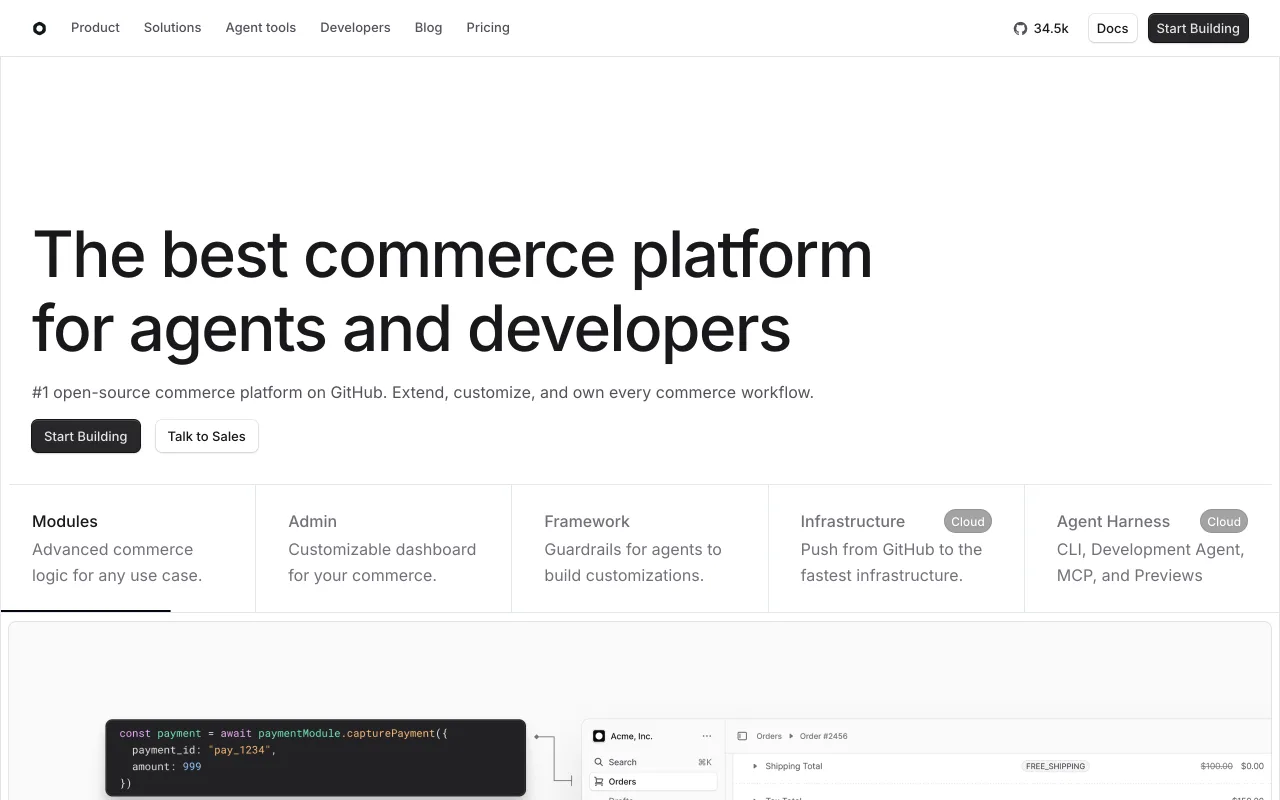
Medusa is an open-source commerce framework built on Node.js and TypeScript, released under the permissive MIT licence, and it has been the fastest-growing project in this space. Its appeal is developer experience and modularity: a clean module system, a large and active community, and zero licence or GMV fees. The trade-offs are those of a younger, fast-moving project. The jump from v1 to v2 was a near-complete rewrite with breaking changes and a substantial migration for existing projects, a reminder that the platform is still moving quickly. You assemble more yourself, some advanced B2B and enterprise capabilities are still maturing, and as with any self-hosted project the operational responsibility is yours, though a managed Medusa Cloud is now available if you would rather not run it. A strong choice for JavaScript teams that want a flexible, fully owned starting point and are comfortable building on top of it.
Watch-outs: younger ecosystem, a breaking v1-to-v2 migration, more assembly required, B2B and enterprise features still maturing.
Saleor
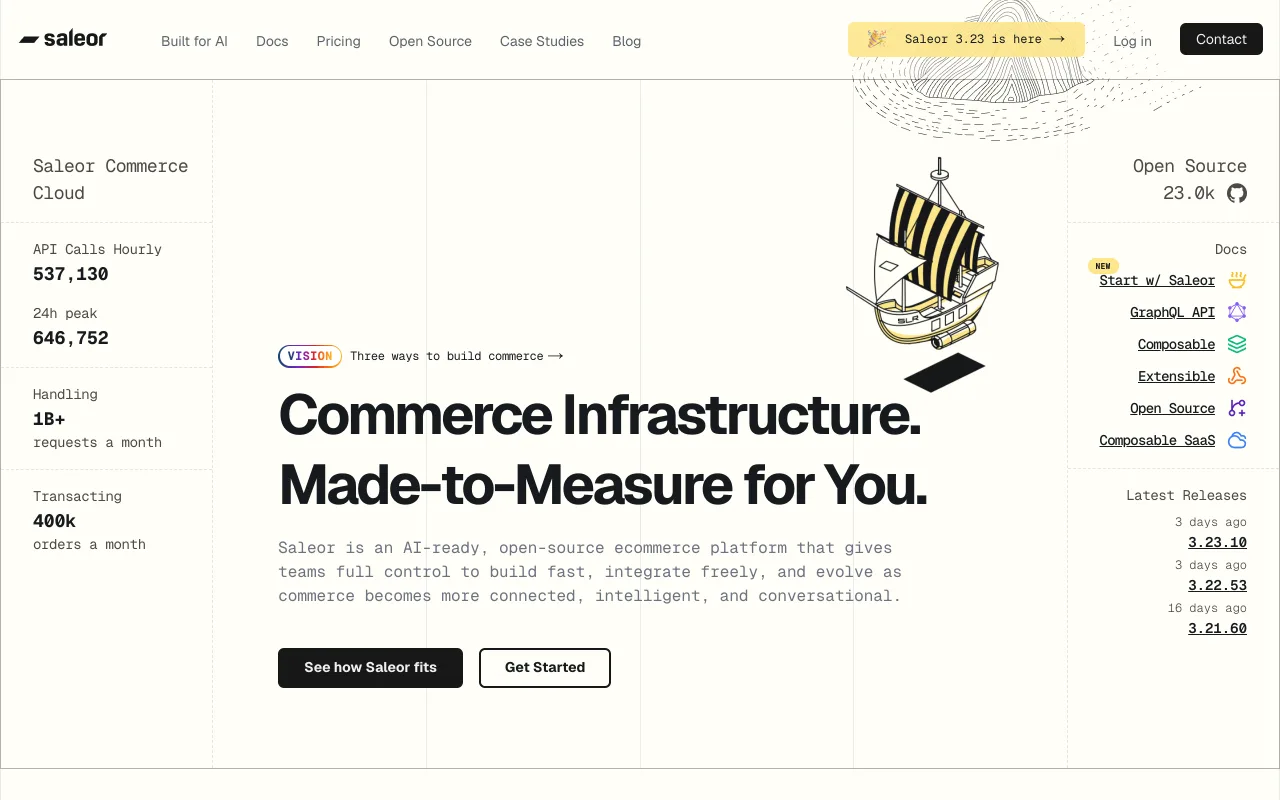
Saleor is an open-source, GraphQL-first commerce platform built on Python and Django, released under the BSD-3 licence, with multi-channel support as a first-class part of the core rather than a bolt-on. Its GraphQL-native API is clean and a pleasure to build against, and although the BSD-3 core remains self-hostable, Saleor now leads primarily with its managed cloud. The main consideration is the stack: Saleor is Python on the backend, so it fits teams that are comfortable there (or working purely against the API from a JavaScript frontend) better than a shop that wants TypeScript end to end. The ecosystem is also smaller than the SaaS incumbents. A modern, developer-friendly option, especially where a GraphQL-first design and native multi-channel matter.
Watch-outs: Python backend stack, smaller ecosystem than SaaS incumbents, you operate the self-hosted deployment.
Vendure
Vendure is the platform we build, so read this with that in mind. It is an open-source headless commerce platform built with TypeScript, NestJS, and GraphQL, designed around the "consolidate the backend" principle this guide keeps coming back to: a single coherent commerce core you extend with plugins and expose through one GraphQL API, rather than a stack of separately operated services. It aims to be a complete platform rather than a starting kit, with the B2B and omnichannel capabilities (multiple sales channels, customer-specific pricing, company account hierarchies, approval workflows) that put it on B2B and B2B2C shortlists.
On licensing, Vendure differs from Medusa and Saleor: it is open core rather than permissively licensed. The commerce core is open source under GPLv3 and free to self-host, while the advanced enterprise capabilities live in a commercial layer on top. That cuts both ways. The upside is a company funding the project and productising enterprise B2B features instead of leaving you to build and maintain them yourself; the trade-off is that the deepest capabilities are not in the free core. That commercial layer is also how the project is funded: of the three open-source platforms here, Vendure is the only one not backed by venture capital, while Medusa and Saleor have both raised VC rounds. For a backend you intend to build on for years, that independence shapes incentives, the project answers to the teams running it in production rather than to a fixed-timeline venture return, with no outside pressure to relicense the core later. You can self-host the open-source core, or hand operations to Vendure Cloud, the managed runtime built and run by the Vendure team: push to Git and deploys, migrations, autoscaling, and multi-region are handled for you, on predictable per-environment pricing rather than a percentage of revenue. Crucially the core stays the same either way, so choosing the managed runtime is not a lock-in decision the way a proprietary SaaS backend is. Cloud is in early access now, available through a paid design-partner programme.
On storefront effort, the cost this guide flags as most underestimated, Vendure ships an open-source storefront starter on Next.js and a production-ready storefront you can adopt directly, so you are not building the frontend from a blank page. And because the platform is API-first by design, it is well positioned for the shift toward agentic commerce, with agentic capabilities arriving across its open-source and commercial products.
The honest cons: as with any self-hosted platform you own the operational responsibility (unless you run it on Vendure Cloud), it is smaller than the SaaS incumbents, and it assumes a team comfortable with a modern TypeScript codebase. If that describes you and you sell into B2B or across multiple channels, it is worth evaluating. See how Vendure approaches the commerce backend, or how it handles B2B commerce specifically.
Watch-outs: self-hosted operational responsibility (or Vendure Cloud), smaller than SaaS incumbents, assumes TypeScript capability.
Enterprise composable platforms
These are the platforms that defined composable, MACH-style commerce. They are powerful and built for scale, and they ask for an enterprise budget and an engineering organisation to match.
commercetools
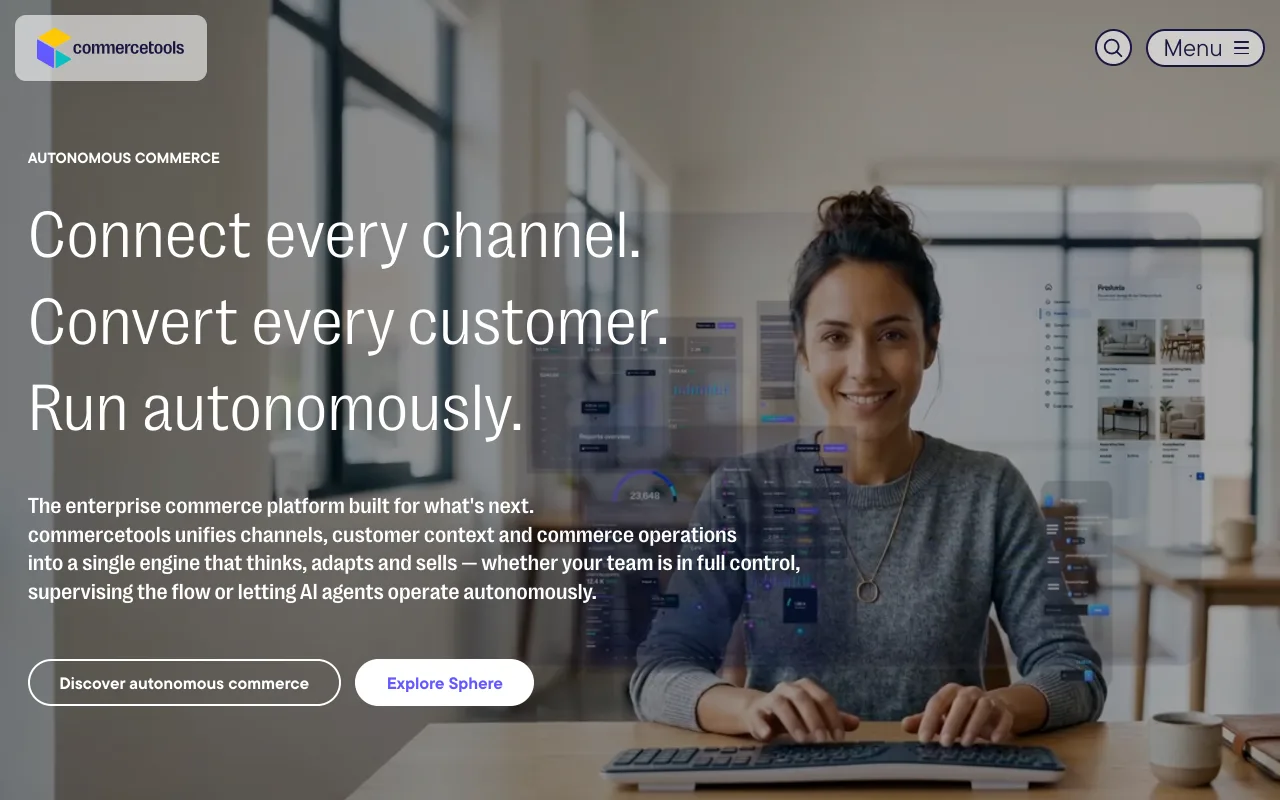
commercetools is the reference implementation of composable commerce and the platform that did the most to popularise the MACH approach. It is API-first, multi-tenant, and genuinely flexible: large enterprises with multiple brands, regions, and channels can model almost anything on it. That flexibility is also the cost. You assemble a great deal yourself, the platform is proprietary and rented rather than owned, and pricing starts in the tens of thousands of dollars a year and climbs from there. It is a strong fit for large organisations with dedicated platform teams and a real composable mandate, and overkill for most growing brands.
Watch-outs: high entry cost, steep assembly effort, full composable operational burden.
Elastic Path
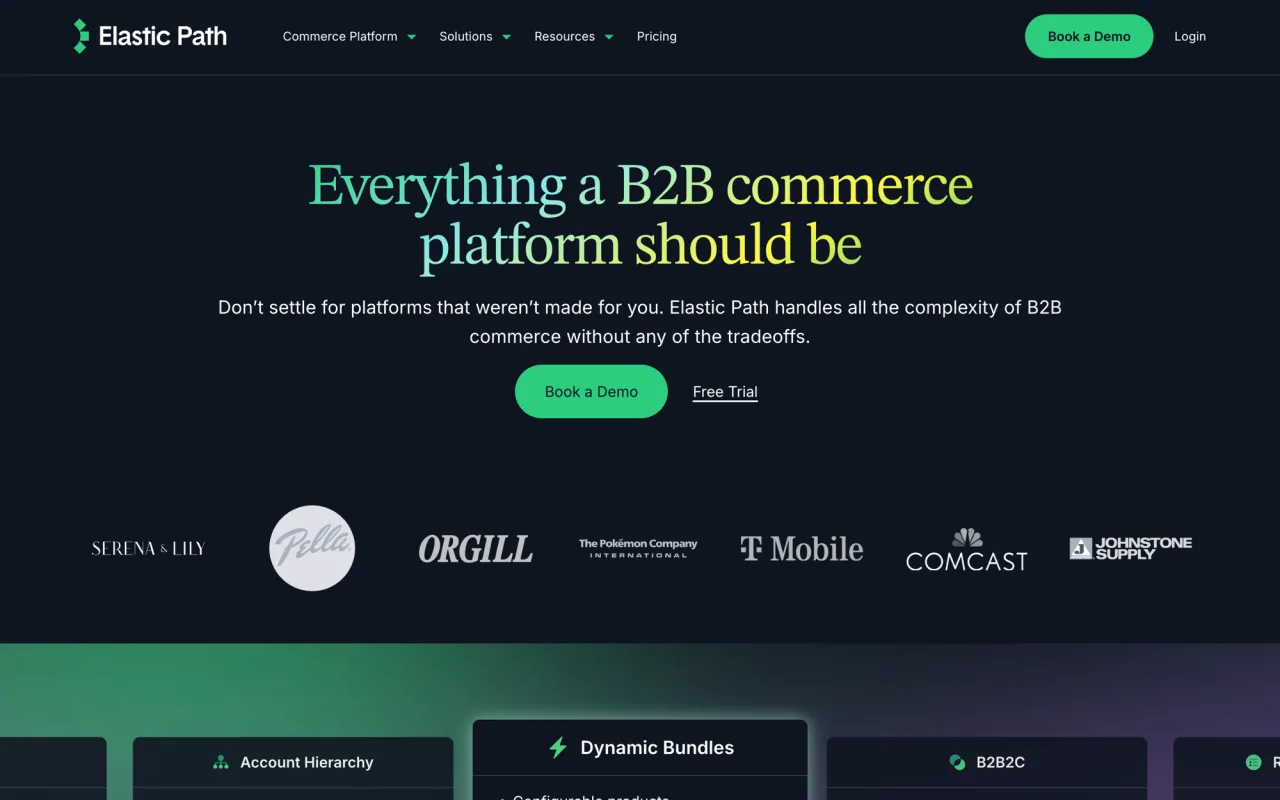
Elastic Path leans into the hardest end of the market: complex B2B, configurable products, and subscription commerce for large enterprises with sprawling omnichannel operations. Its composable architecture and integration capabilities are built for that complexity. Like commercetools, it is proprietary, enterprise-priced, and integration-heavy, so the value shows up when your requirements genuinely exceed what a more packaged platform can express. For mid-market teams it is usually more platform than the problem needs.
Watch-outs: enterprise pricing and sales motion, significant integration work, best justified by genuine B2B complexity.
Complex B2B and B2C on one adaptable, headless ecommerce platform.
Explore VendureEnterprise commerce suites
These are established commerce platforms that now support headless delivery. You get a mature feature set, at the price of a heavier core and, often, a less modern developer experience.
Adobe Commerce
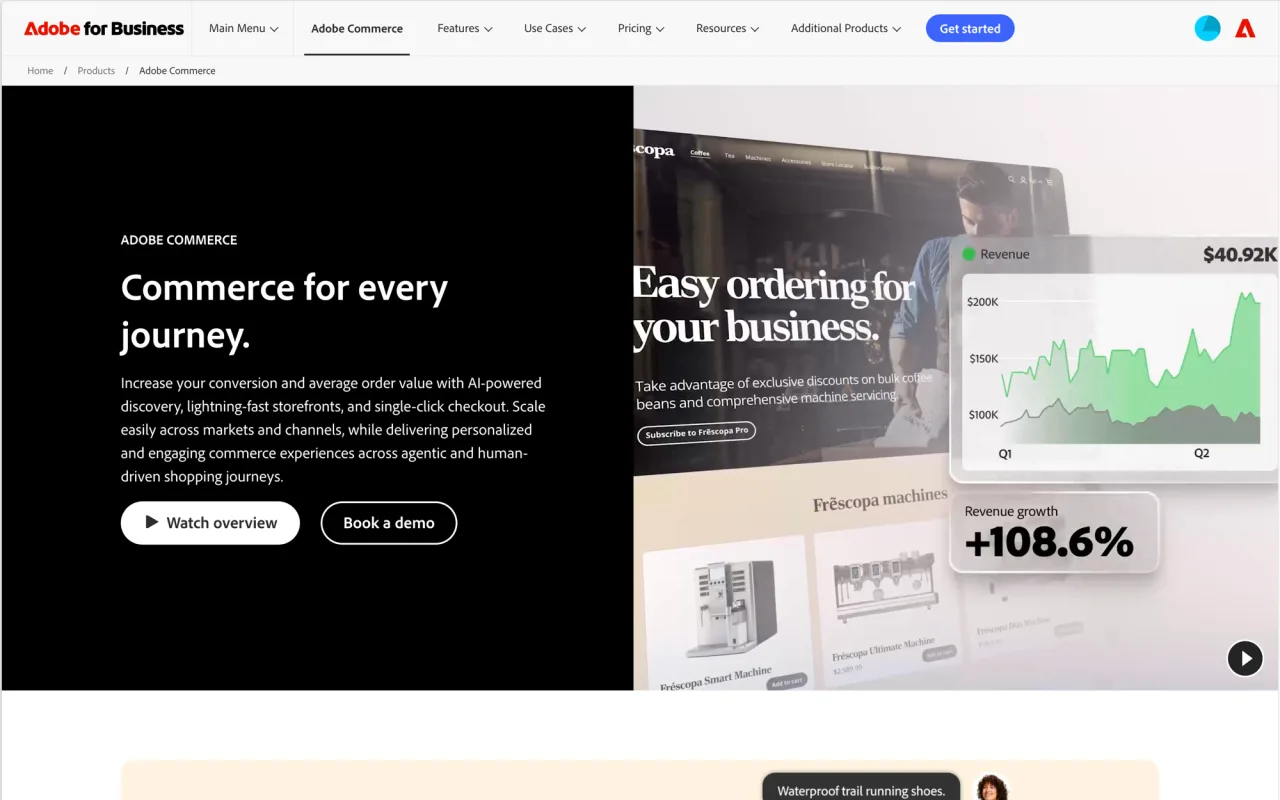
Adobe Commerce, built on Magento, has deep open-source roots and a large extension ecosystem. The open-source edition is genuinely free to self-host, while the paid Adobe Commerce tier adds managed hosting, B2B modules, and Adobe ecosystem integration. It can run headless through its APIs and the PWA tooling. The honest trade-off is weight: Magento is a large PHP application that is demanding to run, scale, and upgrade, and the developer experience feels dated next to the newer API-first platforms. It makes most sense for enterprises already invested in Adobe.
Watch-outs: heavy PHP core, costly to operate and upgrade, dated DX relative to modern stacks.
Salesforce Commerce Cloud
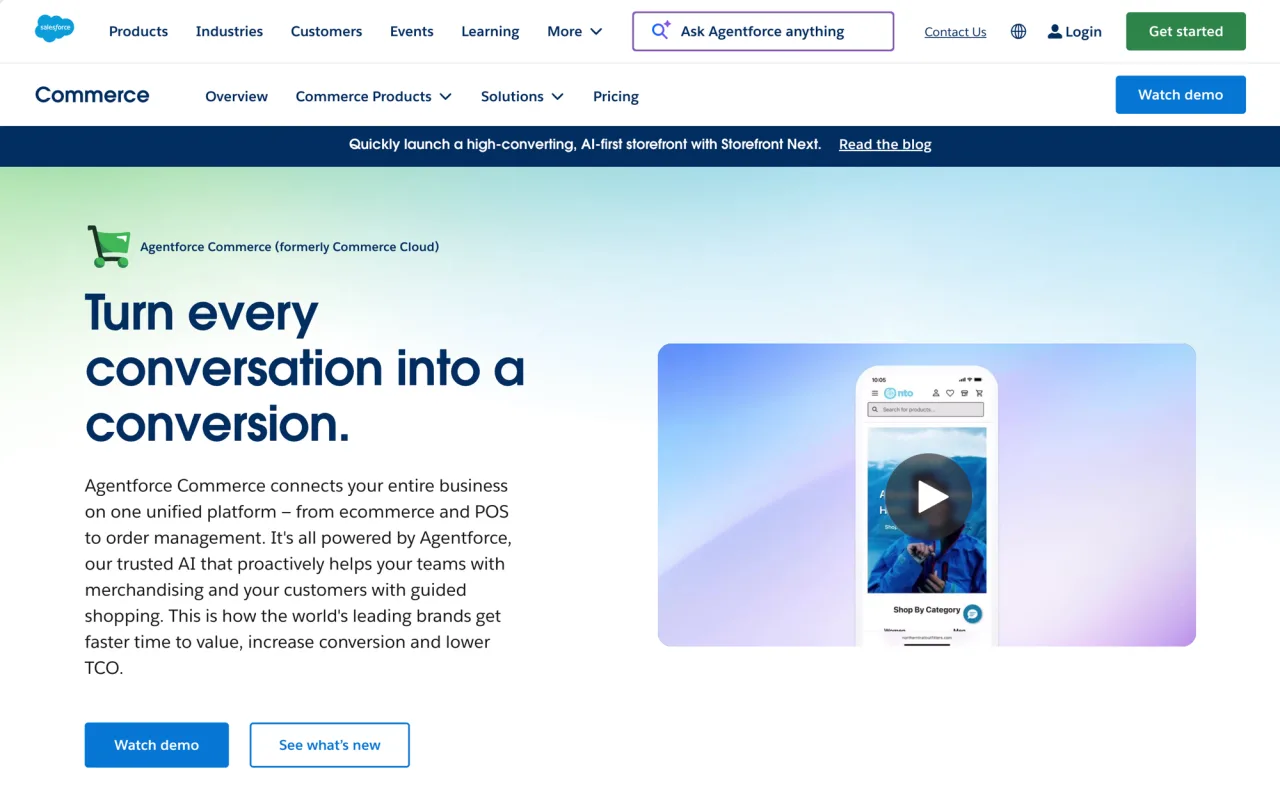
Salesforce Commerce Cloud (recently rebranded Agentforce Commerce) is a proprietary enterprise SaaS whose main draw is deep integration with the wider Salesforce ecosystem (CRM, marketing, service). For an organisation already standardised on Salesforce, that gravity is real. The costs are equally real: it is closed, expensive (typically priced as a percentage of GMV), and gives developers less low-level control than an open or API-first platform. It is an ecosystem decision more than a pure commerce one.
Watch-outs: GMV-based pricing, limited developer control, value tied to the Salesforce ecosystem.
SaaS platforms with headless APIs
These platforms run your commerce backend as a managed service and expose APIs for a custom frontend. You trade backend control for operational simplicity.
Shopify (Hydrogen)
Shopify is the most popular commerce SaaS in the world, and Hydrogen is its first-party headless stack: a framework now built on React Router (the successor to Remix) and deployed on Shopify's Oxygen edge runtime. If you are already on Shopify, it is the fastest credible path to a custom storefront, and brands like Allbirds and Gymshark run it in production. The constraints follow from the model. The backend stays a managed black box you do not control, Hydrogen plus Oxygen ties you to Shopify's frontend and hosting choices (which move quickly, with regular breaking changes), and you still pay Shopify's plan and transaction fees on top. Excellent inside the Shopify world, limiting if you want to own the backend.
Watch-outs: backend lock-in, Oxygen and framework coupling, ongoing platform and transaction fees.
BigCommerce
BigCommerce is a SaaS platform with a strong, well-documented set of headless APIs. On several axes it is more open than Shopify, with fewer hard limits on how you use the storefront APIs, which makes it a comfortable mid-market choice for teams that want SaaS convenience with a custom frontend. It is still a managed, proprietary backend, so the ceiling on deep customisation is lower than an open-source platform you control, and you operate within BigCommerce's model and pricing. A sensible middle option for teams not ready to run their own backend.
Watch-outs: proprietary managed backend, customisation ceiling, you build within BigCommerce's rules.
Which one is right for you?
The platforms above sort cleanly once you match them to a situation rather than a ranking:
- Developer-led team that wants to own the backend. An open-source platform. Choose Medusa for a JavaScript-first modular base, Saleor for a GraphQL-first Python stack, or Vendure for a TypeScript core with strong B2B and omnichannel capabilities.
- Large enterprise, dedicated platform team, real composable mandate. commercetools or Elastic Path. You have the engineering organisation to absorb the assembly cost, and the requirements to justify it.
- Already invested in a major ecosystem. Adobe Commerce if you live in Adobe, Salesforce Commerce Cloud if you live in Salesforce. The integration gravity outweighs the lock-in.
- D2C brand scaling fast, already on Shopify. Shopify with Hydrogen. The fastest path to a custom storefront without leaving a platform that already works for you.
- Mid-market, want SaaS convenience plus a custom frontend. BigCommerce. Headless flexibility without running your own backend.
The strongest signal is rarely a feature checkbox. It is the match between how a platform wants to be built on and how your team actually wants to work.
Worth reading, once a month
Product updates, customer stories, and engineering thinking, delivered monthly.
Frequently asked questions
There is no single best headless commerce platform, only the best fit for a given team and set of requirements. Developer-led teams that want to own the backend choose an open-source platform like Medusa, Saleor, or Vendure; large enterprises with composable mandates tend toward commercetools or Elastic Path; D2C brands on Shopify reach for Hydrogen. The deciding factors are open-source versus proprietary, hosting model, how much you have to assemble, and your best-fit segment.
The leading open-source headless commerce platforms are Medusa (Node.js, MIT licence), Saleor (Python, GraphQL-first, BSD-3 licence), and Vendure (TypeScript and GraphQL, GPLv3). Medusa suits JavaScript teams wanting a modular base, Saleor suits teams comfortable with Python and a GraphQL-first design, and Vendure suits teams that want a TypeScript core with strong B2B and omnichannel capabilities. All three are free to self-host with no GMV fees, with one difference worth noting: Medusa and Saleor are permissively licensed, while Vendure is open core, so its core is open source but the advanced enterprise features sit in a commercial layer. Because the code is genuinely open source in each case, the core runs the same whether you self-host or move to the vendor's managed cloud, so you can switch between the two without the re-platforming a proprietary SaaS backend would force on you. Vendure's managed runtime is Vendure Cloud.
Shopify can be used headlessly. Through its Storefront API and the Hydrogen framework (built on React Router and deployed on Oxygen), you can build a custom frontend against Shopify's commerce backend. The backend itself remains a managed, proprietary service you do not control, and Shopify's plan and transaction fees still apply. Hydrogen is a strong option if you are already committed to Shopify, and a poor fit if your goal is to own the backend.
Headless commerce decouples the storefront from the commerce backend and connects them over an API. Composable commerce goes further and also breaks the backend into separately chosen, separately operated services. Every composable system is headless, but not every headless system is composable. You can run a headless frontend over a single coherent backend without fragmenting it into microservices. See our guide to headless commerce for the full distinction.
Costs come in three shapes. Open-source platforms have no licence fee for the code you self-host: Medusa and Saleor are permissively licensed, while Vendure is open core, with a free GPLv3 core and paid enterprise modules. With all three you mainly pay for the infrastructure you run them on, plus any managed-cloud option. Enterprise platforms like commercetools carry annual licences starting around $50,000 and rising with scale. SaaS platforms like Shopify and Salesforce Commerce Cloud typically charge a plan fee plus a percentage of revenue. The cheapest sticker price is not always the lowest total cost of ownership once engineering and operations are counted.
B2B needs (customer-specific pricing, configurable products, account hierarchies, ERP integration) narrow the field. At the enterprise end, commercetools and Elastic Path are built for complex composable B2B. Among open-source platforms, Vendure provides B2B capabilities such as customer-specific pricing, company account hierarchies, and approval workflows, which is why it appears on many B2B and B2B2C shortlists. The right choice depends on whether you want a managed enterprise platform or an open-source one you run and extend yourself. See how Vendure handles B2B commerce.
Conclusion
The "best" headless commerce platform is the one that matches how your team wants to build and what your business actually requires. Open-source platforms buy ownership at the cost of running them yourself. Enterprise composable platforms buy flexibility at the cost of assembly and budget. SaaS platforms buy simplicity at the cost of control. None of those trade-offs is wrong; they are just suited to different situations.
Whichever way you lean, weigh the backend hardest, because it is the part you cannot easily swap later. If you want a platform you own, built on a modern TypeScript stack with strong B2B and omnichannel capabilities, see how Vendure approaches headless commerce, or talk to us about your requirements and we will walk through them honestly.
Share this guide
Build on an open-source headless commerce platform
Vendure is the complete, headless ecommerce platform for complex B2B. Replace fragile workarounds and fragmented stacks while keeping the systems your business already runs.