Next.js Ecommerce Templates: Build a Modern Storefront
If you are building an ecommerce storefront, Next.js is the default choice for the frontend, and a good template or starter saves you weeks. This guide covers why Next.js fits ecommerce, what to look for in a Next.js ecommerce template, and two ready-to-use storefronts for Vendure: an open-source Next.js starter and a production-grade B2B storefront.
Why Next.js is a strong fit for ecommerce frontends
Next.js gives you the rendering flexibility a storefront needs: server-side rendering for dynamic product pages, static generation for category listings, and incremental static regeneration (ISR) for data like inventory that changes often. You pick the right strategy per route instead of committing the whole site to one.
The performance payoff is real. When Vercel migrated its Grep app to Next.js, it reported a 70% faster First Contentful Paint. For a storefront, faster rendering means better conversion and better search rankings.
Headless commerce, briefly
A Next.js storefront pairs with a headless backend: the frontend is decoupled from the commerce engine and talks to it over APIs, so you can build and ship the storefront independently of backend changes. That separation is what lets you optimise the frontend freely while the backend stays stable. For the full picture, see our guide to headless architecture.
Vendure's Next.js storefront options
Vendure is an open-source headless commerce platform built with TypeScript and GraphQL. It gives you the backend through a GraphQL Shop API; you own the frontend entirely. There are two ready-to-use Next.js storefronts to start from, depending on how much you want pre-built.
Open-source Next.js starter
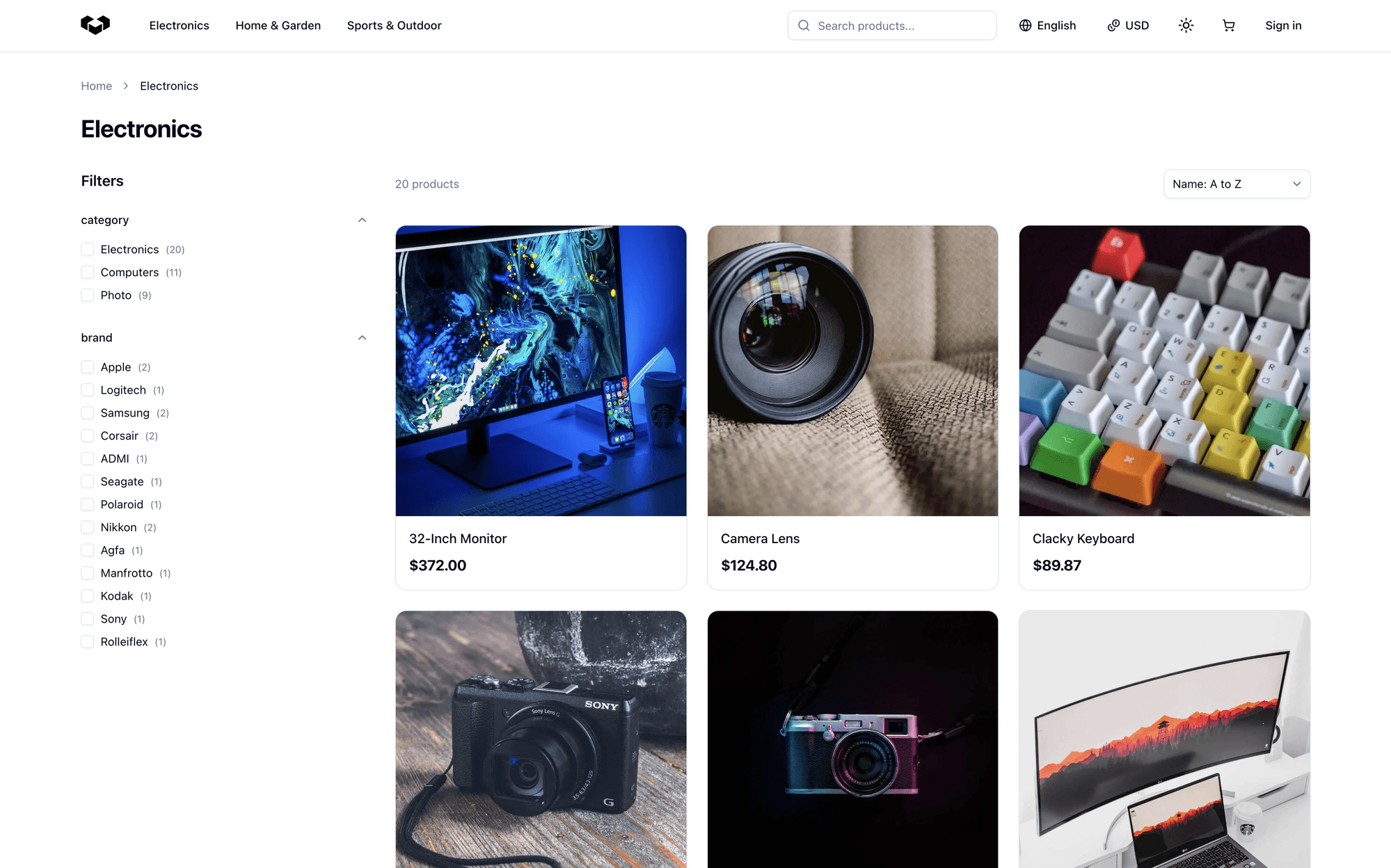
The open-source Next.js starter is a clean, modern storefront wired to Vendure's Shop API, with product browsing, search, cart, checkout, and customer accounts working out of the box. It is a solid, free foundation to fork and theme for a B2C store, and it runs on Vercel's infrastructure with its CDN and edge caching by default.
Production-grade B2B storefront in Vendure Platform
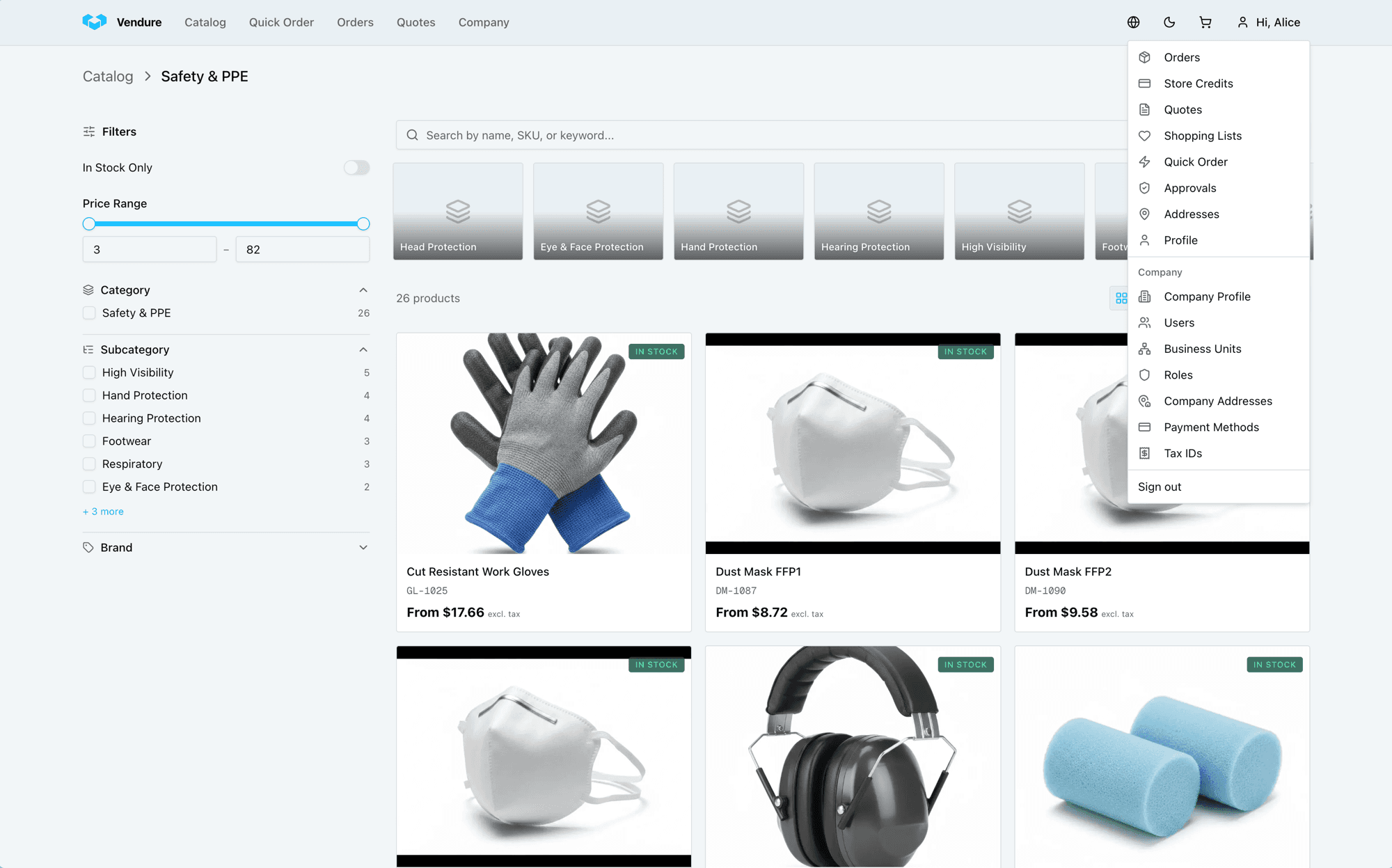
If you are building B2B, Vendure Platform includes a production-grade Next.js storefront with the full procurement surface already wired to a customer-facing app: company accounts and hierarchies, quote-to-order, approval workflows, quick-order, and store credit. It is built on Next.js and is yours to fork, theme, or lift pieces from, a buyer-ready storefront in weeks rather than a multi-month build.
Ready to build? The Vendure docs cover architecture, setup, and extension from day one.
Read the docsWhat to look for in a Next.js ecommerce template
A few things separate a production-ready Next.js ecommerce template from a demo.
Performance. Speed converts. Akamai's research found that a one-second delay in load time can cut conversions by around 7%. Good templates ship automatic code splitting, image optimisation, and edge caching, and use ISR so inventory stays fresh without rebuilding the whole site.
SEO and Core Web Vitals. Server-side rendering or static generation means search engines receive fully rendered HTML, which is essential for indexability and rankings. Next.js handles this well out of the box, which is a big part of why it is so common for SEO-critical commerce.
Omnichannel and PWA. Shoppers move between devices. Progressive Web App support gives you app-like mobile experiences from a single codebase, without a separate native build.
Templates vs building from scratch
A template is not a constraint, it is a head start. The decision comes down to time-to-market and how much standard ecommerce scaffolding you want to skip. Templates give you proven components, established patterns, and a sensible architecture, which matters most when speed matters or your team is new to ecommerce.
Starting from a template does not mean giving up customisation. Modern Next.js ecommerce starters are foundations, not finished products: they provide the scaffolding and best practices and leave room for your business logic and brand.
Integrations that matter
A storefront has to connect to payment providers, search, a CMS, an ERP, and analytics. Vendure's plugin architecture is how you add those. The plugin ecosystem and a straightforward plugin API cover payment providers, search such as Algolia, and CMS integrations such as Strapi and Sanity, and you can write your own plugin against the same API when something is missing.
The headless, API-first approach is what makes this work: each frontend and service talks to the same backend through well-defined APIs, so you connect the pieces you need without the backend becoming a bottleneck.
Complex B2B and B2C on one adaptable, headless ecommerce platform.
Compare plansDeveloper experience
A good Next.js ecommerce template prioritises developer experience. TypeScript end to end, a clean code structure, solid documentation, and an active community all reduce the time to build and maintain a storefront. Vendure's TypeScript-first approach gives you type safety across the stack, so errors surface at compile time instead of in production.
Component-driven development helps too: reusable product cards, cart, and checkout components mean you customise proven patterns to match your brand instead of reinventing them.
Scaling your Next.js ecommerce platform
A Next.js and Vendure stack scales horizontally. On the backend, Vendure runs as a server process and a worker process that you scale independently; on the frontend, Next.js deploys to platforms with edge caching and ISR. As your catalogue grows, query optimisation and proper indexing keep the database responsive, and multi-layer caching (CDN edge plus application caches) keeps response times fast.
This is proven in production. Munch, a food-waste marketplace, runs its entire commerce operation on Vendure across four countries, peaking at around 10,000 payment transactions a day for 350,000 monthly active users.
Deployment stays flexible: ship to Vercel, AWS, or your own infrastructure, and use container-based deployments to scale out during traffic spikes and back down when it is quiet.
Worth reading, once a month
Product updates, customer stories, and engineering thinking, delivered monthly.
Security and compliance
Ecommerce handles sensitive customer data, so security has to be built in: HTTPS everywhere, tokenised payments, and PCI compliance handled by specialist payment gateways rather than your own systems. Vendure contributes built-in security features, regular updates, and a transparent open-source model that allows community security audits, and Next.js is secure by default, so you start from a strong foundation.
Getting started with Vendure and Next.js
A practical path to a working storefront:
- Pick your starting point. Use the open-source Next.js starter for a B2C build, or the Vendure Platform storefront if you need B2B flows out of the box.
- Stand up the backend. Spin up Vendure with
npx @vendure/create, then point your storefront at its Shop API. - Customise incrementally. Theme the components, add your business logic, and bring in plugins for payments, search, or CMS as you need them.
- Get help when you need it. The Vendure Discord and documentation provide support from developers worldwide.
Conclusion
The right Next.js ecommerce template sets the foundation for your storefront. With Vendure's TypeScript backend, Next.js on the frontend, and two ready-to-use storefronts to start from, you can go from zero to a customised, production-grade store without building the standard scaffolding yourself.
If you are building B2C, start with the open-source Next.js starter. If you need B2B, explore the Vendure Platform storefront, or read the documentation to go deeper.
Share this guide
Build for B2B complexity. Run every channel.
Vendure is the complete, headless ecommerce platform for complex B2B. Replace fragile workarounds and fragmented stacks while keeping the systems your business already runs.