What Is B2B Ecommerce? The Complete Guide for 2026
B2B ecommerce has moved from a convenience to the default way businesses buy. The buyers placing your orders grew up shopping online, and they now expect the same self-service, the same transparency, and the same speed from a wholesale or distribution supplier that they get from a consumer store, on top of the contract pricing, approvals, and account structures that business buying has always required.
This guide explains what B2B ecommerce is, how it differs from B2C, the models it covers, the platform features that actually matter, and the trends shaping it in 2026. It is written for commerce leaders, ecommerce managers, and the engineers who build the systems behind them. Where a point connects to running this in production, we link through to how Vendure handles complex B2B, but the guide is platform-neutral by design.
What is B2B ecommerce?
B2B ecommerce (business-to-business ecommerce) is the sale of goods or services between businesses through an online platform, rather than over the phone, by fax, or through a sales rep. It covers the full buying motion, browsing catalogues, agreeing prices, placing and approving orders, and reordering, conducted digitally between a supplier and its business customers.
What makes B2B different is the buying motion. A B2B order often runs through customer-specific pricing, negotiated quotes, multi-person approval, purchase orders, and credit terms, against a catalogue that can differ from one customer to the next. The technology is much the same as consumer ecommerce; what sits behind the familiar storefront is closer to procurement than to retail checkout.
B2B ecommerce is also large and growing fast. One widely cited estimate put the global B2B ecommerce market at around USD 19.3 trillion in 2024, on track to reach USD 47.5 trillion by 2030, a compound annual growth rate of roughly 16%. Estimates vary widely by methodology, but they agree on the shape: a market several times the size of B2C, growing at double digits as more of the buying motion moves online.
B2B vs B2C ecommerce: what's different
Both sell online, but they optimise for different buyers and different transactions. B2C is built for a single shopper making a quick, self-contained purchase. B2B is built for an organisation buying repeatedly, often at volume, under terms negotiated in advance.
| Dimension | B2B ecommerce | B2C ecommerce |
|---|---|---|
| Buyer | An organisation, often several people | A single consumer |
| Typical order value | High, recurring | Lower, one-off |
| Pricing | Customer-specific, contract, quantity breaks | One public price |
| Payment | Purchase orders, invoicing, credit terms | Card or wallet at checkout |
| Buying process | Quotes, approvals, multi-step | Add to cart, pay |
| Catalogue | Can vary per customer | Same for everyone |
| Account model | Companies, business units, roles | One personal account |
| Relationship | Long-term, contractual | Transactional |
The practical takeaway: a B2B store is not a B2C theme with a login wall. The complexity lives in pricing, accounts, and approvals, and a platform that treats those as afterthoughts will cost you margin and sales-team hours every month.
Types of B2B ecommerce
"B2B ecommerce" covers several distinct selling models. Most suppliers run more than one.
Wholesale
Selling goods in bulk to other businesses, typically retailers or resellers, that sell on to their own customers. Wholesale ecommerce hinges on volume pricing, minimum order quantities, and fast reordering of the same lines.
Manufacturers
Producers selling directly to distributors, retailers, or other manufacturers. Orders are often large, scheduled, and tied to production and supply-chain systems, with configurable or made-to-order products.
Distributors
Businesses that buy from manufacturers and sell on to wholesalers, retailers, or end businesses. Distribution runs on broad catalogues, customer-specific pricing, and high reorder frequency, so catalogue and pricing accuracy is everything.
B2B2C
A business sells to another business, which sells on to consumers, with the original supplier sometimes reaching the end customer directly. Many suppliers run a B2B portal and a D2C storefront side by side on the same catalogue.
B2B marketplaces
Platforms that connect many business buyers and sellers in one place, such as Amazon Business or Alibaba. They offer reach and discovery, in exchange for a degree of channel control and margin.
SaaS and subscription B2B
Recurring sale of software or services to businesses, billed per seat or per usage. The commerce challenge shifts from shipping goods to managing entitlements, renewals, and usage-based billing.
Ready to build? The Vendure docs cover architecture, setup, and extension from day one.
Read the docsHow B2B ecommerce works
A B2B store starts where a B2C store stops: with the account. A business customer is a company, not a person, so the platform models the organisation first, business units, the users inside them, and the roles that decide who can browse, who can buy, and who has to approve.
From there, a typical buying motion looks like this:
- Catalogue and pricing. The buyer sees a catalogue and prices specific to their company, contract rates, customer-group pricing, and quantity breaks, not a single public price.
- Quote or cart. For negotiated or large orders, the buyer requests a quote and the two sides agree terms. For routine purchases, they add to cart or paste a list of SKUs for a quick order.
- Approval. Orders above a threshold route to the right approver inside the buyer's organisation before they are placed.
- Order and fulfilment. The approved order is placed at the agreed price, paid by purchase order or on credit terms, and handed to fulfilment, often via an ERP.
- Reorder. Replenishment buyers reorder from history in one click, carrying their contract pricing and account context forward.
Underneath, the platform stays in step with the systems of record, the ERP for customer master data and pricing, the PIM for the catalogue, the CRM for sales activity, so the storefront reflects the same reality the rest of the business runs on.
Where B2B ecommerce gets hard
The storefront is the easy part. What teams consistently underestimate is the machinery behind it. Three areas account for most of the pain.
Pricing that has to agree with itself. A B2B catalogue carries contract prices, customer-group rules, quantity breaks, and packaging-unit pricing, often several at once for the same product. The hard requirement is consistency: the price a buyer sees in the storefront has to match the quote, the order, and the reorder six months later. When pricing logic is scattered across systems or maintained through spreadsheets and CSV imports, the numbers drift, and every mismatch is a margin leak or a finance dispute.
Accounts and approvals, modelled properly. A business customer is an organisation, not a login. Buyers, business units, and approver tiers have to map onto the platform with roles scoped to where each person sits, and orders above a threshold have to route to the right approver before they are placed. Platforms that bolt a single shared login onto a B2C account model break the moment a customer manages three business units or needs finance sign-off on a large cart.
Integration with the systems of record. Commerce is one node in a stack that already includes ERP, PIM, and often CRM. The catalogue's source of truth is usually the PIM; customer master data and contract terms live in the ERP. A platform that tries to become the new master ends up keeping a second copy of everything in sync forever. The ones that work sit in front of those systems and read from them, so there is one source of truth per kind of data.
Front-end polish does not rescue a store where pricing, accounts, or integration are broken. Those three are where B2B projects are won or lost.
Key features of a B2B ecommerce platform
The models above share a common set of requirements. A platform built for B2B should handle these as production capability, not as a custom build you fund and then maintain:
- Company accounts and hierarchies. Customer companies with business units, company-scoped users, and roles and permissions that match who does what inside the buyer's organisation. See company accounts.
- Customer-specific catalogues and contract pricing. Contract prices, customer-group rules, and quantity breaks, run through one pricing engine so the storefront, quotes, and reorders all agree. See catalogue and pricing.
- Quote management. Quotes from draft to accepted order, with negotiation history, so an agreed quote becomes an order at the negotiated price without rekeying. See quote management.
- Approval workflows. Multi-level approval chains with named or role-based approvers, timeouts, and escalations for orders, quotes, or returns. See approval workflows.
- Quick order and reorder. Paste-a-SKU-list ordering and one-click reorder from history, the default motions for procurement and replenishment buyers.
- Self-service and shopping lists. Saved lists and account self-service at user, business-unit, or company scope, so buyers serve themselves instead of emailing a rep.
- ERP, PIM, and CRM integration. The commerce platform is one node in the stack, not a replacement for it. The catalogue stays in PIM, customer and pricing master data stays in ERP, and commerce runs the buying experience on top.
- An extensible, API-first architecture. The buying motion shapes to how you actually sell, without forcing your business around the vendor's template or handing your team a blank slate to build from.
Vendure Platform ships these capabilities ready to use, company accounts, approvals, quotes, and contract pricing, on an enterprise commerce platform your team can still tailor to how you sell. For the buyer-facing side of these features, see B2B workflows.
Benefits of B2B ecommerce
Moving the buying motion online pays off in several ways at once:
- Lower cost to serve. Self-service ordering, reordering, and account management take routine work off your sales and support teams, so they spend time on accounts that need them.
- Larger, more frequent orders. Always-on ordering, quick reorder, and accurate pricing lift order value and frequency compared with phone-and-email selling.
- Wider reach. A digital storefront and marketplace presence open customers and geographies a field sales team cannot cover economically.
- Better data. Every order, quote, and search is captured, giving you a clearer picture of demand and a basis for personalisation and forecasting.
- A buying experience that retains customers. Buyers increasingly choose suppliers on the quality of the digital experience, and getting it right is now a competitive advantage.
- Scalability without re-platforming. A well-architected platform absorbs new products, channels, markets, and business models without a rebuild each time.
Headless commerce for B2B complexity, D2C flexibility, and one backend to run both.
Explore B2B commerceCommon misconceptions about B2B ecommerce
A few myths still slow teams down. The most common:
"Our buyers would rather call or email." Some will, but the trend runs the other way: business buyers increasingly research and reorder online, and pick suppliers on the quality of the digital experience. Putting ordering online doesn't remove the relationship, it takes routine transactions off your reps so they spend their time where it counts.
"Ecommerce means publishing prices we'd rather keep private." Not in B2B. Customer-specific catalogues and contract pricing sit behind authentication, so each buyer sees their negotiated terms and no one else's. You decide what is public, what is login-only, and what is quoted.
"We need a separate B2B suite, walled off from B2C." Rarely. A platform with a horizontal capability set runs a B2B portal and a B2C storefront on the same catalogue and order flow. Most mixed-model teams consolidate onto one platform instead of paying for and maintaining two.
"B2B ecommerce is just B2C with a login screen." This is the costly one. The login is the easy part; the complexity is in pricing, account hierarchies, and approvals. A consumer platform with a login bolted on breaks exactly where B2B gets interesting.
"Going digital means a long, risky replatform." It can, but it doesn't have to. Scoped to a clear buying motion and built on an extensible platform, B2B projects ship in weeks, not years. Wilhelm Weishäupl replaced a failing portal in four weeks, not four quarters.
B2B ecommerce examples
The model spans household-name marketplaces and specialised suppliers:
- Amazon Business brings consumer-grade discovery and self-service to business procurement at scale.
- Alibaba connects manufacturers and wholesalers with business buyers worldwide.
- Grainger sells industrial supplies and MRO products to businesses through a deep digital catalogue.
- McKesson runs healthcare distribution with the contract pricing and compliance that sector demands.
Specialised suppliers run the same motion on their own platforms:
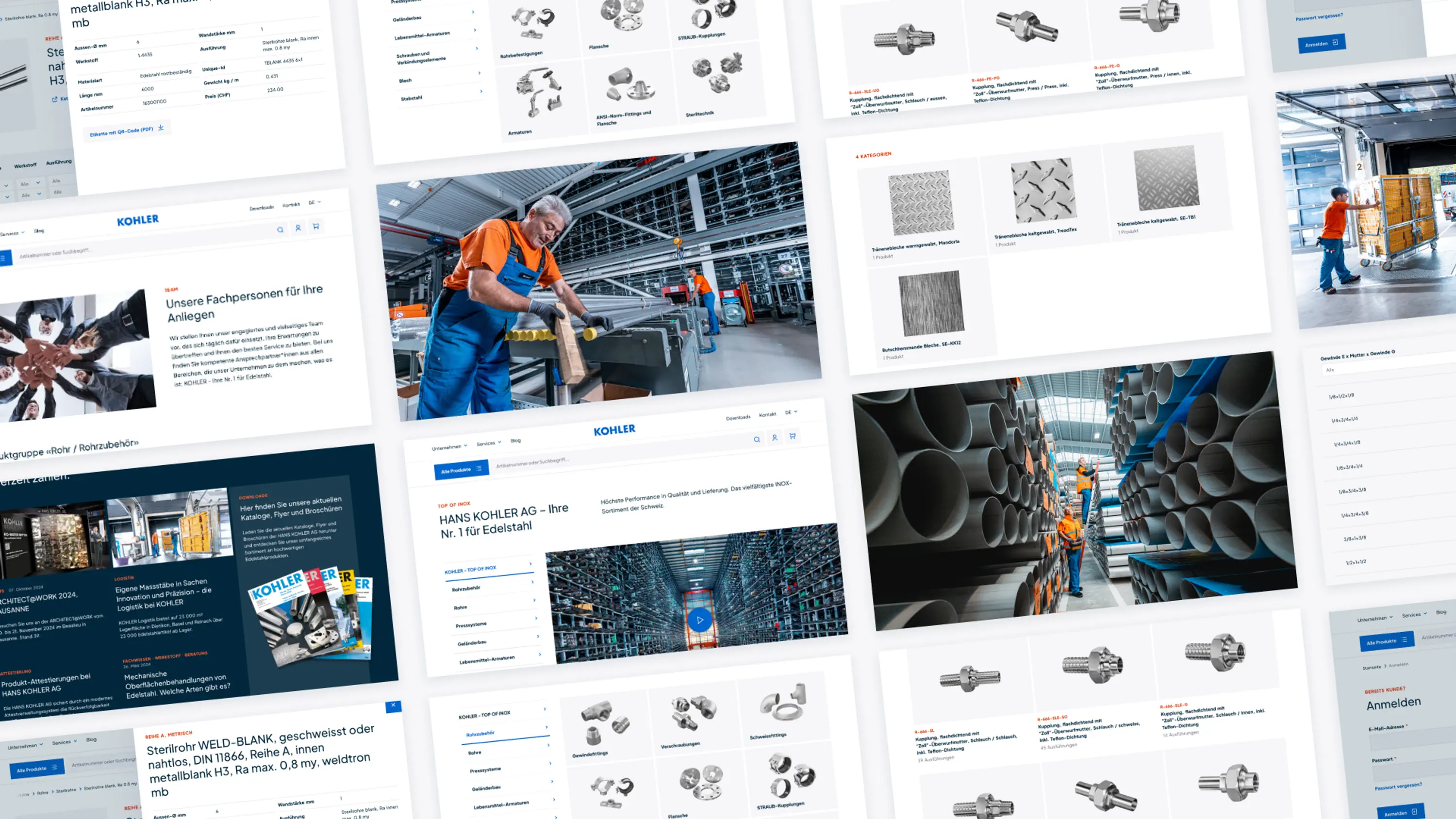
- HANS KOHLER AG, a steel trader, unified its B2B and B2C selling on a single Vendure platform, with customer-specific pricing and configurable products, and lifted daily orders by 15–20%. A clear example of the hybrid B2B2C model running on one stack.
- Wilhelm Weishäupl, a 190-year-old Munich work-wear supplier, replaced a failing consumer-grade WooCommerce portal with a purpose-built Vendure B2B ordering system in four weeks. Multi-tenant franchise portals with role-based access and ERP integration cut bulk reorders from minutes to seconds, with zero downtime since launch.
B2B ecommerce trends in 2026
The category is moving quickly. The trends worth planning for:
- Headless and extensible architecture. Buyers, channels, and integrations change faster than rigid suites can keep up. A headless architecture lets teams change one part of the stack, a storefront, a pricing rule, an integration, without re-platforming the whole thing.
- Conversational interfaces on both sides of the transaction. The most concrete near-term shift is chat-style interfaces replacing forms and menus, for buyers and sellers alike. On the buyer side, a buyer describes what they need in plain language and the system assembles the order, applies their contract pricing, and routes it for approval, instead of clicking through a catalogue. On the seller side, ecommerce operations teams run the business the same way: standing up a customer-specific assortment, onboarding a new account, or adjusting prices through a conversational interface rather than a maze of admin screens. Agentic ordering, where AI places routine reorders against agreed rules, and AI-assisted discovery, where buyers arrive through AI assistants as well as search engines, are extensions of the same shift.
- Self-service as the default. Digital-first buyers want to configure, quote, and order without talking to anyone. The supplier's job is to make the complex parts, pricing, approvals, and compliance, work without a human in the loop for the routine cases.
- Marketplaces and B2B2C. More suppliers sell through marketplaces and run their own, and more run B2B and D2C side by side, raising the bar for platforms that can serve multiple models from one catalogue.
- Embedded payments and financing. Net terms, purchase-order workflows, and embedded financing are moving into the checkout itself, closing the gap between the buying experience and how businesses actually pay.
The common thread is pace: buyers and channels now change faster than a fixed platform can follow.
Worth reading, once a month
Product updates, customer stories, and engineering thinking, delivered monthly.
How to choose a B2B ecommerce platform
Run any shortlist against the way you actually sell, not a generic feature checklist:
- Does it fit your buying motion? Company accounts, contract pricing, quotes, and approvals should be production capability, not a project you fund and maintain.
- Is pricing consistent everywhere? Contract and customer-group prices should hold across storefront, quote, order, and reorder from one source of truth.
- Does it integrate with your stack? ERP, PIM, and CRM stay the systems of record; the platform should sit in front of them cleanly, not become a second master to reconcile.
- Can your team change it? Favour extensible platforms you can adapt in-house over rigid suites where every exception is a change request and a consulting bill.
- What is the real total cost? Weigh licensing, implementation, and the ongoing cost of maintaining custom B2B logic against capability you get on day one.
- Build, buy, or both? The choice that outlasts the others is whether the B2B layer comes with the platform or has to be built on top of it.
A rigid B2B suite makes every approval path or pricing exception that doesn't match its template a change request and a consulting bill. A general-purpose stack avoids that lock-in but hands you a blank slate: the B2B layer isn't in the box, so your team builds it and then maintains it for the life of the platform. The third path ships company accounts, approvals, quotes, and contract pricing as day-one capability and still lets your team shape them to how you actually sell. That is what Vendure Platform is built to offer.
Frequently asked questions
What is B2B ecommerce?
B2B ecommerce is the sale of goods or services between businesses through an online platform. It covers the full buying motion, customer-specific catalogues and pricing, quotes, approvals, ordering, and reordering, conducted digitally between a supplier and its business customers rather than over the phone or through a sales rep.
How is B2B ecommerce different from B2C?
What differs is the buying motion. B2B sells to organisations, with several people often involved, under customer-specific pricing, purchase orders, credit terms, and multi-step approval. B2C sells to a single consumer at one public price with card payment at checkout. A B2B store models companies, roles, and contracts; a B2C store models individual shoppers.
What are the main types of B2B ecommerce?
The common models are wholesale, manufacturers selling direct, distributors, B2B2C (selling to a business that sells on to consumers), B2B marketplaces such as Amazon Business and Alibaba, and SaaS or subscription sales. Most suppliers run more than one model at the same time.
How does B2B ecommerce work?
It starts with the account: a business customer is a company, with business units, users, and roles. Buyers see catalogues and prices specific to their company, request quotes or add to cart, route larger orders through approval, place the order on purchase order or credit terms, and reorder from history. The platform stays in step with the ERP and PIM behind it.
What features should a B2B ecommerce platform have?
At a minimum: company accounts and hierarchies, customer-specific contract pricing, quote management, approval workflows, quick order and reorder, self-service, and integration with ERP, PIM, and CRM. An extensible, API-first architecture matters too, so the buying motion can change without re-platforming. See how Vendure handles complex B2B.
What are some examples of B2B ecommerce?
Large marketplaces such as Amazon Business and Alibaba, and specialised suppliers such as Grainger (industrial supplies) and McKesson (healthcare distribution). Individual suppliers run the same motion on their own platforms, for example the steel trader HANS KOHLER AG, which unified B2B and B2C on one Vendure platform, and Munich work-wear supplier Wilhelm Weishäupl, which replaced a consumer-grade portal with a purpose-built B2B ordering system.
Is B2B ecommerce growing?
Yes. Analysts size the global B2B ecommerce market in the trillions of dollars, several times the size of B2C, and growing at double-digit annual rates as more business buying moves online and digital-first buyers expect self-service.
How do I choose a B2B ecommerce platform?
Match the platform to how you actually sell. Check that company accounts, contract pricing, quotes, and approvals are production capability rather than a custom build; that pricing stays consistent across storefront, quote, order, and reorder; that it integrates cleanly with your ERP and PIM; and that your team can extend it without a re-platform. See how to choose a B2B ecommerce platform.
Can one platform run both B2B and B2C?
Yes. A platform with a horizontal capability set can run a B2B portal and a B2C storefront side by side on the same catalogue and order flow. Most mixed-model teams consolidate onto one platform instead of paying twice for two. Vendure runs both B2B and B2C on the same backend.
Conclusion
B2B ecommerce is no longer a digital storefront bolted onto a sales team. It is how business buying works, and the suppliers who win treat it that way: they model companies and contracts properly, make self-service the default for routine buying, and choose a platform they can change as their customers and channels do.
If you are evaluating where to run that motion, see how Vendure handles complex B2B, company accounts, approvals, quote negotiation, and contract pricing on one platform that serves B2B and B2C alike. Or talk to us about your B2B scenarios and we will walk you through them against production capability.
Share this resource
You may also like